Newsroom
MetaMask Adds Stellar Network as Default Chain for Millions of Users
30 October, 2026 / News / AI / Tags: stellar, metamask, xlm, soroban, default
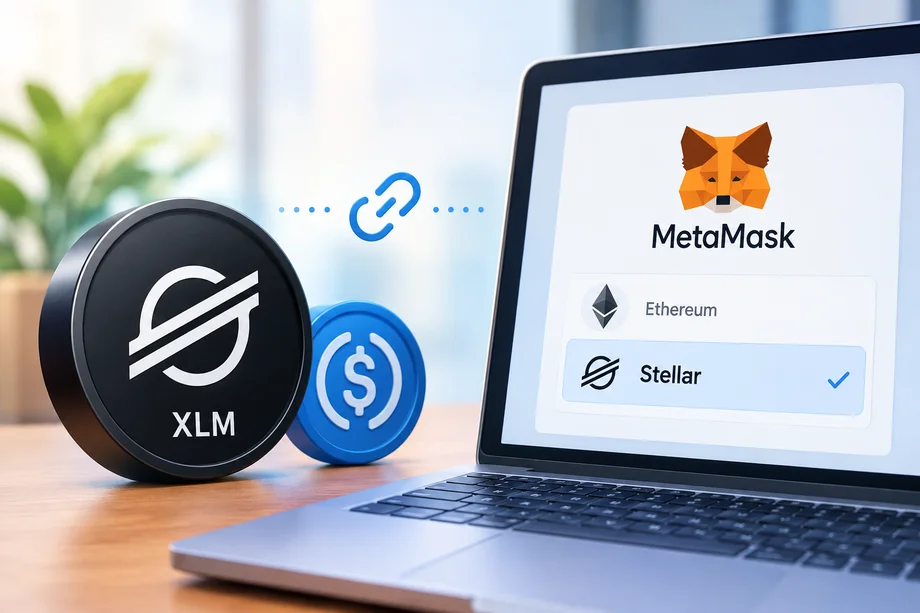
MetaMask has integrated Stellar as a default network in its mobile app and browser extension, allowing users to manage XLM and other assets with no additional setup
Stellar Integration Launches Across MetaMask Platforms
MetaMask made Stellar a default network on October 29, 2026, across both its mobile application and browser extension. The update, announced at the Meridian conference in Lisbon, delivers an automatic XLM address to every existing account holder. This address derives directly from the current recovery phrase, eliminating the need for a separate wallet or new seed phrase.
Users can now hold, send, and receive XLM alongside assets on other supported blockchains. They can also manage tokens issued on Stellar, including trustline assets and Soroban smart contract tokens, and perform swaps between Stellar and EVM networks. Existing Stellar wallet owners gain an import option that moves their legacy accounts into MetaMask using the same recovery phrase.
The change aligns with MetaMask’s wider push to expand beyond Ethereum-based chains. Stellar’s architecture supports instant transactions with three-to-five-second finality and fees well under one cent. It powers real-world applications such as remittances, commerce, and public-sector payments, where the global average cost of sending $200 stood at 6.36 percent in the third quarter of 2025.
User Experience and Technical Requirements
Stellar addresses activate on-chain only after receiving at least one XLM. Each trustline for non-XLM assets reserves 0.5 XLM, and swaps from other networks do not automatically create these trustlines. Users must therefore fund the account to unlock full functionality.
MetaMask now counts more than 30 million monthly active users who benefit from this single-tap access. The integration replaces previous third-party Snap solutions, embedding Stellar functionality directly into the core wallet experience. Denelle Dixon, CEO of the Stellar Development Foundation, described the addition as giving users instant transactions and minimal network fees through a network that has facilitated billions in real-world payment value.
Supporting Stellar’s Institutional and Developer Momentum
The update coincides with growing adoption on the Stellar network. Circle has issued more than $650 million in USDC on Stellar, while institutions such as Securitize plan to use the platform for tokenized securities with over $5 billion in managed assets. Franklin Templeton and WisdomTree already offer native tokenized money-market funds on Stellar, and Bermuda has embedded the network into its fully on-chain economic plan.
For developers, the default chain access opens Soroban contracts directly within MetaMask, removing friction around seed phrase management and onboarding. Curve Finance has launched its first non-EVM deployment on Stellar’s Soroban, expanding decentralized exchange liquidity. Total value locked on Stellar remains below $150 million, yet payment flows reached more than $18 billion in the third quarter of 2025.
| Institution | Stellar Use Case | Asset Volume |
|---|---|---|
| Circle | USDC issuance | Over $650 million |
| Securitize | Tokenized securities | Over $5 billion |
| Franklin Templeton, WisdomTree | Tokenized money-market funds | N/A |
Broader Context and Future Outlook
Stellar processed over $55.6 billion in payment volume in 2025, a 52 percent increase from the prior year. The network’s 80-plus supported endpoints and cross-border payment infrastructure continue to attract institutional interest, including a US Dollar-based digital currency pilot by U.S. Bank. Data from Artemis and DefiLlama will track future XLM account funding, cross-chain swap volumes, and USDC transaction flows.
MetaMask has positioned Stellar as the second major default non-EVM chain, following Solana. Future developments may include MetaMask Card spending in XLM or USDC and deeper Soroban dApp integration. The move signals continued expansion of the Open Money platform, where barriers to entry no longer dictate access to global payment infrastructure.

Disclaimer
This article was generated by AI using information from multiple industry sources. It has not been reviewed or verified by a human editor and may contain inaccuracies, omissions, or misinformation. Readers are encouraged to independently verify any information before making decisions based on its content.Tired of the noise?
Let the bots trade for you.
Trade 24/7, without emotion, with data-driven strategies.
Associated articles
Curve Finance Deploys StableSwap on Stellar in First Native Non-EVM Launch
Securitize Plans Stellar Integration as 17th Blockchain for Tokenized Assets
BNB Chain Dominates Franklin Templeton's $1.5 Billion Benji Tokenized Platform

BlackRock’s BUIDL Fund Surges Past $900 Million on Avalanche
Circle Sets Arc Mainnet Launch for September 16 With Institutional Validators
Latest articles

Chainalysis Confirms Agentic AI Attack Accessed Customer Account Details

Reddit Stock Drops 30% After User Growth Miss and Search Referral Warning

Recall Foundation to Wind Down Operations and Burn 35.86% of RECALL Tokens

Aave Restores V3 and V4 Lending After Binance Breach, Limits Nine Assets