Newsroom
Ethena Debuts Pay App Bringing USDe to Everyday Savings, Spending and Transfers
1 September, 2026 / News / AI / Tags: ethena, usde, cashback, users, vip
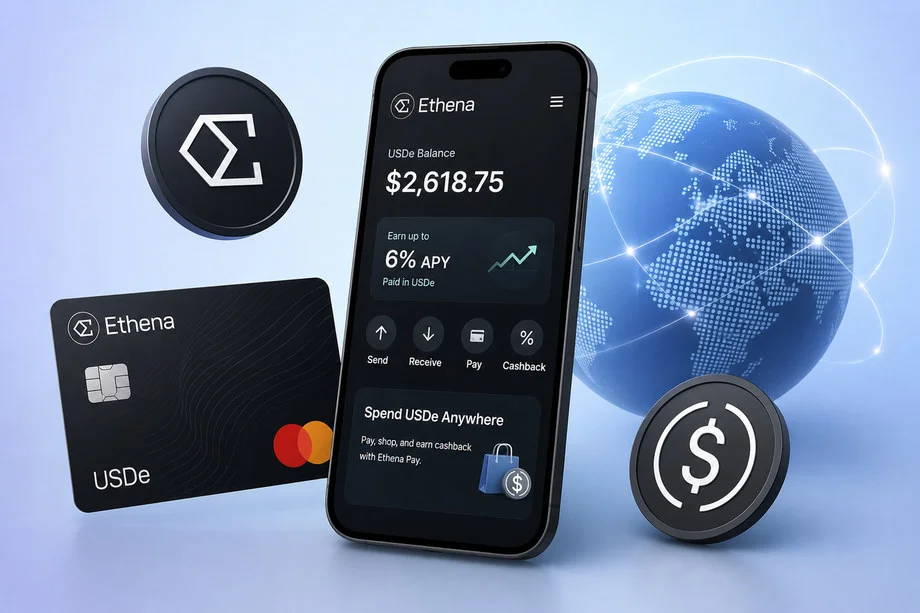
The self-custodial mobile platform launches in beta for 400 users across dozens of countries, offering rewards up to 6% and Avalanche settlement
Ethena has released Ethena Pay, a self-custodial consumer finance application that packages its USDe synthetic dollar into a single platform for savings, payments and cross-border money movement. Described as an “internet money neobank,” the iOS app became available on Apple’s App Store on Tuesday and positions the synthetic dollar as a practical alternative to conventional banking products for everyday use.
The product allows users to maintain a dollar-denominated balance in USDe, earn promotional rewards on eligible holdings, spend via a linked payment card and move funds between crypto wallets, bank accounts and other users. Avalanche serves as the exclusive settlement network for transfers, payments and related money movement within the app.
Beta Rollout and Geographic Reach
Access begins with a limited group of 400 early users. Ethena plans to expand availability on a weekly basis through September as the platform exits beta. The initial footprint covers 48 countries spanning Latin America, the Caribbean, Africa, Asia, the Middle East and Oceania. Supported markets include Brazil, Mexico, Australia, Japan, Singapore, the United Arab Emirates, Kenya and South Africa, subject to local eligibility rules.
The app is not available at launch in the United States, the European Union, Canada, Taiwan or South Korea. Expansion into those markets is planned during the beta period but remains contingent on regulatory approvals. Some reports also note the United Kingdom among the initially excluded jurisdictions.
Users can deposit fiat currency or crypto, with funds converted into USDe. The platform supports free dollar, pound and euro onramps as well as local-currency options. International Bank Account Numbers (IBANs) link self-custodial stablecoin accounts to traditional banking rails, enabling deposits and withdrawals that settle into local currencies. Backend infrastructure for on- and off-ramps is provided in part by Iron, a firm owned by MoonPay.
Rewards Structure and Membership Tiers
Ethena Pay structures balance rewards across three tiers. Standard users can earn a total annualized rate of up to 5% on balances capped at $5,000. Pro and VIP users can receive up to 6% on eligible balances of $15,000 and $50,000 respectively. Amounts above those caps continue to earn the prevailing USDe base rate but do not receive the additional Daily Boost that brings totals to the advertised tier rates.
The Daily Boost is calculated on a time-weighted average daily balance and paid in USDe, typically within 24 hours after the accrual day. Users must complete at least one qualifying card transaction each calendar month to receive it. Ethena characterizes the boost as a discretionary promotional incentive rather than interest or a deposit product. Balances and rewards are not covered by the U.S. Federal Deposit Insurance Corporation or any government-backed insurance scheme.
Standard membership is free. Pro status requires locking $2,000 worth of ENA tokens or referring 10 eligible users. VIP membership requires locking $10,000 of ENA or securing 50 referrals.
Card Spending and Cashback
The Visa Spend Card is issued by Third National, a Puerto Rico-chartered bank, under a Visa license, with the card program managed by Signify Holdings operating as Rain. The card works across Visa’s merchant network and supports Apple Pay.
Cashback is paid in AVAX. Standard users receive 4% on the first $2,500 of monthly spending. Pro members earn 4.5% on the first $8,000, and VIP users receive 5% on the first $20,000. Rates step down in higher spending bands. At selected merchants, Pro and VIP users can receive elevated cashback of up to 5% and 10% respectively.
Certain categories are excluded from cashback, including ATM withdrawals, cash advances, gambling, gift cards, account funding, peer-to-peer transfers, and purchases of cryptocurrencies, stablecoins, non-fungible tokens or securities. Transactions under $1 also receive no reward. Once a payment settles, usually within one to three business days, the dollar value of the cashback is converted into AVAX at the prevailing rate; the subsequent value of that AVAX remains subject to market movements.
Transfers and Settlement
Transfers between Ethena Pay users can be sent via username or payment tag at no fee. Bank transfers denominated in U.S. dollars, euros and British pounds are also free. Other bank transfers carry fees of 0.05% to 0.1%. Avalanche handles settlement for these flows, keeping the underlying blockchain layer largely invisible to users while processing payments and money movement.
Ethena Pay Ltd., a Malta-registered software company, states that it does not operate as a bank, broker-dealer, investment adviser or money services business. Third-party providers supply the financial services accessible through the app. Under the self-custodial model, private keys, seed phrases and recovery details remain on the user’s device; Ethena Pay cannot access assets or restore a wallet if credentials are lost.
USDe Background and Token Reaction
USDe is a synthetic dollar designed to maintain a value near $1 through crypto collateral and hedging strategies that include derivatives positions. It has grown to a market capitalization of approximately $4.1 billion, ranking as the sixth-largest stablecoin. Ethena’s governance token, ENA, carries a market capitalization of roughly $1.5 billion and rose about 9% following the Pay announcement, outperforming a largely flat broader market. The token had already gained around 68% over the preceding month.
Ethena founder Guy Young framed the neobank product as a way to reach consumers who are not already active onchain. He noted that most ordinary financial needs center on sending, saving and spending, and argued that stablecoin and blockchain rails can deliver near-instant, low-cost transfers together with higher savings rates and globally available products.
The launch continues Ethena’s broader expansion beyond its original basis-trade model for generating returns on USDe. The protocol has previously introduced a savings product with Coinbase and revised ENA token economics, while exploring additional return sources such as equity perpetuals.

Disclaimer
This article was generated by AI using information from multiple industry sources. It has not been reviewed or verified by a human editor and may contain inaccuracies, omissions, or misinformation. Readers are encouraged to independently verify any information before making decisions based on its content.Tired of the noise?
Let the bots trade for you.
Trade 24/7, without emotion, with data-driven strategies.
Associated articles

OKX Rolls Out Stablecoin Savings and Payments App Aimed at Emerging Markets
MEXC Rolls Out Visa Crypto Card With Up to 10% USDT Cashback
Nu Expands to U.S. Market with Banking Suite and Stablecoin Global Account

World Rolls Out Self-Custodial World Money Super App Across 150+ Countries

Krak Rolls Out Multi-Asset US Debit Card Amid Payward Expansion
Latest articles

SkyAI Exits Solana Holdings Completely, Launches $201 Million Share Buyback

Strategy Buys 267 Bitcoin and Raises Preferred Share Buyback Cap to $3 Billion

Dormant 2013 Bitcoin Wallets Shift Over $67 Million After More Than a Decade

Binance Rolls Out AI Pro Tool for Chat-Based Automated Trading Strategies