Newsroom
Chainlink Rolls Out CCIP 2.0 With Institutional Controls and Faster Cross-Chain Speeds
29 September, 2026 / News / AI / Tags: verifiers, chainlink, confirmation, ccip, finality
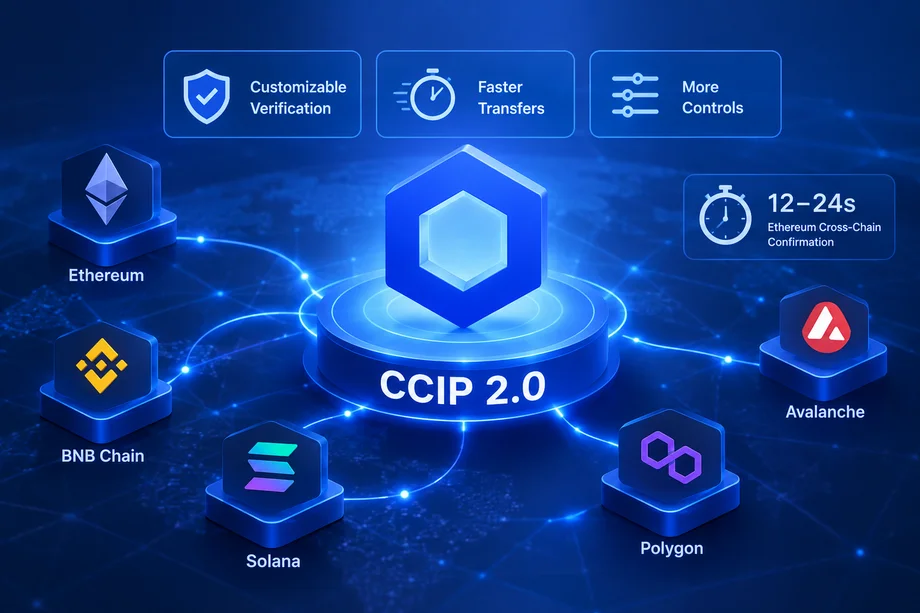
The protocol upgrade lets asset issuers run custom verifiers, adds compliance tools and cuts Ethereum confirmation times to as little as 12–24 seconds
Chainlink activated version 2.0 of its Cross-Chain Interoperability Protocol on September 28, introducing optional verification layers, compliance controls and configurable settlement speeds designed for institutional token transfers. The release arrives as banks and asset managers expand experiments with tokenized assets and on-chain payments.
CCIP 2.0 lets token issuers and other institutions operate their own Cross-Chain Verifiers alongside Chainlink’s default system. These additional verifiers perform an extra cryptographic check before a transfer completes. Users can also set verification rules and settlement requirements that scale with the value and risk of each transaction.
Compliance and Settlement Options
The upgrade embeds Chainlink’s Automated Compliance Engine into the cross-chain flow. The engine can enforce allowlists, sanctions screening, transaction limits and other policy checks before assets move. Issuers may require specific verifiers to approve a transfer or impose value-based thresholds that trigger further review.
Amazon Web Services and Google Cloud are available as hosting platforms for the new verifiers. Infosys and Nethermind are building verification services that institutions can plug in. Settlement timing is now configurable: smaller transfers can use shorter confirmation windows while larger ones can wait for stronger finality guarantees.
Chainlink states that its infrastructure currently secures more than $84 billion in cross-chain token value and has recently moved about $15 billion through the system. The company has also noted engagement from Swift, DTCC, Euroclear and UBS on related projects.
Faster Ethereum Confirmations
A parallel technical change integrates Ethereum’s Fast Confirmation Rule. Eligible cross-chain transactions originating on Ethereum can now receive an early confirmation signal in 12 to 24 seconds, down from the previous roughly 13-minute wait for full finality. The faster path relies on validator attestations and network-synchrony assumptions; full protocol-level finality remains available and is still the default setting.
The Fast Confirmation Rule operates at the client level and does not require changes to Ethereum’s core protocol. Other stages of a cross-chain transfer may still introduce additional latency, so the net speed gain depends on the specific route and application settings.
Technical Continuity and Market Context
Developers retain the existing Router interface, allowing most applications to adopt the new features without rewriting code. Default behavior continues to use Chainlink’s 16-operator Committee Verifier and full source-chain finality. Modular fee components and customizable execution options give teams further control over cost and risk profiles.
CCIP currently supports interoperability across 78 blockchains, including Ethereum, Solana, Arbitrum, Base and BNB Chain. The practical reach of the faster confirmation option will vary by route as individual network integrations adopt the feature.
At the time of the launch, LINK traded near $14–$15. The token had advanced more than 30 percent over the preceding month before consolidating around those levels.
The combination of custom verifiers, built-in compliance tools and optional rapid confirmation is intended to align cross-chain infrastructure with the operational and regulatory requirements of institutional users moving tokenized assets between networks.

Disclaimer
This article was generated by AI using information from multiple industry sources. It has not been reviewed or verified by a human editor and may contain inaccuracies, omissions, or misinformation. Readers are encouraged to independently verify any information before making decisions based on its content.Tired of the noise?
Let the bots trade for you.
Trade 24/7, without emotion, with data-driven strategies.
Associated articles
Nethermind Ends LayerZero Verifier Role, Joins Chainlink as Node Operator

Infosys Teams With Chainlink to Expand Institutional Onchain Finance

Chainlink Debuts CCIP Vault Adapters Enabling Deposits From Over 80 Chains
Wyoming Migrates State Stablecoin FRNT to Chainlink CCIP After Security Review

Chainlink Partners With Bottomline to Open Blockchain Settlement for 600-Plus Banks
Latest articles

SkyAI Exits Solana Holdings Completely, Launches $201 Million Share Buyback

Strategy Buys 267 Bitcoin and Raises Preferred Share Buyback Cap to $3 Billion

Dormant 2013 Bitcoin Wallets Shift Over $67 Million After More Than a Decade

Binance Rolls Out AI Pro Tool for Chat-Based Automated Trading Strategies