Newsroom
CFTC Proposes Treating Sports and Event Contracts as Swaps Amid Court Battles
10 October, 2026 / News / AI / Tags: casino, gambling, contracts, cftc, sports
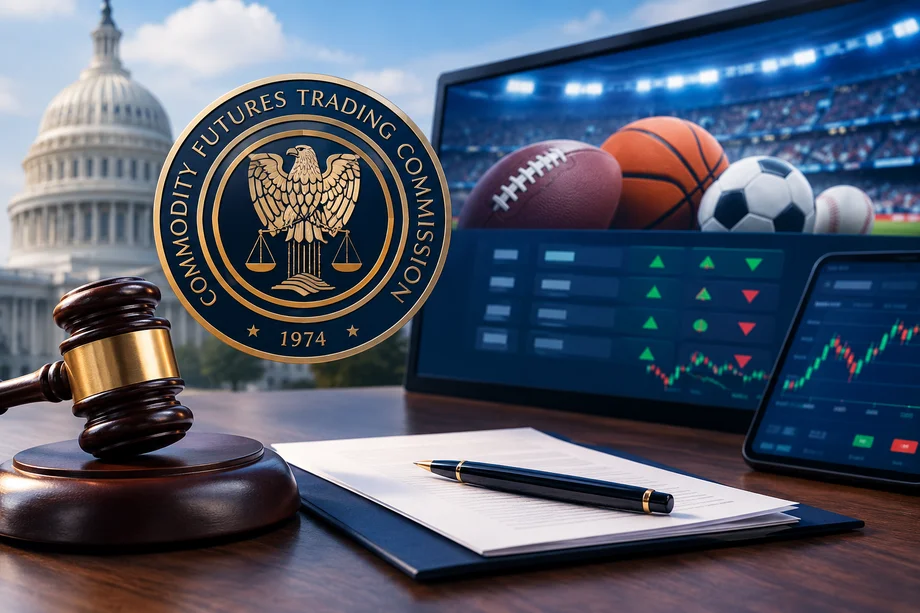
The U.S. derivatives regulator moved on Oct. 9 to classify certain prediction-market contracts as swaps while carving out traditional casino-style wagers from federal oversight
The Commodity Futures Trading Commission announced a proposal on Oct. 9 that would fold event contracts linked to sports, politics, cultural events and weather into the legal definition of swaps. At the same time, the agency issued an interim final rule that keeps conventional sportsbook wagers and casino games outside that definition.
The dual actions aim to clarify the CFTC’s authority over prediction-market products traded on registered platforms while preserving state-level regulation of traditional gambling. Both measures open a 30-day public comment period once published in the Federal Register. The casino exclusion takes effect immediately upon publication.
Proposal Extends Swap Definition to Event Contracts
In its notice of proposed rulemaking, the CFTC stated that event contracts are financial instruments already recognized in the derivatives industry as swaps. The agency argued that explicitly including them under the Commodity Exchange Act would eliminate uncertainty about their status.
The statutory definition of a swap covers payments that depend on the occurrence of events with potential financial, economic or commercial consequences. The proposal asserts that sports outcomes, political results, cultural events and weather readings can meet that threshold even when no immediate financial loss is demonstrated in a specific instance.
For weather contracts, the commission cited temperature changes that may affect agriculture, energy use and outdoor activity. The filing maintains that the possibility of such effects is sufficient under the law.
Selig added that the contracts fall within the agency’s exclusive jurisdiction under the Commodity Exchange Act.
Casino Exclusion Maintains State Authority Over Traditional Wagers
The accompanying interim final rule formalizes the CFTC’s longstanding view that casino-style gambling products are not derivatives. Sportsbook wagers and casino games will therefore remain outside the swap definition and subject to state gambling laws.
The agency described the exclusion as a clarification of existing limits on its authority rather than a new regulatory category. The rule leaves current compliance obligations for prediction-market operators unchanged.
Conflicting Court Rulings Fuel Ongoing Legal Disputes
Federal appeals courts have issued differing preliminary decisions on whether CFTC registration of an exchange preempts state sports-gambling enforcement.
The Third Circuit in April upheld a preliminary injunction protecting Kalshi against New Jersey enforcement, finding that the sports contracts at issue qualified as swaps and that the exchange had shown a reasonable likelihood of success on its preemption claim.
By contrast, the Sixth Circuit on Sept. 25 rejected Kalshi’s requests for injunctions in cases involving Ohio and Tennessee. The panel concluded that Kalshi had not established the contracts were swaps and that, even assuming they were, the states’ gambling laws were not displaced. The Ninth Circuit earlier allowed Nevada to continue enforcing its gaming rules during litigation.
New Jersey has asked the Supreme Court to review the Third Circuit decision. The National Football League filed a brief on Oct. 8 supporting that request, citing concerns over consumer protection, inside information and game integrity. According to the league, NFL-related markets accounted for $1.8 billion of $3.3 billion in prediction-market trading on the first Sunday of the season.
Kalshi has until Nov. 9 to respond to New Jersey’s petition. In a separate matter, Robinhood Derivatives sought Supreme Court review of a Ninth Circuit ruling involving Nevada officials; respondents received an extension until Nov. 13 to file answers.
State actions have also targeted other platforms. New York Attorney General Letitia James filed a petition on Sept. 24 alleging that Polymarket offered sports contracts without a state gambling license and allowed users under 21. Separate cases involving Kalshi, Coinbase Financial Markets and Gemini Titan have been reported.
Next Steps and Market Implications
The proposed inclusion of event contracts and the interim casino exclusion were submitted to the White House Office of Information and Regulatory Affairs on Sept. 28 under separate regulatory identifiers. Neither had become operative at the time of submission.
Once published, the 30-day comment windows will allow industry participants, state regulators and other interested parties to weigh in before any final rules are adopted. The measures arrive as prediction-market trading volumes continue to grow and as federal and state authorities remain locked in litigation over the boundary between regulated derivatives and state-controlled gambling.
Disclaimer
This article was generated by AI using information from multiple industry sources. It has not been reviewed or verified by a human editor and may contain inaccuracies, omissions, or misinformation. Readers are encouraged to independently verify any information before making decisions based on its content.Tired of the noise?
Let the bots trade for you.
Trade 24/7, without emotion, with data-driven strategies.
Associated articles
New Jersey Petitions Supreme Court Over Regulation of Sports Contracts on Prediction Markets
NFL Backs States in Supreme Court Dispute Over Kalshi Prediction Markets

CFTC Orders Kalshi to Keep Trading After New York Seeks $36 Billion Shutdown
Sixth Circuit Rules Kalshi Sports Contracts Subject to State Gambling Laws

Washington Court Blocks Kalshi Sports Contracts in Escalating Federal-State Regulatory Clash
Latest articles

Triple-A Breach Attacker Transfers $12.4 Million in Ether to Tornado Cash

KAIA Token Jumps Over 50% on Upbit Listing News

Tether Temporarily Freezes $1.45 Million USDT in THORChain Vaults on TRON

ESMA Reviews Tokenized Collateral Risks for EU Clearinghouses