Newsroom
Sixth Circuit Rules Kalshi Sports Contracts Subject to State Gambling Laws
26 September, 2026 / News / AI / Tags: sports, kalshi, circuit, contracts, tennessee
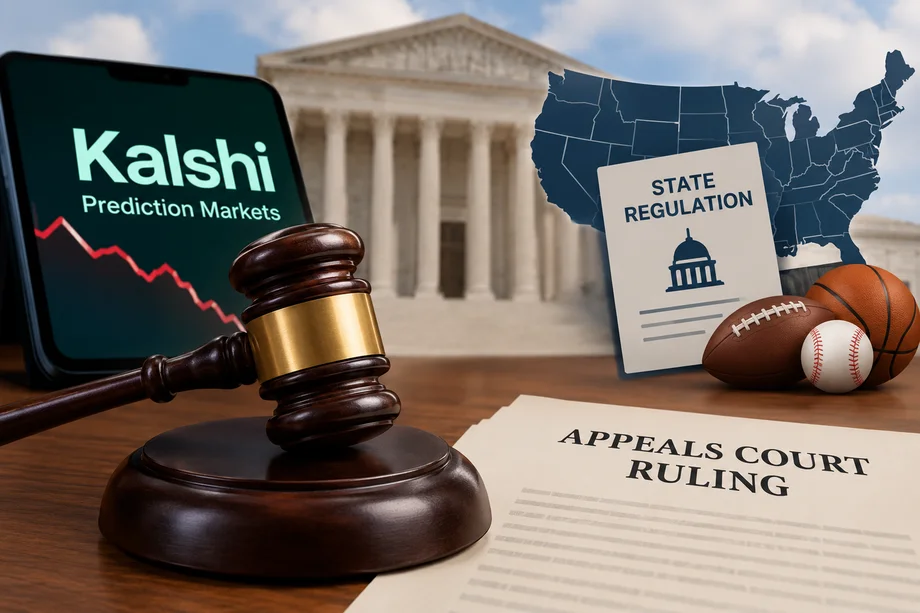
A federal appeals court sided with Ohio and Tennessee regulators, deepening a circuit split over whether prediction-market sports contracts fall under federal or state authority
A three-judge panel of the U.S. Court of Appeals for the Sixth Circuit ruled on September 25 that prediction-market operator Kalshi must face state gambling laws in Ohio and Tennessee. The unanimous decision found that the company’s sports-event contracts do not qualify as swaps under the Commodity Exchange Act and that federal commodities law does not override the states’ authority to regulate them as gambling products.
The ruling resolved two consolidated cases. It affirmed a lower court’s denial of Kalshi’s request for a preliminary injunction in Ohio and vacated a Tennessee district court’s earlier order that had blocked state enforcement. The cases now return to the trial courts for further proceedings.
Core Holdings of the Decision
Kalshi, a designated contract market registered with the Commodity Futures Trading Commission since 2020, began listing sports contracts after self-certifying them in January 2025. The products cover tournament outcomes, player statistics, golf, soccer results and combinations of game events. Traders take yes-or-no positions that settle based on the specified result.
Ohio’s Casino Control Commission and Tennessee’s Sports Wagering Council had warned Kalshi that it was offering sports wagering without state licenses. Both states set a minimum age of 21 for sports betting. Kalshi argued that its federal registration and the nature of the contracts placed them exclusively under CFTC jurisdiction, shielding them from state gambling rules.
Writing for the panel, Circuit Judge Julia Smith Gibbons concluded that Kalshi had not shown the contracts meet the statutory definition of a swap. The Commodity Exchange Act defines a swap in part as a contract whose payments are tied to an event associated with a potential financial, economic or commercial consequence. The court reasoned that sporting outcomes produce only indirect, downstream effects—such as changes in sponsorship revenue or local business activity—rather than the inherent financial consequences contemplated by the statute.
Even assuming the contracts qualified as swaps, the panel held that the Commodity Exchange Act neither expressly nor impliedly preempts Ohio’s or Tennessee’s gambling statutes. The judges noted that Congress used clear preemption language elsewhere in commodities law but did not do so in the exclusive-jurisdiction provision Kalshi relied upon. They also pointed to a statutory provision allowing the CFTC to review event contracts involving activities unlawful under state law, which they viewed as inconsistent with a complete displacement of state authority.
Practical and National Implications
The decision does not impose a nationwide ban on sports prediction markets. It addresses only the preliminary-injunction stage in the Sixth Circuit and applies specifically to the sports contracts at issue. Other event contracts—those tied to elections, economic indicators or weather—raise separate classification questions that the court did not resolve.
Kalshi spokesperson Dani Lever said the company expects the ruling to face further review. She argued that varying state rules at geographic borders undermine the operation of a single national electronic market. The court acknowledged that compliance measures such as geofencing could impose costs but found that difficulty does not render simultaneous compliance with federal and state requirements impossible.
The Sixth Circuit decision joins a recent Ninth Circuit ruling that allowed Nevada to regulate similar contracts. By contrast, the Third Circuit held earlier in 2026 that the CFTC possesses exclusive authority over swaps in a case involving New Jersey. That conflicting decision has already prompted a request for Supreme Court review. A pending appeal in the Fourth Circuit concerning Maryland adds further complexity.
States have contended that prediction-market sports products compete directly with licensed sportsbooks without contributing state tax revenue and that they are available to adults as young as 18. Kalshi and other platforms maintain that the contracts function as financial derivatives regulated at the federal level. The growing divergence among federal appellate courts leaves operators and regulators without a uniform national standard for the same sports contracts traded across state lines.
Kalshi remains a federally registered exchange. The September ruling concerns only the enforceability of state gambling laws against its sports offerings in Ohio and Tennessee while litigation continues.
Disclaimer
This article was generated by AI using information from multiple industry sources. It has not been reviewed or verified by a human editor and may contain inaccuracies, omissions, or misinformation. Readers are encouraged to independently verify any information before making decisions based on its content.Tired of the noise?
Let the bots trade for you.
Trade 24/7, without emotion, with data-driven strategies.
Associated articles

Judge Denies Kalshi Bid to Block New York Gambling Law Enforcement

Washington Court Blocks Kalshi Sports Contracts in Escalating Federal-State Regulatory Clash
New Jersey Petitions Supreme Court Over Regulation of Sports Contracts on Prediction Markets

Federal Judge Blocks Minnesota Prediction Market Ban Ahead of August Deadline

Connecticut Sues Kalshi Over Sports Event Contracts in Escalating Regulatory Fight
Latest articles

Network School Acquires Farcaster, Rebrands as Network State Protocol with New User Rules

US Judge Rejects Gemini and CFTC Bid to Void $5 Million Settlement

Capital B Posts $78 Million H1 Loss on Bitcoin Impairment While Expanding Holdings

Solana Accelerate China Event in Shanghai Suspended After Police Presence Reported