Newsroom
CFTC Prepares Independent Crypto Market Rules as Clarity Act Faces Senate Hurdle
21 August, 2026 / News / AI / Tags: cftc, selig, clarity, agency, senate

Agency Chair Michael Selig directs staff to draft a regulatory framework using existing powers if Congress fails to advance digital asset legislation in September
Commodity Futures Trading Commission Chairman Michael Selig has instructed agency staff to develop crypto market structure rules under current legal authority, signaling that the regulator will not wait indefinitely for Congress to pass the Digital Asset Market Clarity Act.
Speaking Thursday at the inaugural meeting of the CFTC’s Innovation Advisory Committee in Washington, Selig said legislation remains the preferred route for durable oversight. He made clear, however, that the agency is already preparing an alternative path if the bill stalls.
Selig added that the commission will give the legislation time for a vote but will act quickly if lawmakers cannot deliver a bipartisan measure to the president’s desk.
Proposed Framework for Crypto Asset Markets
Under the approach outlined by Selig, the CFTC would explore rules to create a specialized designation for crypto asset markets, modeled on existing designated contract markets. Both currently registered firms and unregistered crypto exchanges could seek this status. Once designated, platforms would be permitted to offer leveraged or margined crypto asset trading under rules tailored to digital asset risks and under direct CFTC supervision.
Selig also directed staff to engage with developers of on-chain finance protocols. The goal is to identify legal and compliant ways for these developers to offer their products in the United States, addressing long-standing uncertainty around regulatory liability for software and protocol creators.
The CFTC already oversees derivatives markets involving digital assets, including futures, options and swaps, and holds enforcement authority against fraud and manipulation in spot commodity transactions. Full routine supervisory power over spot crypto exchanges, however, would require additional statutory authority that the Clarity Act is designed to provide.
Clarity Act Status and Political Timeline
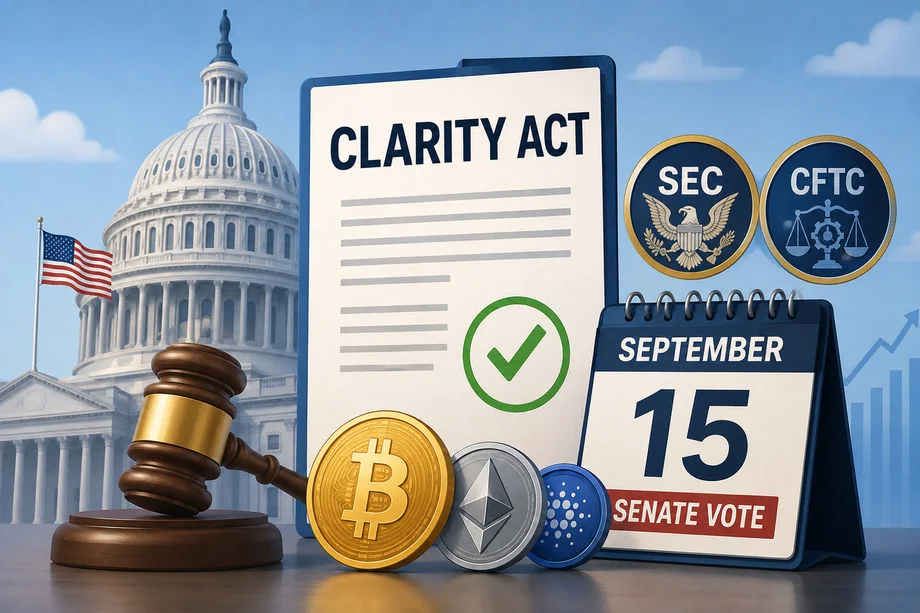
The House of Representatives approved its version of the Clarity Act in July 2025. The Senate Banking Committee advanced related text in May 2026. Senate Majority Leader John Thune has filed cloture on the motion to proceed, setting up a procedural vote scheduled to ripen on September 15 after lawmakers return from the August recess.
Cloture requires 60 votes. Even if successful, the vote would only open debate; further amendments and a final passage vote would still be needed. Any differences between Senate and House versions would require additional reconciliation before the bill could reach the president.
Negotiations have centered on ethics restrictions for public officials, treatment of stablecoin rewards, decentralized finance protections and the division of authority between the CFTC and the Securities and Exchange Commission. The bill would generally place qualifying digital commodities under CFTC oversight while preserving SEC jurisdiction over assets treated as securities.
President Donald Trump hosted crypto industry executives at the White House on August 19 and urged lawmakers to pass a “fair version” of the legislation, describing it as necessary to preserve digital asset policies beyond his administration. Executives from major firms including Coinbase, Gemini, Ripple, Kraken and others attended the event.
Broader Agency Agenda
Thursday’s Innovation Advisory Committee meeting also examined artificial intelligence in financial markets and prediction markets. The CFTC has asserted exclusive jurisdiction over prediction markets on the basis that event contracts qualify as swaps. The agency has pursued litigation against state authorities challenging that position and plans additional proposals to modernize rules governing designated contract markets that list event contracts.
Separately, the CFTC on August 19 requested public comment on derivatives linked to artificial intelligence computing capacity. Selig described compute as a critical commodity for the AI sector and said the United States needs robust derivatives markets for it. The consultation addresses liquidity, pricing, manipulation risks and possible perpetual compute futures. Public comments remain open for 60 days after publication in the Federal Register.
Selig has served as the sole Senate-confirmed CFTC commissioner since December 2025. The agency is designed to operate with a bipartisan five-member commission. Staffing levels have declined from fiscal 2025, raising questions about resources if the agency assumes broader responsibilities for spot crypto markets.
The SEC has advanced its own digital asset proposals in parallel, including potential safe harbors and exemptions related to investment contracts and tokenized securities. Both agencies have previously coordinated on asset classification through joint efforts, though formal rulemaking remains distinct.
Market participants now face a dual timeline: the September 15 Senate procedural vote on the Clarity Act and the CFTC’s parallel preparation of rules that could proceed under existing Commodity Exchange Act authority if legislation does not advance.
Disclaimer
This article was generated by AI using information from multiple industry sources. It has not been reviewed or verified by a human editor and may contain inaccuracies, omissions, or misinformation. Readers are encouraged to independently verify any information before making decisions based on its content.Tired of the noise?
Let the bots trade for you.
Trade 24/7, without emotion, with data-driven strategies.
Associated articles

CFTC Sets First Innovation Committee Meeting on Crypto Rules Amid Stalled Legislation
Senate Faces Critical September 15 Vote on Crypto Market Structure Bill

CFTC Unveils Optional Federal Rules for Leveraged Crypto Trading After Clarity Act Stalls
SEC and CFTC Signal Agency-Led Crypto Rules After Senate Blocks Clarity Act
Senate Banking Committee Poised for Historic CLARITY Act Markup on May 14
Latest articles
Lighter Token Climbs More Than 20% on Planned CFTC Filing and Research Note

Samsung and SK Hynix Upgrade China NAND Factories Amid AI Demand and Local Rivalry

China Prosecutors Move to Confiscate $5.1 Billion Bitcoin Haul Seized in UK Fraud Case

Bank of Korea Holds Rate at 3% After Consecutive Hikes, Eyes Data for Next Move