Newsroom
MoonPay Opens Seoul Hub With Major Korean Banks for Won Stablecoin Expansion
30 September, 2026 / News / AI / Tags: moonpay, korean, won, woori, korea
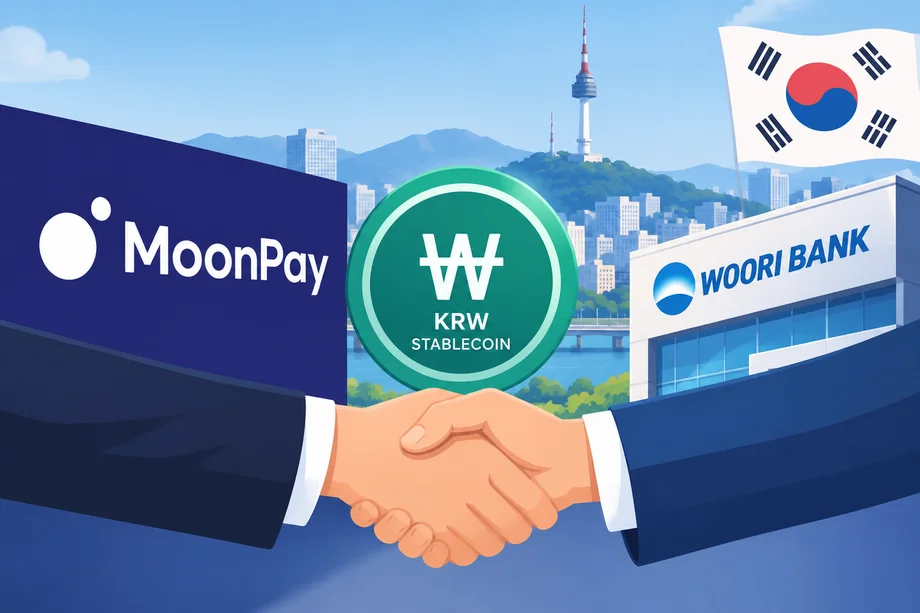
Payments firm launches Korean subsidiary on Sept. 29 to support regulated KRW stablecoins, faster remittances and cross-border settlements across Asia-Pacific
MoonPay established its South Korean subsidiary on September 29, 2026, positioning Seoul as the regional base for its Asia-Pacific operations. The move connects the company’s global digital asset infrastructure with leading Korean financial institutions to advance won-backed stablecoins, international remittances and payment services.
MoonPay Korea will not issue its own stablecoin. Instead, it will supply distribution, settlement, wallet access, conversion and cross-border infrastructure while Korean banks retain responsibility for issuance and reserve management. The company is preparing the necessary regulatory steps, including virtual asset service provider registration, to support its local activities.
Partnerships With Leading Korean Institutions
The subsidiary launches with active collaboration involving Woori Bank, KB Financial Group and KakaoBank. MoonPay is also working with Korean fintech firm Finger to link its global APIs and wallet systems with domestic banking platforms. MoonPay had previously acquired Finger with partners to strengthen local integration capabilities.
Woori Bank and MoonPay signed a memorandum of understanding in April 2026 focused on infrastructure for won-pegged stablecoins. The partners now plan to connect Woori’s domestic banking services with MoonPay’s international wallet network. This could allow overseas Koreans, tourists and students to purchase, hold and convert won-backed stablecoins outside South Korea. The collaboration also targets two-way corporate payments, enabling South Korean businesses to settle with foreign suppliers and overseas companies to send funds into the country. Woori already supports related activity through the BDACS KRW1 token, which is backed one-to-one by won deposits held at the bank.
KB Financial Group is examining wallets, stablecoin distribution, overseas remittances and conversion between conventional currency and digital assets. KB Kookmin Bank will explore these services for both retail and institutional clients. KB Kookmin Card plans to test whether foreign visitors holding stablecoins can pay South Korean merchants. Prior to the announcement, KB conducted a trial remittance involving a won-backed digital asset converted on-chain into a dollar stablecoin and delivered to a Vietnamese bank account. The process took less than three minutes and reduced fees by 87 percent compared with a conventional SWIFT transfer.
KakaoBank is developing a cross-border remittance model aimed at international students. Under the proposed flow, KakaoBank would manage the domestic application, compliance checks and initial transfer. MoonPay would handle the blockchain settlement, conversion into dollars and deposit into a U.S. bank account, with the full process targeted for completion in under one hour. The partners are also reviewing custody, distribution and swapping services for won-, dollar- and yen-pegged stablecoins, with potential future integration into the wider Kakao Pay ecosystem.
South Korea as Regional Testing Ground
MoonPay views South Korea as an ideal environment for refining its institutional offerings before wider Asian expansion. The country combines strong demand for virtual assets with advanced digital payment systems and a concentrated banking sector that has already experimented with blockchain settlement solutions. MoonPay reports more than 32 million verified customers, over 1,500 transaction partners and cumulative transaction volume exceeding 45 billion dollars. Its infrastructure supports more than 120 fiat currencies and 170 payment methods across more than 180 service areas.
Bugeon Lee, a MoonPay founding executive who will lead Asia-Pacific operations from Seoul, stated that Korea’s regulatory clarity, scale and technological sophistication create a powerful foundation for stablecoin adoption. He noted that regulated won issuance combined with MoonPay’s global distribution and settlement network could help Korean institutions extend the won’s reach into digital commerce.
MoonPay CEO and founder Ivan Soto-Wright described stablecoins as becoming the backbone of digital finance and identified Korea as one of the world’s most forward-looking markets.
Regulatory Context and Next Steps
The expansion occurs as South Korea advances its second-stage digital asset legislation. The Financial Services Commission expects review of the Digital Asset Framework Act to reach a National Assembly subcommittee in November. The Bank of Korea has supported a framework that places won-denominated stablecoins under regulated banks. Policymakers are examining issuer eligibility, reserve requirements and overseas distribution rules.
MoonPay is structuring its Korean operations around existing financial institutions and local compliance standards. Its planned full-stack approach covers deposits, withdrawals, payments, settlements, refunds and transaction monitoring while incorporating Korean requirements for customer identification, anti-money laundering controls, abnormal transaction detection and security procedures.
Short-term priorities include integrating pilot services through Finger, launching remittance and settlement test flows with Woori Bank and KakaoBank, and expanding consortium participation. Longer-term outcomes will depend on legislative decisions covering reserve rules, eligible issuers and cross-border distribution. At the Seoul launch, MoonPay also demonstrated an AI-driven payment system capable of executing small digital payments for external search services.
If the model proves effective, it may offer a reference for other Asian markets seeking bank-led issuance of regulated stablecoins linked to global payment networks.
Disclaimer
This article was generated by AI using information from multiple industry sources. It has not been reviewed or verified by a human editor and may contain inaccuracies, omissions, or misinformation. Readers are encouraged to independently verify any information before making decisions based on its content.Tired of the noise?
Let the bots trade for you.
Trade 24/7, without emotion, with data-driven strategies.
Associated articles

Shinhan Financial Partners With Visa to Build Stablecoin Payment Infrastructure
Toss Bank Partners with Solana for Stablecoin Remittance Pilot

SBI Group and Kyobo Life Complete Direct Yen-Won Stablecoin Cross-Border Pilot

Kakao Pay and KakaoBank Partner With Fireblocks on Stablecoin Infrastructure Tests

Jeonbuk Bank Deploys Ripple Payments for Faster Business Cross-Border Transfers
Latest articles
Blockchain Association Urges Clarity on DeFi and Stablecoin Rules Under GENIUS Act
XRP Launches Official X Account, Jointly Managed by Ripple and XRPL Foundation
ESMA Expands MiCA Register to 375 Providers as BingX, YouHodler and Openbank Join

France Narrowly Approves Crypto-to-Stablecoin Tax from 2027