Newsroom
Arbitrum Pauses New Stylus Activations Over AI-Assisted Attack Risks
3 October, 2026 / News / AI / Tags: stylus, arbitrum, activations, webassembly, solidity

Security Council blocks fresh Stylus contract activations on Arbitrum One and Nova after identifying threats from custom WebAssembly programs, while existing contracts and Solidity operations continue unaffected
Arbitrum’s Security Council enacted an emergency measure on October 2, 2026, suspending new Stylus contract activations across Arbitrum One and Nova. The action, taken around 11:30 a.m. ET, responds to growing risks from sophisticated AI-assisted attacks that exploit hand-crafted WebAssembly programs built outside the standard Stylus compiler toolchain.
How the Pause Was Implemented
Rather than requiring a software upgrade to ArbOS, the Council raised the gas cost for Stylus contract activation to a level described as prohibitively expensive. This configuration change immediately prevents new activations without altering the underlying protocol. Existing Stylus contracts remain fully operational and can continue executing. Developers may still extend active programs through a permissionless keepalive renewal process before expiration. However, any contract needing a first-time activation, reactivation after expiration, or a new application version requiring fresh activation is blocked.
Ordinary Solidity contract deployment and execution on both networks continue without interruption. The intervention is limited strictly to Stylus activations and leaves the bulk of Arbitrum activity, including DeFi protocols and standard dApps, running normally.
Nature of the Identified Threats
The Security Council cited increasingly advanced AI-assisted attacks that generate custom WebAssembly bytecode designed to bypass the usual Stylus compiler safeguards. These programs target edge cases that standard tooling would typically prevent. The primary risks involve potential disruption to on-chain activity and denial-of-service conditions that could affect network liveness. Officials confirmed that no vulnerabilities allowing theft of user funds have been identified, and no such attacks have occurred.
Stylus enables developers to deploy programs written in languages that compile to WebAssembly, expanding beyond traditional Solidity. The pause specifically addresses programs created with nonstandard toolchains, leaving validated and already-activated code untouched.
Additional Safeguard for BoLD Dispute Resolution
Alongside the activation pause, the same emergency action introduced a protective measure for Arbitrum One’s BoLD one-step proofs. BoLD handles dispute resolution during the chain’s challenge periods for settlement to Ethereum. The new guard activates if two contradictory answers are submitted for the same step and both are validated by the one-step proof system. In that scenario, settlement from Arbitrum One to Ethereum is temporarily held, allowing time for a fix.
Arbitrum One itself continues processing transactions as usual under this condition. The potential impact is limited to messages, including withdrawals, that have not yet been confirmed on Ethereum. Those pending transfers could experience delays until the Council resolves any conflict and restores normal settlement. The guard does not pause withdrawals by default; delays occur only if the specific contradictory-proof situation arises.
Path Forward for Stylus Activations
No specific date has been set for lifting the restriction on new Stylus activations. The Arbitrum Foundation will collaborate with the ArbitrumDAO to determine both the timing and the method for restoring the ability to activate new contracts. Until that decision, teams with live Stylus applications can maintain operations and renewals, while those preparing new deployments or major version updates must wait.
The measures leave the majority of network functions intact while addressing targeted risks to stability. Developers and users of Arbitrum One and Nova face no interruption to existing Stylus contracts or standard Solidity activity during this temporary period.

Disclaimer
This article was generated by AI using information from multiple industry sources. It has not been reviewed or verified by a human editor and may contain inaccuracies, omissions, or misinformation. Readers are encouraged to independently verify any information before making decisions based on its content.Tired of the noise?
Let the bots trade for you.
Trade 24/7, without emotion, with data-driven strategies.
Associated articles
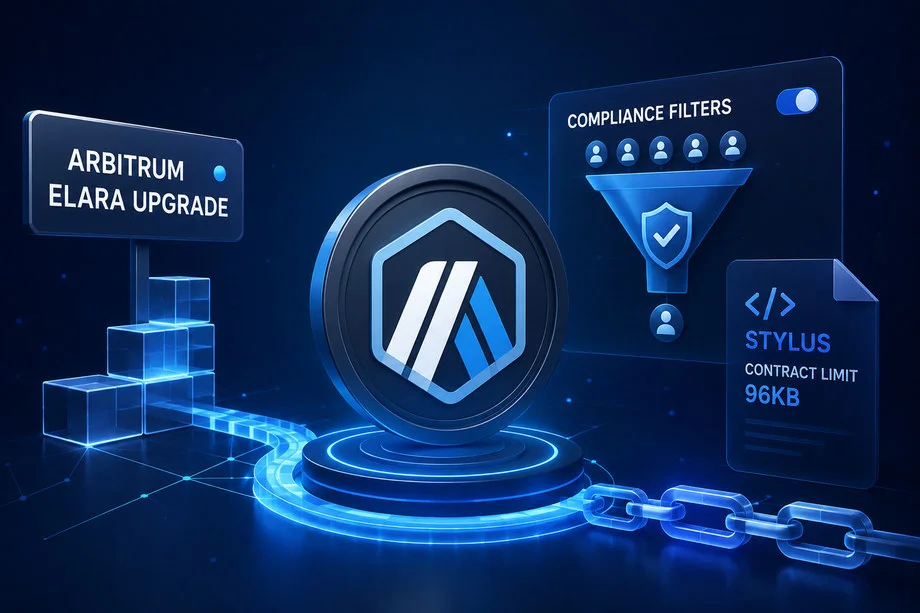
Arbitrum Activates ArbOS 61 Elara Upgrade Expanding Orbit Tools and Stylus Capacity

Ethereum Delays Glamsterdam Hoodi Testnet Activation Over Gas Security Risks

Ethereum Rolls Out Clear Signing Standard to Eliminate Blind Transaction Approvals

CME Group Set to Launch Nasdaq Crypto Index Futures on June 8
Harmony Proposes Full Shutdown of Layer-1 Network and ONE Token Shift to Ethereum
Latest articles

Blockchain Association Presses Congress for Crypto Tax Overhaul Amid Stalled Market Structure Bill

New York AG Seeks $1.37 Billion From NovaTech Founders in Crypto Fraud Case

US Senator Seeks Records on Tether Payments to Firm Tied to Former White House Crypto Adviser

Bitcoin Core Revises Security Policy as AI Tools Simplify Bug Discovery