Newsroom
Arbitrum Activates ArbOS 61 Elara Upgrade Expanding Orbit Tools and Stylus Capacity
22 August, 2026 / News / AI / Tags: arbitrum, elara, stylus, orbit, chains
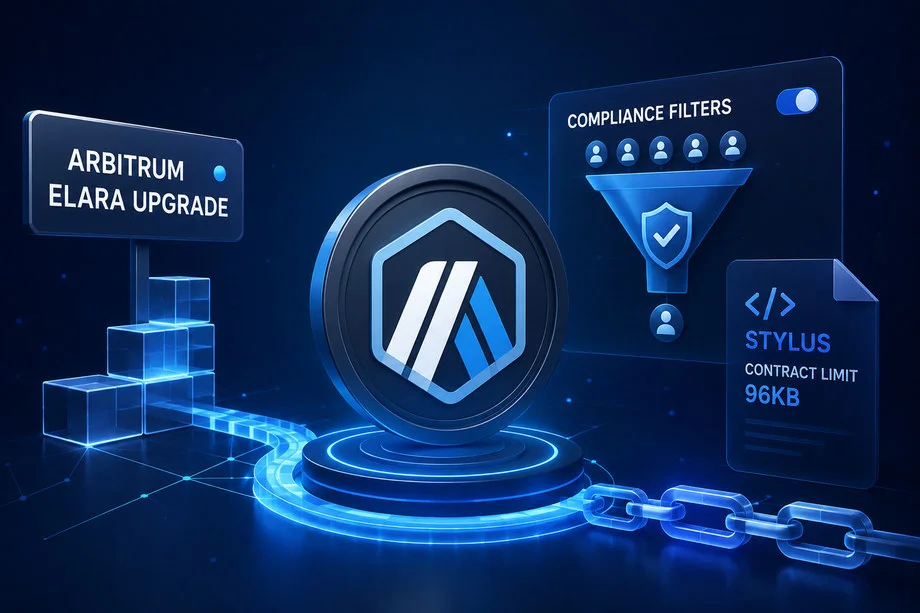
The ArbOS 61 Elara upgrade went live on August 20, 2026, adding optional compliance features for dedicated chains, priority fee support, and a fourfold increase in Stylus contract size limits on Arbitrum One
Arbitrum has activated its ArbOS 61 upgrade, known as Elara, across the platform following approval by ArbitrumDAO governance. The release, which became operational on August 20, 2026, delivers targeted improvements for both public networks and operators of dedicated Orbit chains while requiring node operators to update to Nitro version 3.11.3.
Elara introduces configurable tools designed primarily for enterprise and custom chain deployments. These capabilities remain disabled by default on Arbitrum One and Nova, ensuring that public network users experience no immediate changes to transaction processing or fee structures beyond specific infrastructure adjustments.
Optional Compliance Filtering for Orbit Chains
A central addition is protocol-level compliance filtering available exclusively to dedicated chain operators. Chain owners can enable the feature and select third-party screening providers to generate lists of restricted addresses. Rules can then govern how those addresses interact with the network, including transaction submission, contract calls, and fund transfers.
Enforcement occurs in two stages. The sequencer evaluates incoming transactions against the configured rules and blocks non-compliant activity before inclusion in a block. For transactions routed through the parent chain Delayed Inbox, a monitoring component can flag the transaction hash to an on-chain guardian, causing the state transition function to reject it. Restricted addresses are stored as salted hashes rather than in plain text.
Documentation advises operators to wait at least 30 days after the Arbitrum One activation before enabling the filtering tools, allowing the system to demonstrate stability in production. The feature is intended for private or regulated Orbit deployments and does not apply to public Arbitrum One or Nova activity.
Priority Fees and Alternative Data Availability
Elara also installs the underlying support for priority fees, or tips, on dedicated chains. Activation requires action by the chain owner through the access-controlled ArbOwner precompile, followed by a sequencer update to reorder transactions according to the tips. On Arbitrum One, the upgrade only lays the groundwork; enabling priority fee collection network-wide would require a separate constitutional vote by ArbitrumDAO.
Dedicated chain operators gain access to an Alternative Data Availability API. This interface allows integration of external data-availability providers without maintaining a customized fork of the Nitro software stack, reducing long-term engineering requirements for independent chains. Arbitrum One continues to settle transaction data on Ethereum and does not use this option.
Changes Specific to Arbitrum One
On the public mainnet, Elara introduces a BaseFeeManager contract that permits Offchain Labs to adjust the minimum layer-2 base fee within a governance-approved range of 0.01 to 0.10 gwei. The authority is time-limited to two years from activation, requires public forum notice before any change, and can be revoked by the DAO at any time. The mechanism does not automatically raise fees; it creates a pre-approved pathway for limited adjustments if network conditions require them.
Stylus smart contracts receive a substantial expansion of code size capacity. The limit rises from 24 KB to 96 KB, a fourfold increase that applies only to Stylus contracts written in languages such as Rust, C, and C++. Solidity contract size limits remain unchanged at 24 KB to preserve EVM compatibility and node performance assumptions. Larger contracts use a fragment-based deployment model in which the Stylus SDK automatically splits oversized binaries and deploys a collection contract that references the fragments.
The upgrade also removes support for the WebAssembly multi-value extension. Developers with contracts relying on that feature must review compatibility notes before activation or reactivation, as affected contracts will no longer be usable under the new rules.
Broader Implications for the Ecosystem
The Elara release continues Arbitrum’s development of the Orbit framework, which enables teams to launch customized chains built on Arbitrum technology. These chains can incorporate permissioning, compliance tooling, custom gas models, and operational controls suited to institutional or regulated use cases while leaving the public networks unaffected.
Everyday users of Arbitrum One will primarily notice the expanded Stylus capacity and the refined base-fee adjustment process. Dedicated chain operators now possess additional configuration options for compliance and fee markets. Whether and how quickly these tools see adoption remains to be determined by individual chain teams and any future governance decisions regarding priority fees on the main network.
Node operators across the platform must complete the required software update to Nitro v3.11.3 to remain synchronized with the upgraded protocol.


Disclaimer
This article was generated by AI using information from multiple industry sources. It has not been reviewed or verified by a human editor and may contain inaccuracies, omissions, or misinformation. Readers are encouraged to independently verify any information before making decisions based on its content.Tired of the noise?
Let the bots trade for you.
Trade 24/7, without emotion, with data-driven strategies.
Associated articles

Arbitrum Builds Strength Through Robinhood Chain Partnership and Fee Model Changes

Arbitrum Pauses New Stylus Activations Over AI-Assisted Attack Risks

Robinhood Chain Posts $4.5 Million in Daily Fees While Paying Ethereum $398
Cardano Unveils Two-Phase Dijkstra Upgrade Roadmap Targeting 2026-2027

Uniswap Governance Votes on V4 Fees and Robinhood Chain Expansion
Latest articles

Blockchain Association Urges Clarity on DeFi and Stablecoin Rules Under GENIUS Act
XRP Launches Official X Account, Jointly Managed by Ripple and XRPL Foundation

ESMA Expands MiCA Register to 375 Providers as BingX, YouHodler and Openbank Join

France Narrowly Approves Crypto-to-Stablecoin Tax from 2027