Newsroom
Zcash NU7 Upgrade Set for November 5 After Holders Back Faster Blocks and Halvings
18 September, 2026 / News / AI / Tags: zec, zcash, percent, stale, activation
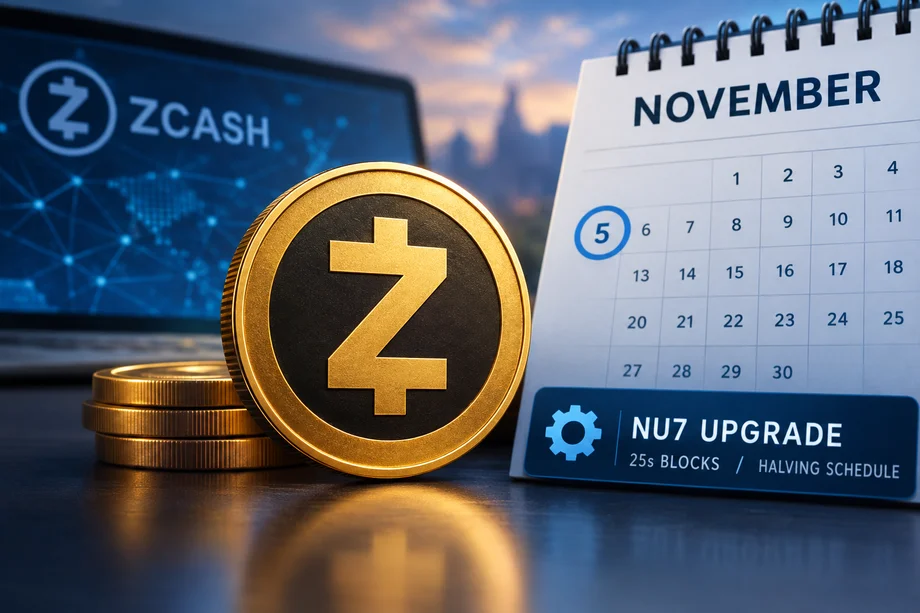
Coinholders approve 25-second blocks and Bitcoin-style issuance cuts as developers lock in testnet and mainnet dates for the next protocol upgrade
Zcash developers have targeted November 5 for activation of the NU7 network upgrade on mainnet following a coinholder vote that strongly favored shorter block times and retention of the existing halving schedule. The plan follows unanimous agreement among the Zcash Foundation, Project Tachyon, Valar Group, ZODL, Shielded Labs and engineering teams on both the feature set and timeline.
Testnet activation is scheduled for October 6, with a final mainnet decision due on October 20 after two weeks of performance review. A September 30 cutoff requires features to be complete for inclusion.
Strong Coinholder Mandate for Faster Blocks
The governance poll that closed September 14 drew participation from roughly 2.4 million ZEC, equal to about 66 percent of the 3.6 million ZEC eligible at the snapshot and well above the one-million ZEC threshold required for a valid signal.
Support for reducing target block spacing from 75 seconds to 25 seconds reached 99.9 percent. The underlying proposal, known as ZIP 218, aims to cut average confirmation latency by a factor of three. It also projects Orchard throughput rising from approximately 2.9 transactions per second to 6.6 transactions per second for typical two-action transactions while imposing new per-block action limits to manage resource use.
Faster blocks are expected to benefit payment, exchange deposit and cross-chain use cases that currently wait for one or more confirmations. Developers note that the change keeps daily issuance constant by adjusting the subsidy paid per block.
Halving Schedule Retained Over Smooth Issuance
Coinholders also voted overwhelmingly to keep Zcash’s discrete Bitcoin-style halvings rather than adopt a smooth issuance curve. Approximately 2.38 million ZEC supported the existing schedule against just over 22,000 ZEC favoring the alternative, producing a roughly 98.9 percent majority.
Separately, 96.6 percent of participating ZEC backed beginning Network Sustainability Mechanism fee reissuance in February 2031. Under the selected design, at least 60 percent of transaction fees will be removed from circulation, with the balance available to miners; the removed coins are intended to return later through block subsidies rather than permanent destruction.
Nearly 99.3 percent of voters preferred shipping NU7 as soon as the core features are ready instead of delaying for every proposed addition.
NU7 Scope and Technical Details
NU7 will disable version 4 transactions at activation. Because the newer version 5 format does not support the original Sprout shielded pool, this step will prevent further spending of remaining Sprout funds. Those balances totaled less than 23,000 ZEC and accounted for under 0.1 percent of transaction volume at the time of the vote. No immediate recovery mechanism is planned, though the specification leaves open the possibility of later restoration.
The upgrade introduces no new transaction formats. Wallets are not expected to require major changes, while full nodes, indexers and block explorers may need adjustments to accommodate the revised consensus rules and higher block rate.
Testing of the 25-second interval examined elevated stale-block risk. Modeling estimates a theoretical stale rate near 3.26 percent; a development network with 99 distributed nodes recorded a 4.86 percent stale rate and 0.37 percent fork rate under load.
Price Action Amid Governance Progress
ZEC has advanced sharply during the governance process. On September 18 the token traded near 1,360 dollars to more than 1,500 dollars across major platforms, with daily gains ranging from roughly 10 percent to 20 percent in recent sessions and 24-hour volume exceeding 2.6 billion dollars at peaks. Privacy-focused assets as a group have outperformed the broader market over the past year.
Additional catalysts in September included the conversion of Grayscale’s Zcash Trust into a U.S.-listed exchange-traded product, which launched with approximately 304 million dollars in assets and subsequently grew as prices rose.
Developers will assess testnet behavior before confirming the precise mainnet activation height on October 20. The November 5 target remains conditional on that review and on features meeting the September 30 readiness deadline.

Disclaimer
This article was generated by AI using information from multiple industry sources. It has not been reviewed or verified by a human editor and may contain inaccuracies, omissions, or misinformation. Readers are encouraged to independently verify any information before making decisions based on its content.Tired of the noise?
Let the bots trade for you.
Trade 24/7, without emotion, with data-driven strategies.
Associated articles

Zcash Holders Approve 25-Second Blocks and Retain Halving Schedule in NU7 Vote

Zcash Activates NU7 Upgrade on Testnet with 25-Second Blocks
Zcash Climbs Sharply After Paradigm Confirms ZEC Holdings

Solana Begins Testing Alpenglow Upgrade Targeting 150-Millisecond Finality

Zcash Sets Ironwood Network Upgrade for July 28 Activation
Latest articles

YieldMax Option Income ETFs Declare Weekly Distributions for October 9

Stablecoins Expand as Core Tools for SaaS and Ecommerce Operations

Crypto Experts Warn of AI Threat to Blockchain Encryption, Urge 'Bunker Mode'

Polkadot Launches DAO-Governed dotUSD Stablecoin as DOT Tests $1 Support