Newsroom
Zcash Holders Approve 25-Second Blocks and Retain Halving Schedule in NU7 Vote
16 September, 2026 / News / AI / Tags: zec, zcash, coinholder, halving, halvings
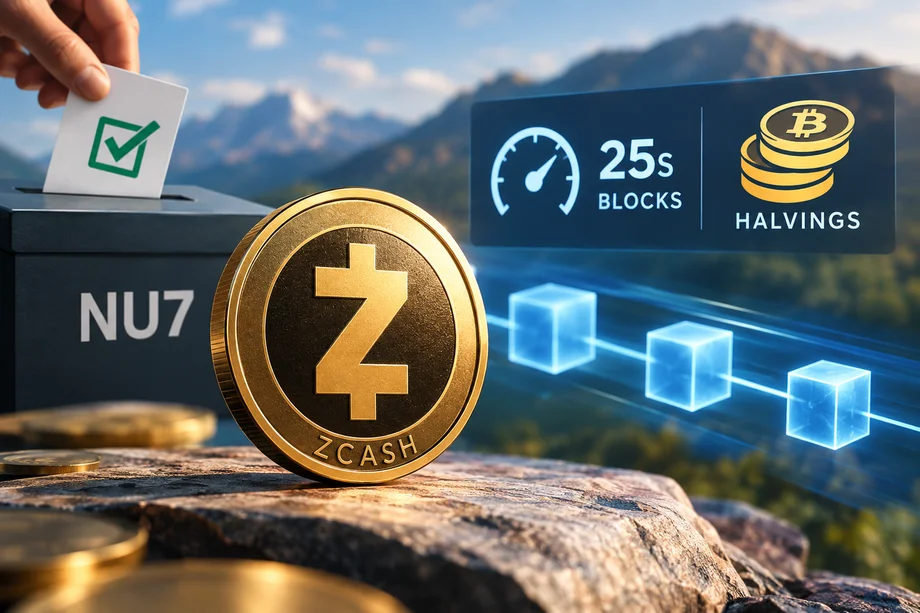
Nearly 2.4 million ZEC participated in a privacy-focused coinholder poll, delivering decisive support for faster confirmations and unchanged monetary issuance rules ahead of the network's next major upgrade
Zcash coinholders have delivered clear direction for Network Upgrade 7, backing a sharp reduction in block times while preserving the network's existing Bitcoin-style halving schedule. Results from the recent vote show overwhelming majorities in favor of the core proposals that will shape the privacy-focused blockchain's next phase of development.
Approximately 2.4 million ZEC took part, representing about two-thirds of the 3.6 million eligible tokens at the snapshot. Turnout far exceeded the 1 million ZEC minimum set by organizers to treat the outcome as representative and marked a substantial rise from earlier community sentiment polls.
Strong Support for Faster Confirmations
Participating holders gave 99.9 percent support to cutting the target block interval to 25 seconds from the current 75 seconds. The change is intended to shorten the expected wait for a transaction's first confirmation. To keep scheduled daily issuance constant, the amount of new ZEC created per block would decline in proportion to the faster rate.
Eligibility required holdings of spendable ZEC in the Ironwood shielded pool. Ballots were encrypted and divided into sixteen components so that validators could tally results without linking votes to individual identities or specific balances.
Halving Schedule Preserved
A 98.9 percent majority favored retaining the current halving schedule rather than shifting to a smoother, gradual reduction in issuance. Halvings cut the block reward by half at predetermined intervals, aligning Zcash monetary policy more closely with Bitcoin's model. The alternative would have replaced those discrete cuts with a continuous decline in new-coin creation.
An earlier advisory-panel poll showed a narrower divide on the same question, with 57 members preferring a gradual curve and 54 supporting retention of halvings. Coinholder preference proved far more decisive.
Network Sustainability Mechanism Delayed
Holders also addressed the Network Sustainability Mechanism, which directs a portion of transaction fees into a pool for later recycling into block rewards while respecting the 21 million ZEC supply cap. Roughly 96.6 to 97 percent of the vote supported postponing any reissuance of those accumulated funds until February 2031. Only a small fraction favored an earlier start.
Several affiliated groups, including Shielded Labs, Project Tachyon, ZODL, the Zcash Foundation and Valar Group, indicated they interpret the result as a clear preference for the later date.
| Proposal | Outcome | Support Level |
|---|---|---|
| Block time reduction to 25 seconds | Approved | 99.9% |
| Retain Bitcoin-style halvings | Approved | 98.9% |
| Delay NSM reissuance to February 2031 | Approved | 96.6–97% |
| Ship NU7 ASAP, drop unfinished features after Sept. 30 | Approved | 99.3% |
Path to Activation Remains Open
The coinholder poll does not itself activate any code. Development teams still must implement, audit and integrate the selected features. Organizers plan to finalize items for the upgrade by a September 30 cutoff. Features not ready by that date are expected to be deferred rather than delay the entire release. Testnet and mainnet activation schedules have not been set.
Holders also favored launching NU7 as soon as practicable once the ready components are complete. The vote stands separate from parallel consultations with other community bodies such as ZecHub and the Zcash Community Advisory Panel.
Zcash continues to rely on zero-knowledge proofs to shield transaction details. NU7 forms the latest step in a sequence of upgrades aimed at improving performance, privacy tooling and long-term economic sustainability without altering the fixed maximum supply.

Disclaimer
This article was generated by AI using information from multiple industry sources. It has not been reviewed or verified by a human editor and may contain inaccuracies, omissions, or misinformation. Readers are encouraged to independently verify any information before making decisions based on its content.Tired of the noise?
Let the bots trade for you.
Trade 24/7, without emotion, with data-driven strategies.
Associated articles
Zcash NU7 Upgrade Set for November 5 After Holders Back Faster Blocks and Halvings
Zcash Activates NU7 at Block 3,543,405 to Cut Block Times to 25 Seconds
Zcash Activates NU7 Upgrade on Testnet with 25-Second Blocks
Zcash Climbs Sharply After Paradigm Confirms ZEC Holdings

Zcash Ironwood Hard Fork to Isolate Orchard Pool Vulnerability
Latest articles
Canada Launches Consultation on Stablecoin Rules With Yield Ban Intact

Chainlink Unveils CustodySync to Unlock Institutional Access to DeFi Lending

BNB Standard Rings Nasdaq Opening Bell to Mark Rebrand and New CEO

Verizon Raises 2026 Outlook After Strong Subscriber Gains and $2 Billion AWS AI Deal