Newsroom
Raoul Pal Sees Capital Rotating From AI Stocks Into Crypto on Liquidity Shifts
6 October, 2026 / News / AI / Tags: pal, raoul, solana, ethereum, dollar
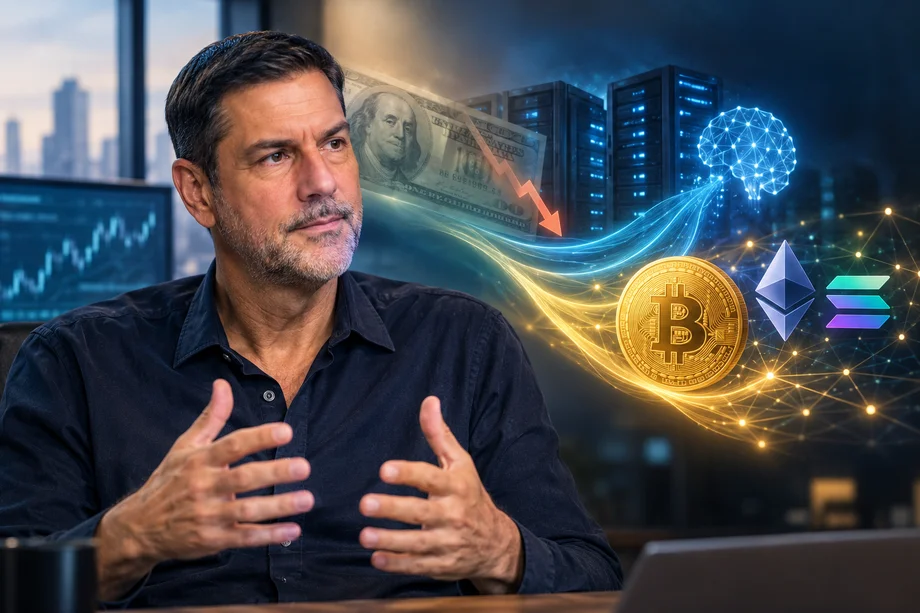
Real Vision founder says a weaker dollar could unlock further crypto gains while an AI pause may redirect funds, with smart-contract platforms set to benefit from agent activity
Real Vision founder Raoul Pal has argued that crypto markets stand to gain from a rotation of capital away from artificial intelligence equities, provided macroeconomic conditions ease. In a recent discussion, he identified the strength of the US dollar and elevated bond yields as key constraints on liquidity flowing into digital assets.
Pal stated that higher yields and a firm dollar have limited the free movement of capital into risk assets. He indicated that a policy or market-driven decline in the dollar would improve the backdrop for crypto.
His preferred set of conditions includes a weaker dollar, a steeper yield curve and expanded bank lending that increases the money supply. Current data shows those conditions have not yet aligned. The US 10-year Treasury yield reached 5.29 percent in September, and the Federal Reserve raised its benchmark rate by a quarter percentage point.
AI Trade Pause as Secondary Path for Capital Flow
Pal pointed to competition between AI equities and crypto for investor funds. He cited a period from August 19 to August 25 when Bitcoin rose approximately 25 percent to around 80,000 dollars while Nvidia recorded seven consecutive declining sessions. He described such pauses in the AI trade as periods when liquidity can shift toward crypto.
An outright collapse in AI stocks would be unwelcome, in his assessment, because it would signal liquidity being withdrawn from the broader system. That withdrawal would undermine the conditions required for sustained crypto advances.
In the absence of a weaker dollar and easier financial conditions, Pal identified sideways trading in AI stocks as a second-best scenario. Under that outcome, capital could still rotate into crypto without a sharp liquidity shock.
AI Agents Expected to Drive Activity on Ethereum and Solana
Beyond near-term liquidity dynamics, Pal outlined a longer-term structural shift tied to AI agents. These software systems are beginning to transact, including payments for content access. Amazon Web Services introduced a monetization feature in June that allows content owners to charge AI bots for access. Coinbase supports verification and settlement through its x402 protocol, with USDC on Base among the payment options.
Pal suggested agents may eventually raise operating funds by issuing tokens for projects lasting from a week to a year, then execute tasks and generate returns. Smart-contract platforms would provide the rails for those transactions.
He expects Ethereum and Solana to capture a larger share of this activity relative to Bitcoin, which he believes will participate less directly in the economic flows generated by agent transactions.
Caution on Solana Surpassing Ethereum in Market Value
Pal expressed support for both Ethereum and Solana yet urged restraint on predictions that Solana will overtake Ethereum by market capitalization in the current cycle. Multicoin Capital co-founder Kyle Samani had forecast such a crossover. Pal responded that Samani needs to hold his horses a little bit, while acknowledging the outcome remains possible.
Data from DefiLlama illustrated the distinction. Solana recorded about 3.2 million active addresses over a recent 24-hour period, compared with 387,000 for Ethereum. Ethereum, however, held approximately 54.4 billion dollars in decentralized finance protocol value against Solana’s 6.7 billion dollars.
Pal framed the comparison through a measure he terms economic density, calculated as total value locked divided by active users. Ethereum draws greater capital relative to its user base, while Solana’s activity tends to involve smaller transaction sizes.
He has discontinued public price targets after previous forecasts were widely clipped and recirculated. He described the notion of Bitcoin reaching one million dollars by 2030 as a meme linked to adoption, exchange-traded fund interest and collateral use, adding that he sees no issue with such a level by 2032.
Market participants will watch whether the dollar and yields ease sufficiently to support broader liquidity, and whether AI equities enter a period of consolidation rather than sharp decline. Those developments, alongside rising agent-driven transaction demand, form the core elements of Pal’s current framework for crypto market direction.
Disclaimer
This article was generated by AI using information from multiple industry sources. It has not been reviewed or verified by a human editor and may contain inaccuracies, omissions, or misinformation. Readers are encouraged to independently verify any information before making decisions based on its content.Tired of the noise?
Let the bots trade for you.
Trade 24/7, without emotion, with data-driven strategies.
Associated articles

Tether USDT Surpasses Ethereum in Major Valuation Shift

Bitcoin $1 Million by 2030 Called Mathematically Impossible by Research Chief

ARK Invest Shifts $31.5 Million Toward Coinbase and Circle in Crypto Equity Rebalancing

Arthur Hayes Sells 2,364 ETH for $4.3 Million at $241,000 Loss Amid Market Decline

Fidelity Seeks SEC Nod to Stake Ethereum in $898 Million ETF and Pay Cash Yields
Latest articles

Canada Launches Consultation on Stablecoin Rules With Yield Ban Intact

Chainlink Unveils CustodySync to Unlock Institutional Access to DeFi Lending
BNB Standard Rings Nasdaq Opening Bell to Mark Rebrand and New CEO

Verizon Raises 2026 Outlook After Strong Subscriber Gains and $2 Billion AWS AI Deal