Newsroom
VeChain CEO Positions Blockchain as Core Trust Layer for Autonomous AI Agents
5 November, 2026 / News / AI / Tags: vechain, agents, agent, sunny, reputation
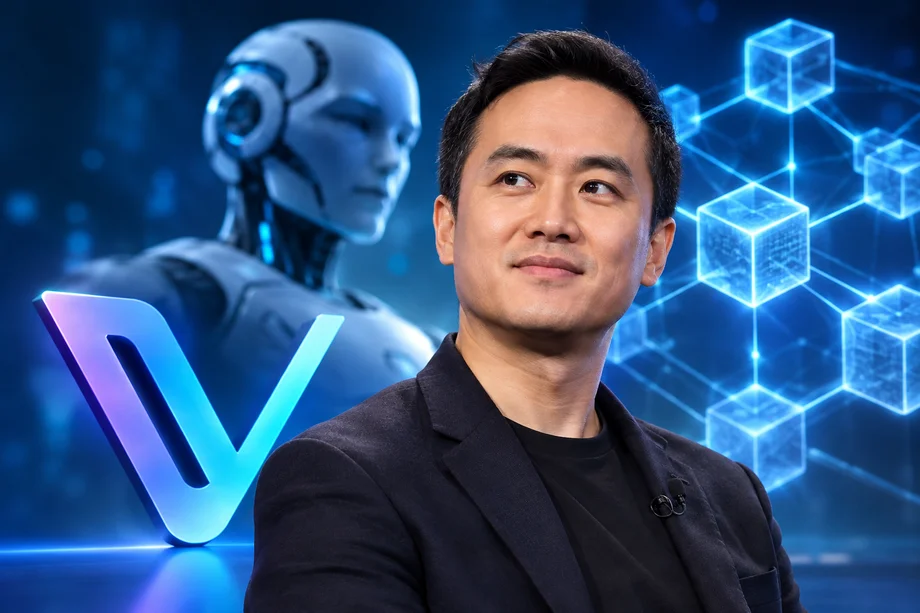
Sunny Lu argues always-on AI agents require identity and reputation systems on blockchain, citing digital passports and smart-contract settlement via VeWorld.ai
VeChain co-founder and CEO Sunny Lu has stated that blockchain technology offers the ideal foundation for establishing trust in autonomous artificial intelligence agents. Speaking during a recent industry discussion, Lu said agents that operate continuously without constant human oversight would create demand for verifiable identity and reputation mechanisms, potentially driving a new phase of blockchain adoption.
Lu described the need for a dedicated accountability framework as AI agents become more prevalent in everyday and commercial settings. He argued that public confidence depends on reliable ways to confirm an agent’s origin, track its performance history, and hold both the agent and its creator responsible for outcomes.
Identity, Reputation and On-Chain Accountability
In Lu’s model, AI agents would carry digital passports that function as persistent identifiers. These would sit inside a decentralized credibility system capable of recording and updating reputations for the agents themselves as well as the individuals or organizations that build them. The system would make performance data transparent and auditable over time.
Smart contracts would handle settlement of interactions. Whether an agent is exchanging value with another agent or completing a task for a human user, programmable rules on the blockchain could execute payments and enforce terms without relying on centralized intermediaries. Lu linked these concepts directly to VeWorld.ai, an agent-building platform that runs on the VeChain network.
VeChain has previously focused on enterprise applications such as supply-chain verification and food traceability. Lu’s comments frame AI agents as a logical extension of that work, shifting the same principles of independent verification and proof toward software entities that act independently.
Expanding Access Beyond Professional Developers
Beyond trust infrastructure, Lu highlighted an economic opportunity. He suggested that accessible agent-building tools could allow people without coding skills to package their specialized knowledge, local expertise or personal interests into commercial services. The comparison he drew was to the rise of mobile app stores, which enabled individual developers to reach global markets and monetize software.
Lu shared examples from his own experiments. He built an educational agent to assist his daughter, another to support his mother’s daily routine and recovery process, and a virtual employee that managed purchasing, inventory, sales and operations for an acquaintance’s retail shop in Milan. These cases illustrate how domain knowledge could be productized through agents rather than traditional software development.
Industry Caution on Provider Dependence
While Lu outlined a path toward greater accountability, other industry figures have flagged risks associated with heavy reliance on third-party agent platforms. Animoca Brands chairman Yat Siu has previously noted that crypto traders might deploy AI agents to operate continuously, yet users could find themselves dependent on services whose underlying models, updates or execution paths they do not control. Such dependence introduces operational and strategic vulnerabilities, particularly in high-stakes environments.
Lu’s vision of on-chain identity and reputation records aims to reduce opacity by making provenance and performance history publicly checkable. Whether these systems can scale reliably enough for broad institutional and consumer use remains an open question as agent platforms continue to mature.

Disclaimer
This article was generated by AI using information from multiple industry sources. It has not been reviewed or verified by a human editor and may contain inaccuracies, omissions, or misinformation. Readers are encouraged to independently verify any information before making decisions based on its content.Tired of the noise?
Let the bots trade for you.
Trade 24/7, without emotion, with data-driven strategies.
Associated articles
World Unveils Banking Identity Suite to Combat AI Fraud and Deepfakes

Four Firms Test AI Agents for Secure Crypto Payments Aimed at Japanese Tourists in South Korea

Coinbase CEO Argues AI Agents Will Boost Crypto Demand as Base Surpasses 100 Million Payments

Mastercard Sponsors XRP Ledger Hackathon in New York Targeting AI and Lending

Moonbeam Pivots to Base Network for AI Agent Infrastructure
Latest articles

Greece Passes 10% Crypto Gains Tax With €500 Annual Exemption

GOPAX Halts All Services After Hack Threat, Moves Assets to Cold Storage

Keel Infrastructure Dumps Entire Bitcoin Treasury for $192 Million as It Shifts to AI
Hyperliquid Strategies Applies for U.S. Futures Broker License to Access Onchain Perpetual Markets