Newsroom
US State Department Launches Freedom Tech Program With Bitcoin Policy Institute
25 July, 2026 / News / AI / Tags: freedom, institute, department, diplomatic, policy
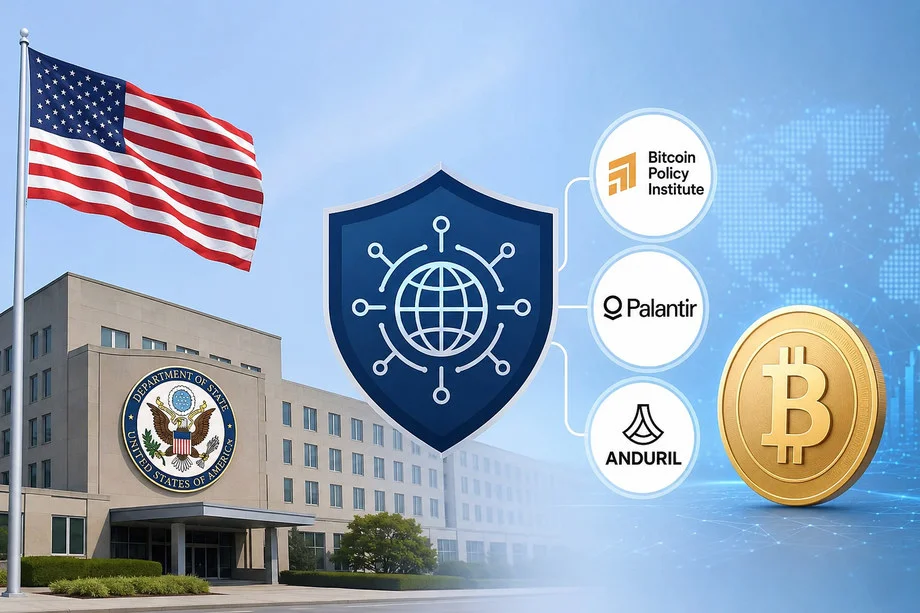
The Freedom Tech Excellence Program partners with the Bitcoin Policy Institute, Palantir, Anduril and others to advance global digital freedom through temporary private-sector secondments
The U.S. State Department has launched the Freedom Tech Excellence Program, a public-private initiative designed to strengthen diplomatic efforts on digital freedom and freedom of expression worldwide. Announced on Friday, the program names the Bitcoin Policy Institute as a founding partner alongside Palantir Technologies, Anduril Industries and the Victims of Communism Memorial Foundation.
Program Structure and Objectives
The Freedom Tech Excellence Program operates as a talent-exchange arrangement. Private-sector specialists will serve limited-term assignments inside the State Department while remaining employees of their home organizations. The arrangement is not intended as a route to permanent government employment. Participants will help shape responses to digital-freedom challenges by applying specialized knowledge in areas where the department may lack sufficient internal expertise.
Priority themes include safeguarding First Amendment principles and free expression in the digital age, countering unlawful digital surveillance and online fraud, advancing privacy-enhancing technologies such as strong encryption and virtual private networks, promoting responsible governance of emerging technologies including artificial intelligence, and protecting children and other users in online environments.
The State Department described the arrangement as mutually beneficial. Private-sector participants gain direct exposure to foreign-policy work and development issues, while the department gains access to technical skills in rapidly evolving domains.
Role of the Bitcoin Policy Institute
Founded in 2021, the Bitcoin Policy Institute describes itself as a non-profit, non-partisan think tank focused on research, education and engagement with policymakers on Bitcoin-related issues. Its inclusion signals growing recognition within parts of the U.S. government that decentralized payment systems can serve as practical tools for individuals facing censorship or restricted financial access in authoritarian settings.
The institute has long argued that open, permissionless networks can help dissidents, independent media and civil-society groups maintain operational capacity when traditional banking channels are constrained. By embedding its personnel, the program places that perspective inside formal diplomatic planning processes.
Broader Policy Context
The launch occurs against the backdrop of a more crypto-supportive stance adopted by the Trump administration. In March 2025, an executive order established a Strategic Bitcoin Reserve and a separate U.S. digital-asset stockpile. Those holdings were seeded with approximately 200,000 bitcoin previously acquired through criminal and civil forfeiture proceedings.
The order positioned bitcoin alongside other strategic assets the United States maintains, including gold, petroleum and pharmaceuticals. Under this framing, bitcoin is treated as a scarce national resource with potential relevance to financial sovereignty and resilience rather than solely as a speculative instrument.
Partners such as Palantir Technologies bring established capabilities in large-scale data analytics, while Anduril Industries contributes defense-technology expertise. The Victims of Communism Memorial Foundation, created by an Act of Congress in 1993, adds a human-rights advocacy dimension focused on authoritarian regimes.
Operational Implications
Program participants will concentrate on concrete diplomatic responses rather than pure research. Assignments are expected to address real-time challenges involving information flows, surveillance technologies and emerging artificial-intelligence standards as geopolitical competition in these domains intensifies.
How the resulting work product translates into specific diplomatic playbooks and international partnerships remains to be determined through the temporary secondments now underway. The initiative nonetheless marks a formal integration of Bitcoin-policy expertise into the State Department’s digital-freedom toolkit.


Disclaimer
This article was generated by AI using information from multiple industry sources. It has not been reviewed or verified by a human editor and may contain inaccuracies, omissions, or misinformation. Readers are encouraged to independently verify any information before making decisions based on its content.Tired of the noise?
Let the bots trade for you.
Trade 24/7, without emotion, with data-driven strategies.
Associated articles



Latest articles

SpaceX and Tesla Set Up Committees to Explore Merger That Would Combine Holdings of Over 30,000 Bitcoins

UK Banks Face Thousands of Complaints Over Crypto Transfer Restrictions

Ripple Backs SEC Proposed Crypto Asset Rules After $150 Million Legal Battle

Blockchain.com Introduces Options Trading on Seven Major Crypto Assets