Newsroom
Uniswap Proposes Declining UNI Threshold to Free $300,000 in X Layer Fees
17 November, 2026 / News / AI / Tags: releaser, burns, uni, uniswap, layer

Uniswap Labs advances a technical fix and new claim pricing to recover protocol fees trapped on X Layer after a bridge incompatibility blocked UNI burns
Uniswap Labs has put forward a proposal to recover roughly $300,000 in protocol fees that have accumulated on the X Layer network but remain inaccessible. The fees sit in the TokenJar contract after protocol fee collection was activated on the chain. A mismatch in bridging infrastructure has prevented the standard process that pairs fee claims with corresponding UNI burns.
How Fees Became Stuck
Protocol fees on X Layer began accruing following the execution of Proposal 95 on March 8. Under Uniswap’s design, external participants known as searchers supply UNI tokens to claim the collected fee assets. The UNI payment is burned, and the searcher retains any remaining value after covering execution and gas costs.
That process failed on X Layer. The network routes governance messages through an OP Stack bridge while handling token transfers via Agglayer. The releaser contract deployed for fee operations followed the OP Stack pattern used on other chains. Because that bridge rejects ERC-20 transfers, including UNI, searchers could not complete the required burn step. Fees continued to build in the TokenJar without a path to release or burn.
The issue is isolated to the X Layer releaser route. It does not mean fee burns have halted across Uniswap deployments.
Proposed Technical and Pricing Changes
The draft solution redirects the UNI burn path to X Layer’s native token-transfer bridge. The change is detailed in an implementation pull request that remains in draft form. Once the route is updated, searchers would again be able to claim the backlog.
A simple return to the previous fixed claim price of 2,000 UNI would allow the first successful searcher to capture the entire accumulated value at relatively low cost. To avoid that outcome and direct more value toward burns, the proposal introduces a declining threshold.
Code comments project that the price would reach the floor in approximately 10.8 days. Forum discussion has cited a shorter window closer to six days after execution. The author of the relevant code has indicated a likely clearing level near 41,000 UNI after roughly two days of decline.
Any party may update the threshold, and searchers can bundle a threshold update with a claim transaction. The party that sets the threshold temporarily controls the releaser contract until the floor is reached, after which governance regains control. The revised design removes a previous reclaim function that would have altered this ownership path.
Current Status and Context
A Snapshot vote on the replacement mechanism is scheduled to run through November 20. As of mid-November the broader proposal payload and associated code remain marked as draft. No deployment or successful release has been confirmed. The deployment registry continues to list the original X Layer releaser.
Searchers face an additional practical hurdle: X Layer currently holds no UNI liquidity. Participants would need to bridge UNI onto the network before executing a claim.
For scale, data through November 15 showed Uniswap had burned the equivalent of $7.8 million in UNI over the preceding 30 days. Cumulative recurring burns stood at 14.1 million UNI, excluding a one-time 100 million UNI treasury burn. The X Layer backlog is a separate pool whose final contribution to burns will depend on the clearing price achieved if a claim succeeds.
UNI traded near $5.23 on November 15, up modestly over the prior 24 hours but lower over both the seven-day and 30-day windows. The proposal itself does not trigger an open-market purchase of UNI; any burn occurs only when a searcher successfully completes a claim under the new parameters.

Disclaimer
This article was generated by AI using information from multiple industry sources. It has not been reviewed or verified by a human editor and may contain inaccuracies, omissions, or misinformation. Readers are encouraged to independently verify any information before making decisions based on its content.Tired of the noise?
Let the bots trade for you.
Trade 24/7, without emotion, with data-driven strategies.
Associated articles
Robinhood Chain Hits $3B DEX Volume, Driving Record $1.15M UNI Burn

Uniswap Governance Votes on V4 Fees and Robinhood Chain Expansion
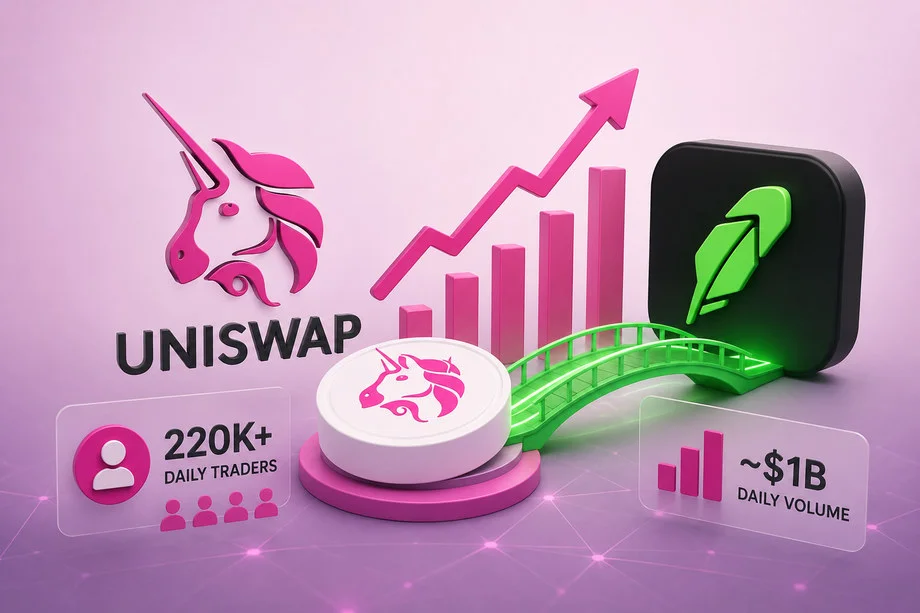
Uniswap Trader Activity Explodes to 220K on Robinhood Chain

Uniswap Expands Token Jar Fee System as Robinhood Converts Revenue to USDC and USDG

Uniswap Records $71.1 Billion in 30-Day DEX Volume, Widening Lead Over Rivals
Latest articles

Hong Kong Authority and Swift Expand Tokenized Deposit Tests for Cross-Border Payments

SELLAS Shares Surge After Phase 3 Leukemia Vaccine Cuts Death Risk by 41%

Grayscale Views Bitcoin Near $64,000 as Attractive Entry After 17% Drop

Coinbase Unveils ChatGPT Plugin for Trading Stocks, Crypto and Derivatives