Newsroom
Uniswap Expands Token Jar Fee System as Robinhood Converts Revenue to USDC and USDG
1 November, 2026 / News / AI / Tags: tjar, jar, uniswap, payout, robinhood

Uniswap Labs has opened its Token Jar infrastructure to third-party applications, enabling automated conversion of multi-token fees. Robinhood is already using the system to receive payouts in stablecoins across supported chains, following more than $15.3 million in conversions processed in October
Uniswap Labs has made its Token Jar, or TJAR, framework available beyond its own protocol, allowing external applications to convert fees collected in varied tokens into a single preferred asset. The system, introduced on October 29, lets projects deposit fee proceeds into a jar and designate the desired payout token without constructing separate conversion pipelines for each chain or asset.
Searchers compete to supply the requested payout token in exchange for the assets accumulated in the jar. They retain any difference remaining after covering execution costs. Operators retain control over conversion thresholds and the destination of funds, which can include a treasury, a bridge, or another specified address.
Scale of Recent Conversions
Uniswap reported that its original protocol-fee conversion system processed more than $15.3 million in assets during October. TJAR builds on that foundation and is now positioned as reusable infrastructure for any application collecting fees across multiple tokens.
The framework operates on seven chains. Its design separates the act of collecting diverse fee tokens from the choice of final payout currency, reducing operational complexity for wallets, exchanges, and payment platforms that previously managed fragmented holdings.
Robinhood Integration
Robinhood has begun using TJAR through the Uniswap API. The brokerage platform converts fees collected on supported networks into USDC and USDG. This arrangement allows Robinhood to standardize its fee revenue in stablecoins rather than managing a mix of individual tokens.
The integration demonstrates how established financial platforms can leverage decentralized infrastructure for routine treasury functions. By specifying stable payout tokens, applications gain greater predictability in accounting and cash-flow management.
Operational Mechanics and Considerations
TJAR functions as an open offer. A searcher deposits the required amount of the designated payout token, claims the jar’s contents, and absorbs the spread after costs. Competition among searchers does not remove execution expenses, market risk, or the effects of limited liquidity in the deposited assets.
Operators must set thresholds carefully. An overly permissive threshold can result in conversions that deliver less value than expected. Limited liquidity in certain tokens may also reduce searcher participation, affecting settlement reliability.
Additional factors that influence performance include gas costs, oracle accuracy for pricing, permission controls, and incident response procedures. These elements determine whether an integration remains efficient under varying market conditions.
Broader Context for Developers and Operators
Fee income in decentralized applications often arrives in long-tail or less liquid tokens. TJAR addresses this fragmentation by centralizing conversion into a single, operator-chosen asset. The system does not dictate who ultimately benefits from the revenue; that outcome depends on how each application configures its payout destination and incentives.
Metrics that will indicate the framework’s practical reach include the number of third-party integrations, the volume of conversions completed, the range of supported networks, and the consistency of execution quality. Transparent reporting of these figures will provide a clearer picture of adoption over time.
Uniswap Labs has positioned TJAR as shared infrastructure rather than a protocol-specific feature. Its availability to external developers marks a shift toward standardized tools that handle routine but operationally complex tasks in fee collection and treasury management.


Disclaimer
This article was generated by AI using information from multiple industry sources. It has not been reviewed or verified by a human editor and may contain inaccuracies, omissions, or misinformation. Readers are encouraged to independently verify any information before making decisions based on its content.Tired of the noise?
Let the bots trade for you.
Trade 24/7, without emotion, with data-driven strategies.
Associated articles
Pons Surges to $5.95M Daily Fees on Robinhood Chain as Uniswap Labs Acquires Token Stake
Robinhood Chain Hits $3B DEX Volume, Driving Record $1.15M UNI Burn

Uniswap Records $71.1 Billion in 30-Day DEX Volume, Widening Lead Over Rivals
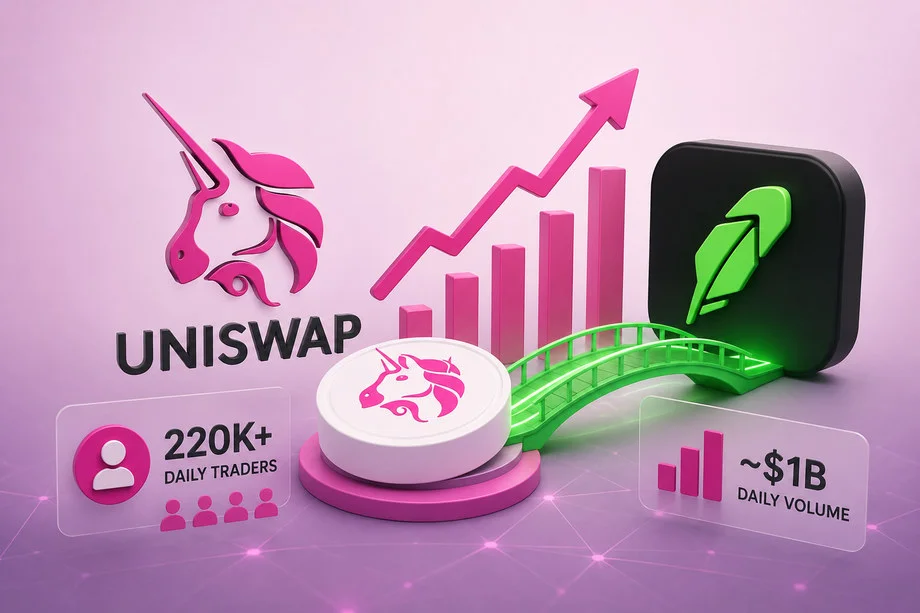
Uniswap Trader Activity Explodes to 220K on Robinhood Chain

Robinhood Chain Nears $1 Billion TVL Through Uniswap Liquidity Integration
Latest articles

OneKey Founder Warns Against Storing Crypto Seed Phrases on Older iPhones

FBI Attributes Record $6.3 Billion Binance Crypto Theft to North Korean Hackers
Binance Moves $581 Million in Bitcoin From SAFU Fund as Asset Recovery Hits 90%

Major USDT Transfers Hit Binance and Coinbase on November 1