Newsroom
Uniswap Labs Activates Aggregator Hooks on Ethereum, Base and Robinhood Chain
22 October, 2026 / News / AI / Tags: uniswap, hooks, aggregator, hook, external
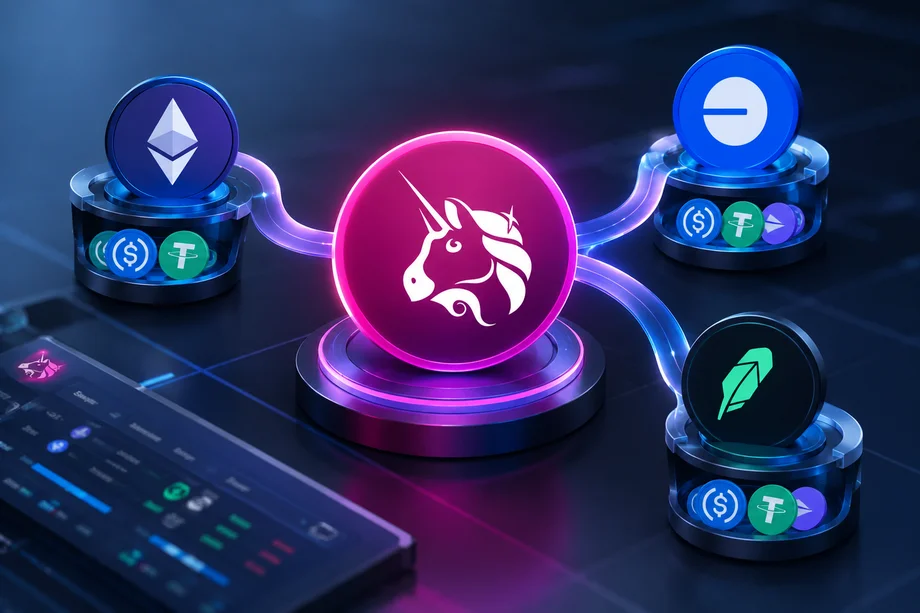
Uniswap v4 now routes trades across external liquidity sources in a single transaction, with protocol fees directed to UNI burns
Uniswap Labs has activated Aggregator Hooks for Uniswap v4 on Ethereum mainnet, Base and Robinhood Chain. The feature wraps external decentralized exchange liquidity so that it appears as native Uniswap pools, allowing the protocol to compare and execute routes across its own pools and outside venues without requiring users to leave the interface.
The update is available through the Uniswap web application and API. Swaps originating in a v4 pool can now draw on liquidity from supported external platforms rather than relying solely on Uniswap-held reserves. Seven external sources are live at launch and together account for more than 90 percent of decentralized exchange activity on the three networks.
How Aggregator Hooks Operate
Hooks in Uniswap v4 are smart contracts attached to liquidity pools that customize pool behavior. Aggregator Hooks specifically present external liquidity sources as standard v4 pools. Any router therefore treats those sources as native Uniswap pools when constructing a trade path.
Every block the router obtains fresh price quotes from the connected venues and assembles the most efficient route that may combine Uniswap pools with external liquidity. The entire path settles in one transaction and requires no additional token approvals from the user.
Supported venues named in developer documentation include Curve, Fluid, PancakeSwap V3 and Slipstream, together with forks of Uniswap V2 and Uniswap V3. The web application automatically incorporates these sources when calculating routes. Developers access the same capability through the Uniswap API.
Protocol Fees and UNI Token Burns
Trades that execute against external liquidity remain subject to Uniswap protocol fees. Proceeds from those fees contribute to the burning of UNI tokens. Uniswap Labs states that the protocol has facilitated more than $4.5 trillion in cumulative trading volume to date.
By bringing routing decisions into the protocol layer, Aggregator Hooks perform a function previously handled by independent aggregators that compare venues and select execution paths. Large orders gain access to deeper combined liquidity, which can reduce slippage in thinner markets.
Rollout Timeline and Network Focus
Developer documentation describes the Aggregator Hooks as production-ready as of late October 2026. The release follows the UNIfication proposal outlined in November 2025, which framed the evolution of v4 into an aggregator. An earlier Aggregator Hook appeared in March 2026 on Tempo, the payments-focused chain developed by Stripe and Paradigm; that deployment was limited to the web application.
Robinhood Chain, which launched in July 2026, has recorded substantial Uniswap activity and high rates of hook adoption. At periods the network has accounted for more than half of certain Uniswap trading-volume measures. Uniswap Labs has indicated plans to extend Aggregator Hook support to additional blockchains.
The modular design of v4 already includes other specialized hooks such as those for permissioned pools and dynamic fees. Aggregator Hooks expand that toolkit by integrating external liquidity directly into the protocol’s routing logic.
Users interacting through the Uniswap web application encounter the expanded routing automatically. Developers building on the API can select routes that incorporate the new hooks, ensuring that both retail and programmatic trading benefit from the broader liquidity base.

Disclaimer
This article was generated by AI using information from multiple industry sources. It has not been reviewed or verified by a human editor and may contain inaccuracies, omissions, or misinformation. Readers are encouraged to independently verify any information before making decisions based on its content.Tired of the noise?
Let the bots trade for you.
Trade 24/7, without emotion, with data-driven strategies.
Associated articles

Uniswap Labs Rolls Out StablePair Hook for Dynamic Fees on Stablecoin Pools

Uniswap Governance Votes on V4 Fees and Robinhood Chain Expansion

Uniswap Records $71.1 Billion in 30-Day DEX Volume, Widening Lead Over Rivals

Uniswap Labs Rolls Out Permissioned Pools on v4 for Regulated Asset Trading

SMBC Nikko Partners with Uniswap on Japan DeFi Gateway for Mid-2027
Latest articles
CoinDCX Confirms Losses After Suspicious $16M Transfers From 2025 Hack Wallets

Robinhood Secures Dubai License for Crypto and Stock Trading, Middle East Launch Delayed to 2027

CZ Warns Crypto Users Over Two Critical PHP Vulnerabilities

Bybit Fintech FZE Receives VARA Licence for Dubai Spot Trading