Newsroom
UK Regulators Target Unregistered Peer-to-Peer Crypto Trading Sites in London
17 September, 2026 / News / AI / Tags: peer, fca, unregistered, laundering, metropolitan
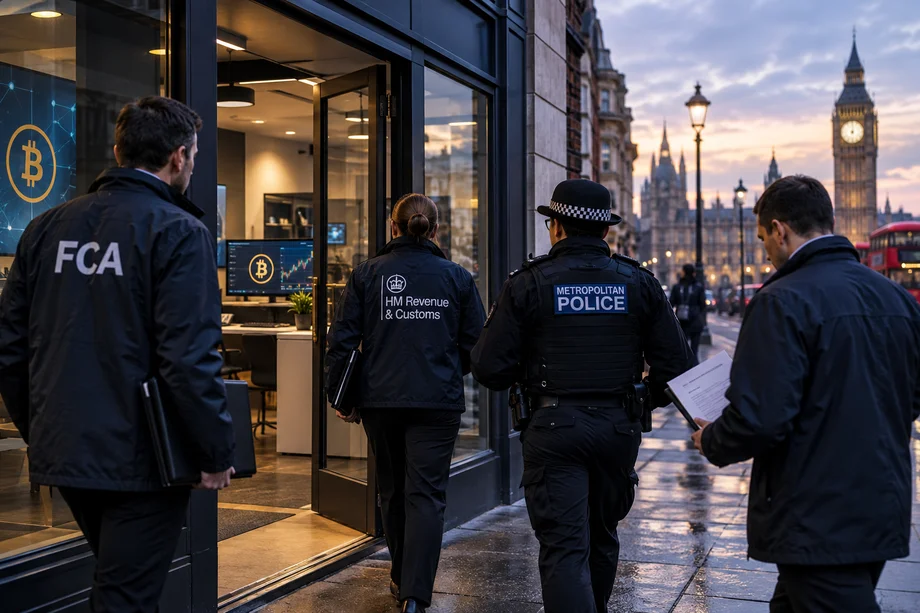
FCA, HMRC and Metropolitan Police issue cease-and-desist orders at three premises as enforcement intensifies ahead of 2027 crypto rules
Britain’s Financial Conduct Authority, working with HM Revenue & Customs and the Metropolitan Police, carried out a joint operation on September 10 against three London locations suspected of running unregistered peer-to-peer cryptocurrency trading businesses. Officials issued cease-and-desist orders requiring the operators to stop the activity immediately. No arrests were reported.
Peer-to-peer crypto trading, in which individuals buy and sell digital assets directly with one another as a business, requires registration with the FCA under anti-money laundering rules. The regulator stated that no peer-to-peer crypto businesses are currently registered anywhere in the United Kingdom. Operators working outside the regime therefore avoid the controls designed to detect and prevent money laundering.
Second Enforcement Sweep This Year
The September action marks the second coordinated operation of its kind in 2026. In April, the FCA, HMRC and the South West Regional Organised Crime Unit inspected eight sites in London, serving similar notices and gathering evidence that is now supporting ongoing criminal investigations and further regulatory steps.
Both operations were conducted under the Money Laundering, Terrorist Financing and Transfer of Funds (Information on the Payer) Regulations 2017. The FCA has regulated crypto businesses for anti-money laundering compliance since 2020. Officials have previously secured convictions in related cases, including a four-year prison sentence for an individual who ran an unregistered crypto ATM network that processed transactions valued at approximately $3.4 million between December 2021 and September 2023. Two other people have also been detained in connection with a suspected illegal crypto exchange.
Detective Sergeant Sathish Alalasundaram of the Metropolitan Police noted the practical difficulties posed by the speed at which funds can move across jurisdictions and the complexity of crypto assets, adding that investigators are adapting their tactics as criminal methods evolve.
Path Toward Full Crypto Regulation
The crackdown comes as the United Kingdom prepares a comprehensive cryptoasset regime. Detailed guidance clarifying which activities fall within the regulatory perimeter was published recently. Covered activities include issuing qualifying stablecoins, operating crypto exchanges, dealing in cryptoassets, safeguarding digital assets and staking.
Firms may apply for FCA authorization between September 30, 2026, and February 28, 2027. The full framework is scheduled to take effect on October 25, 2027. Registration under the current money-laundering rules will not automatically confer authorization under the new regime. In the interim, businesses must continue to meet existing anti-money laundering and financial promotion obligations.
Consumers are advised to check whether any crypto firm is properly registered by using the FCA’s Firm Checker tool before engaging with it. Legal observers have described the successive operations as evidence that the previous lighter-touch approach to crypto oversight is giving way to active disruption of unregistered activity, with criminal liability remaining a risk for operators trading by way of business without the required registration.
Disclaimer
This article was generated by AI using information from multiple industry sources. It has not been reviewed or verified by a human editor and may contain inaccuracies, omissions, or misinformation. Readers are encouraged to independently verify any information before making decisions based on its content.Tired of the noise?
Let the bots trade for you.
Trade 24/7, without emotion, with data-driven strategies.
Associated articles

Robinhood Gains UK Crypto Registration Ahead of 2027 Regulatory Overhaul
UK Opens Crypto Authorization Window as FCA Prepares 2027 Regime

UK FCA Issues Crypto Authorization Guidance Ahead of 2027 Regime as Government Funds Anti-Laundering Drive

Binance Prepares FCA License Bid to Resume UK Services by 2027

South Korea Lawmakers Advance Bill Expanding FIU Powers Against Unregistered Crypto Operators
Latest articles

Litecoin Marks 15 Years of Network Uptime as Grayscale Targets ETF Listing on NYSE Arca

Securitize Brings Major U.S. Stocks to Solana for Eligible Investors

Tikcoin Network Delays TIK Listing to December 12 After October Target Misses

Vitalik Buterin Urges Caution on Crypto Wallet Migrations Amid AI Cryptographic Threats