Newsroom
UK Appoints Six Banks to Lead First Digitally Native Government Bond Pilot
7 October, 2026 / News / AI / Tags: government, hsbc, pilot, settlement, bonds
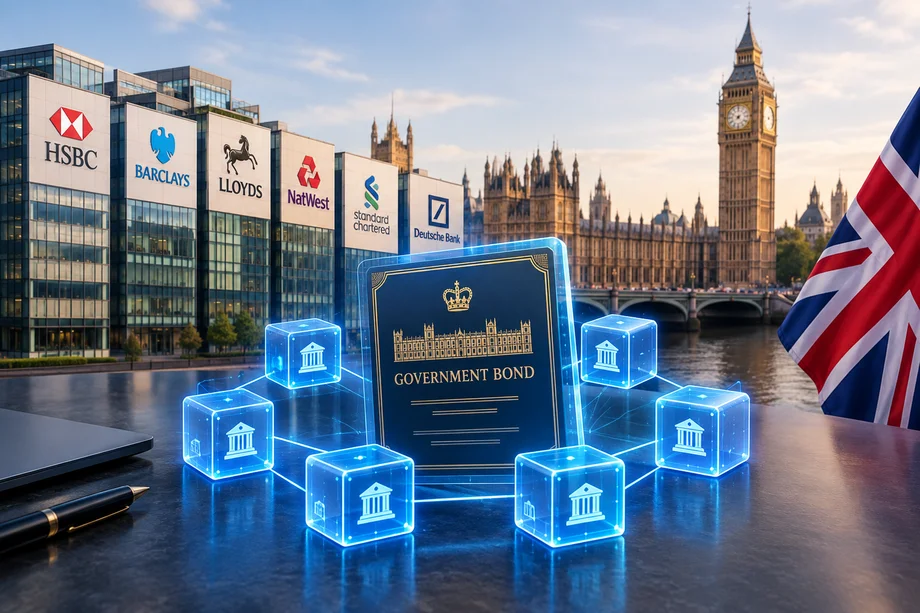
HM Treasury selects Barclays, HSBC, Lloyds, Morgan Stanley, NatWest and RBC Capital Markets as joint lead managers for the DIGIT issuance planned for early 2027
The UK government has named six major banks to act as joint lead managers for its first digitally native sovereign bond, known as the Digital Gilt Instrument or DIGIT. Economic Secretary to the Treasury Lucy Rigby announced the appointments on October 6 during a keynote address at UK Digital Assets Week, following a competitive procurement process.
The banks—Barclays, HSBC, Lloyds Banking Group, Morgan Stanley, NatWest and RBC Capital Markets—will handle underwriting, investor engagement and distribution for the pilot. The selection enables investor discussions to begin ahead of the planned issuance.
Pilot Design and Timeline
DIGIT is designed as a short-dated bond issued directly on digital infrastructure within the UK’s Digital Securities Sandbox. The instrument will use distributed ledger technology across its full lifecycle, including onchain settlement. It will operate independently of the government’s main debt management programme.
Issuance is targeted for the first quarter of 2027. The government intends to list DIGIT as the first digital asset on the London Stock Exchange Group’s main market. Preparations for possible further issuances will depend on the outcome of the initial transaction.
HSBC was appointed as the distributed ledger technology supplier for the pilot in February. In July, HSBC and the London Stock Exchange Group signed a memorandum of understanding to develop a bilateral digital securities depository link. This connection is intended to allow investors to access the instrument through either infrastructure. HSBC became the first firm approved to operate a live digital securities depository in the sandbox in July, with ClearToken later receiving similar approval.
The government plans to introduce secondary legislation in the coming months to support digital services and issuances within the sandbox.
Infrastructure and Integration Challenges
The pilot aims to examine whether distributed ledger technology can shorten settlement times, reduce reconciliation work and lower operating costs in sovereign debt markets. Bank of England Governor Andrew Bailey has indicated the central bank would work toward accepting DIGIT as collateral in its market operations.
Industry participants have noted that successful onchain settlement will require links to cash, custody and existing settlement systems. Common standards and legal certainty are viewed as essential to keep lifecycle events consistent across platforms.
Building these connections from the start could help determine whether tokenization improves liquidity and market efficiency without creating separate digital systems.
Marius Jurgilas, CEO of Axiology and a former central banker, observed that linking issuance, distribution, trading and settlement through regulated infrastructure could broaden the investor base and create additional funding options. Government support may help establish foundations for markets in which capital moves more readily between countries and reaches a wider range of issuers.
Broader Market Context
DIGIT differs from most existing tokenized government bonds, which typically use wrapper structures that keep the underlying asset in traditional systems while providing digital claims. The UK instrument is structured as a native digital issuance with no intermediaries.
Tokenized government bonds currently represent a small portion of the global market. Data from the Bank for International Settlements has identified more than 60 such bonds with a combined value of about $8 billion, against a total global government bond market exceeding $80 trillion. Average bid-ask spreads for tokenized bonds have been reported at around 19 basis points compared with roughly 30 basis points for traditional counterparts, with issuance costs found to be similar.
Separately, tokenized US money-market and Treasury funds reached $14.2 billion in June 2026, up from $1.7 billion two years earlier, according to analytics data. Tokenized wrappers of Treasury and government bonds accounted for a large share of that total.
The DIGIT pilot forms part of wider UK efforts on financial tokenization and sits alongside ongoing work between UK and US authorities on common approaches to tokenized securities, settlement finality and related issues.
Disclaimer
This article was generated by AI using information from multiple industry sources. It has not been reviewed or verified by a human editor and may contain inaccuracies, omissions, or misinformation. Readers are encouraged to independently verify any information before making decisions based on its content.Tired of the noise?
Let the bots trade for you.
Trade 24/7, without emotion, with data-driven strategies.
Associated articles

South Korea Sets February 2027 Start for Tokenized Stocks, Bonds and Funds

India Launches Tokenized Corporate Bond Pilot With Digital Rupee Settlement

Malaysia Central Bank Unveils Tokenized Bond Platform Enabling Round-the-Clock Settlement

Itaú Unibanco Joins Brazil Pilot to Tokenize Bonds and Investment Funds

MUFG Advances Blockchain Trial for Real-Time Japanese Government Bond Repo Settlement
Latest articles

Zcash Co-Founder Proposes Redirecting 8% of Block Subsidies to Network Reserve

Bitcoin Monte Carlo Simulations Point to Median Value of $1.03 Million in 2033

S&P Global Completes Acquisition of OpenZeppelin Smart Contract Security Firm

Franklin Templeton Files Two ETFs to Convert US Stock Dividends into Bitcoin