Newsroom
South Korea Sets February 2027 Start for Tokenized Stocks, Bonds and Funds
4 September, 2026 / News / AI / Tags: securities, korea, tokenized, phase, bonds
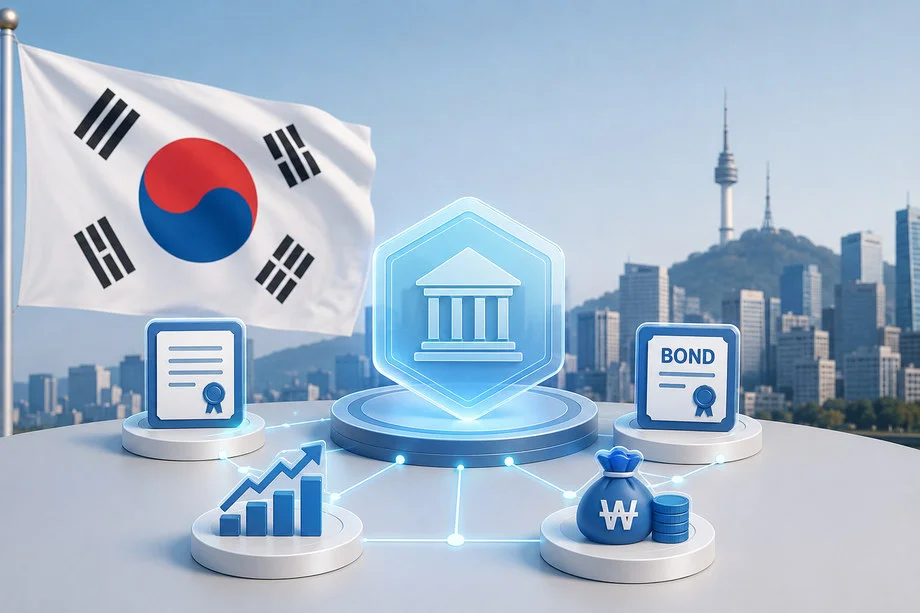
Regulators detail a three-phase plan to move traditional securities onto distributed ledgers, culminating in stablecoin-linked on-chain settlement
South Korea’s Financial Services Commission has published a phased roadmap to expand tokenized securities beyond fractional investment products, with legal recognition scheduled to begin on February 4, 2027. The framework will eventually cover stocks, bonds and funds and aim for full digital capital market infrastructure.
The plan follows amendments to the Electronic Securities Act and Capital Markets Act approved by the National Assembly in January 2026. Those changes establish distributed ledgers as valid securities registries while keeping the instruments under existing capital markets rules rather than crypto-asset regulations.
Three-Phase Implementation Schedule
Phase one launches on February 4, 2027. It covers institutional money market funds, private bonds, unlisted stocks structured through trusts, and publicly offered fractional investment securities. Brokers participating in the initial stage must establish distributed ledger systems connected to the Korea Securities Depository.
Phase two will extend tokenization to all publicly offered securities. Authorities have not fixed a start date. Timing will depend on the operational stability of the first phase, technology readiness among market participants, and progress on stablecoin legislation.
Phase three focuses on building on-chain payment infrastructure linked to stablecoins. This would allow simultaneous settlement of securities and cash legs on the same ledger, potentially reducing traditional T+1 or T+2 cycles. The schedule for this final stage remains contingent on earlier results and pending digital asset legislation.
Licensing, Capital and Retail Safeguards
Existing licensed financial investment companies will be permitted to handle tokenized securities under their current authorizations. No separate license will be required solely for tokenization activities. Intermediaries operating on over-the-counter markets will need prior consultation with the Financial Supervisory Service.
Issuers that choose to manage their own securities accounts must meet higher thresholds. They are required to maintain at least 4 billion won, approximately $3 million, in equity capital. Additional conditions include dedicated staff for account management and internal controls, two employees assigned to computer and IT systems, and compliance with specified cybersecurity and technology standards.
Retail investor protections include subscription limits. For non-monetary trust beneficiary certificates, the maximum individual subscription is the lower of 30 million won, roughly $22,000, or 5 percent of the total issuance volume. Annual net purchases on over-the-counter platforms are capped at 100 million won, about $74,000, per platform.
Infrastructure and Next Regulatory Steps
The Financial Services Commission will propose revisions to subordinate regulations by the end of September 2026. These detailed rules will govern practical aspects of issuance, transfer and compliance. Before the roadmap begins, the commission plans to collaborate with the Korea Securities Depository on the necessary tokenization infrastructure, including systems for issuance, circulation checks, rights management and monitoring.
Market participants are already preparing. The Korea Exchange subsidiary Koscom is developing the KoSTO shared tokenized securities platform with participation from 12 securities firms. Samsung SDS has been contracted to build a token securities platform for the Korea Securities Depository. Separate private-sector initiatives include trials of tokenized funds and earlier pilots involving tokenized government bond settlement.
Tokenized securities will be treated as securities under capital markets law rather than as crypto assets. This classification places them outside the planned 22 percent crypto tax regime scheduled for 2027 and is expected to facilitate participation by institutional investors, pension funds and insurers.
The third phase of the roadmap depends in part on separate legislation covering stablecoins. The Digital Asset Framework Act remains under discussion, with differences between the Financial Services Commission and the Bank of Korea over governance still unresolved. Parallel efforts elsewhere in Asia, including Japan’s longer-term plans for blockchain settlement of stocks and government bonds, indicate regional movement toward digital capital market systems.
Disclaimer
This article was generated by AI using information from multiple industry sources. It has not been reviewed or verified by a human editor and may contain inaccuracies, omissions, or misinformation. Readers are encouraged to independently verify any information before making decisions based on its content.Tired of the noise?
Let the bots trade for you.
Trade 24/7, without emotion, with data-driven strategies.
Associated articles

Hanwha Completes Avalanche-Supported Tokenized Securities Platform Ahead of South Korea Rules

South Korea Prepares Tokenized Stocks, Bonds and Funds for 2027 Launch

Securitize Partners with LG CNS on Tokenized Assets as South Korea Prepares 2027 Framework
UK Appoints Six Banks to Lead First Digitally Native Government Bond Pilot

Itaú Unibanco Joins Brazil Pilot to Tokenize Bonds and Investment Funds
Latest articles
SkyAI Exits Solana Holdings Completely, Launches $201 Million Share Buyback

Strategy Buys 267 Bitcoin and Raises Preferred Share Buyback Cap to $3 Billion
Dormant 2013 Bitcoin Wallets Shift Over $67 Million After More Than a Decade

Binance Rolls Out AI Pro Tool for Chat-Based Automated Trading Strategies