Newsroom
Taiwan Curbs Short Selling and Activates $15 Billion Fund After Stocks Plunge
8 November, 2026 / News / AI / Tags: taiwan, stabilization, index, nov, ceiling
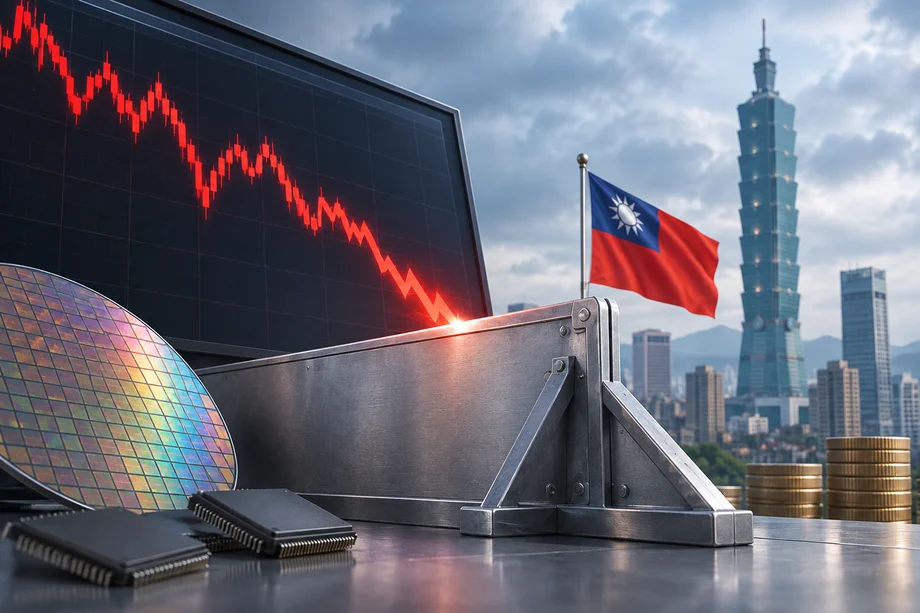
Regulators impose tight limits on borrowed-share sales starting Nov. 9 after the benchmark index entered a bear market on a sharp AI-driven decline
Taiwan’s financial authorities moved quickly over the weekend to stabilize markets after the island’s benchmark stock index suffered one of its steepest drops in decades. The index tumbled as much as 9 percent on Friday, Nov. 6, closing in bear-market territory and posting its largest weekly decline since 2001.
The selloff was concentrated in technology and artificial-intelligence linked shares. Taiwan’s market is heavily weighted toward semiconductors and maintains close ties to the Philadelphia Semiconductor Index. Officials also pointed to broader pressure from declines in U.S. and Asian equities following the U.S. midterm elections and sustained foreign selling.
Scale of the Market Decline
On Nov. 6 the benchmark index fell 1,873.08 points to finish at 39,701.64. It dropped 3,737.67 points in the opening minute of trading. Across the five sessions from Nov. 2 through Nov. 6 the index lost 5,510 points, a weekly decline of 12.19 percent.
The rapid deterioration prompted coordinated action from the Financial Supervisory Commission and the National Financial Stabilization Fund.
New Restrictions on Short Selling
The Financial Supervisory Commission announced that short-sale limits will take effect on Monday, Nov. 9. Orders to sell borrowed shares on the same day will be capped at 3 percent of each stock’s average daily trading volume over the previous 30 business days. The previous limit stood at 30 percent.
The rule applies a separate ceiling to every individual stock based on its own recent turnover rather than a uniform market-wide figure. Broker sales used to hedge warrants or exchange-traded notes, or to fulfill market-making obligations, remain exempt.
In addition, the minimum margin requirement for short sales of listed and over-the-counter securities will rise to 130 percent from 90 percent. Investors will be allowed to post a wider range of collateral subject to approval by a securities finance company or brokerage.
Stabilization Fund Activated for Tenth Time
Taiwan’s National Financial Stabilization Fund authorized its tenth market intervention, empowering the fund’s executive secretary to deploy up to 500 billion New Taiwan dollars, equivalent to roughly $15 billion, as conditions require. The authorization establishes a ceiling rather than a firm commitment to spend the full amount. No specific purchase schedule or initial deployment size was disclosed.
A previous intervention under the same 500-billion-dollar ceiling in April 2025 ultimately used about 12.25 billion New Taiwan dollars.
The combination of tighter short-sale rules and the availability of substantial stabilization capital is intended to restore order after the technology-heavy market’s abrupt reversal. The short-sale restrictions become effective at the open of trading on Nov. 9.
Disclaimer
This article was generated by AI using information from multiple industry sources. It has not been reviewed or verified by a human editor and may contain inaccuracies, omissions, or misinformation. Readers are encouraged to independently verify any information before making decisions based on its content.Tired of the noise?
Let the bots trade for you.
Trade 24/7, without emotion, with data-driven strategies.
Associated articles

KOSPI Drops 3.65% as Chip Stocks Plunge on AI Bubble Concerns

Arthur Hayes Sells 2,364 ETH for $4.3 Million at $241,000 Loss Amid Market Decline
SpaceX Stock Rebounds From Record Low as Earnings and $104 Billion Share Unlock Loom

Crypto Fear and Greed Index Surges to 62 as Bitcoin Rally Sparks Sharp Sentiment Shift
Crypto Sentiment Swings to Extreme Greed as Bitcoin Rally Gains Pace
Latest articles

Nvidia Board Launches Probe Into CEO Jensen Huang Over Foreign Intelligence Reports
Binance Restores HYPE and APT Withdrawals in Phased Post-Breach Recovery

Keplr Suspends Social Logins After Web3Auth Breach Triggers Millions in Cosmos Transfers

Vitalik Buterin Urges Ethereum Community to Value ETH as Store of Value Over Fee Burns