Newsroom
Crypto Sentiment Swings to Extreme Greed as Bitcoin Rally Gains Pace
26 August, 2026 / News / AI / Tags: greed, bitcoin, highs, extreme, index
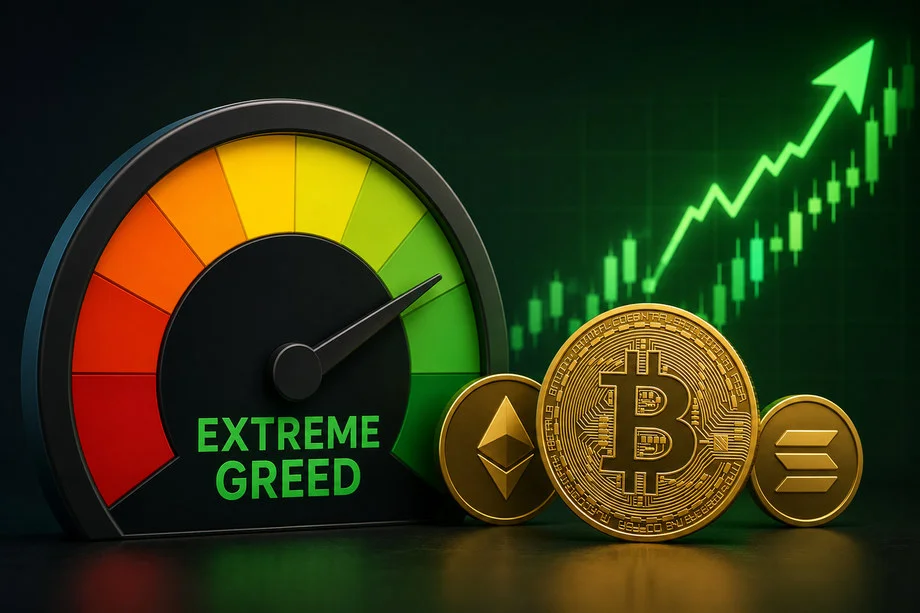
Market mood gauge climbs to multi-month highs after rapid Bitcoin gains, short liquidations and shifting Treasury policy signals, though caution flags remain
Cryptocurrency market sentiment has shifted sharply into extreme greed territory for the first time since late 2024, according to a widely followed gauge, as Bitcoin staged a powerful weekly advance that lifted prices near the $80,000 mark and drew in speculative capital across the sector.
The CoinMarketCap Crypto Fear and Greed Index reached 81 on Sunday and held near that level into the start of the week, crossing the 80 threshold that defines extreme greed. The reading marks the highest level since December 17, 2024, a span of more than 600 days. Just one month earlier the index stood at 36 in fear territory, while a week prior it registered 41. Its 2026 low of 5 occurred on February 5, illustrating a full swing from deep capitulation to aggressive optimism in under seven months.
A separate version of the index registered 74 on Tuesday after sitting at 27 on August 12, before easing to 65 the following day. That Tuesday peak represented the highest mark since early October 2025, five days before a major sell-off that triggered roughly $19 billion in leveraged liquidations in a single session, still the largest such event on record. Alternative trackers have placed the mood in greed rather than extreme greed, reflecting modest methodological differences, yet both show the same rapid directional change.
Bitcoin Leads Broad Market Advance
Bitcoin rose approximately 22 to 24 percent over seven days, climbing from levels below $68,000 last week to approach and briefly exceed $80,000 for the first time in more than three months. The cryptocurrency accounted for nearly 60 percent of total crypto market value during the move, outpacing the broader sector. Total market capitalization expanded by more than 20 percent on a weekly basis at its peak, though trading volumes later softened.
Gains extended beyond Bitcoin. Several major tokens posted advances of up to 70 percent, while smaller and more speculative assets moved even more aggressively. Dogecoin advanced about 24 percent over the week. Thinly traded memecoins recorded steeper climbs, with some rising more than 100 percent as capital rotated into higher-risk names.
The advance was accompanied by a surge in derivatives activity. Roughly $3 billion in short positions were liquidated in a short period, with estimates for the full multi-day squeeze exceeding $4 billion. Funding rates for leveraged long positions climbed to multi-month highs, indicating increased reliance on borrowed capital. Spot Bitcoin exchange-traded funds recorded consecutive days of strong inflows, including hundreds of millions of dollars on individual sessions, adding institutional demand alongside the forced covering of shorts.
Treasury Policy Shift and Macro Backdrop
Market participants linked the timing of the rally to an announcement from the U.S. Treasury Department. Officials said the size of long-duration bond buyback operations would at least double to a minimum of $4 billion per operation, beginning September 9. The program is intended to support liquidity in longer-dated government securities. Although the expanded purchases have not yet begun, the signal contributed to a decline in long-term yields from recent multi-year highs and a softer dollar, conditions that historically support risk assets.
Additional factors included a weaker U.S. dollar index, which touched a three-month low, and renewed discussion around clearer regulatory frameworks for digital assets. Spot Bitcoin ETFs continued to attract capital, with multi-day inflows totaling well over $1 billion at points during the advance. Ethereum and other investment products also saw notable interest.
Signs of Froth and Historical Context
While the rebound has improved several on-chain and technical indicators, analysts have pointed to warning signs that often accompany elevated readings. Short-term holder whales realized more than $1 billion in profits over a recent three-day stretch, including a single-day total above $600 million. Exchange inflows of Bitcoin rose to levels not seen since June. Unrealized profit metrics for traders reached levels that previously preceded sizable pullbacks.
One analytics firm reported that its bull market score jumped from 30 to 80 within a week, with eight of ten underlying signals turning positive. The firm described the market as entering the early stages of a potential new bull phase but stopped short of declaring a confirmed cycle turn, citing the need for a weekly close above the 365-day moving average near $83,000. Other strategists have identified the May 2026 high near $82,800 as a key level for confirmation of stronger upside momentum.
Elevated sentiment readings have historically coincided with periods of heightened vulnerability. The October 2025 peak occurred just before the large liquidation cascade. Funding rates at multi-month highs and heavy speculative activity in low-liquidity tokens are commonly viewed as indicators that the market may be running hot.
Attention Turns to Jackson Hole
Traders are now focused on the Jackson Hole economic symposium, where Federal Reserve Chair Kevin Warsh is scheduled to deliver his first keynote address as chair on Friday. Markets will parse comments for clues on the path of interest rates and inflation after recent volatility in long-term Treasury yields. The outcome could influence risk appetite across digital assets in the near term.
Bitcoin later eased from its recent highs and traded near $79,000, while major altcoins showed mixed performance as some participants locked in weekly gains. The rapid change in the fear and greed gauges has left the market at a point where strong momentum coexists with elevated caution among those tracking historical patterns of extremes.


Disclaimer
This article was generated by AI using information from multiple industry sources. It has not been reviewed or verified by a human editor and may contain inaccuracies, omissions, or misinformation. Readers are encouraged to independently verify any information before making decisions based on its content.Tired of the noise?
Let the bots trade for you.
Trade 24/7, without emotion, with data-driven strategies.
Associated articles

Crypto Fear and Greed Index Surges to 62 as Bitcoin Rally Sparks Sharp Sentiment Shift

Bitcoin Surges Past $71,000 as Short Liquidations Top $3 Billion

Crypto Market Cap Climbs Back Above $3 Trillion as Bitcoin Nears $87,000

Bitcoin Climbs Near $80,000 on Spot Demand Before Whale Sales Spark Pullback

Solana Powers Toward $100 as ETF Inflows Hit Highest Level Since January
Latest articles

SkyAI Exits Solana Holdings Completely, Launches $201 Million Share Buyback

Strategy Buys 267 Bitcoin and Raises Preferred Share Buyback Cap to $3 Billion

Dormant 2013 Bitcoin Wallets Shift Over $67 Million After More Than a Decade

Binance Rolls Out AI Pro Tool for Chat-Based Automated Trading Strategies