Newsroom
Story Protocol Rebrands to DATA Foundation to Build AI Training Data Infrastructure
26 June, 2026 / News / AI / Tags: data, training, licensing, kled, provenance
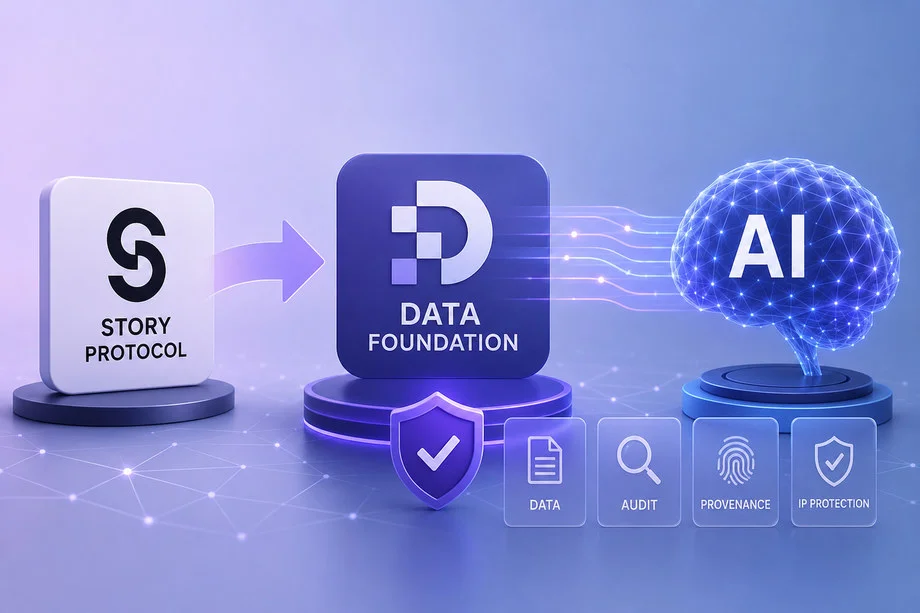
Story Protocol has shifted its focus from broad intellectual property licensing to creating verifiable systems for AI training data, launching the DATA Foundation with new tools and partnerships to address provenance and compliance challenges
The Strategic Pivot
Story Protocol, a blockchain project initially centered on intellectual property rights, has undergone a significant rebrand to the DATA Foundation. This change reflects a deliberate move toward addressing the growing needs of artificial intelligence development, particularly around sourcing and verifying high-quality training data.
The company identified limitations in its original approach. Major rights holders in areas like music, games, and brands preferred to maintain strict control over their assets, which conflicted with open, permissionless licensing models. In contrast, the demand for reliable AI training data presented a clearer opportunity.
- Renaming the network to DATA Network.
- Token migration from $IP to $DATA on a 1:1 basis with no action required for holders.
- Focus on building infrastructure for provenance, licensing, and quality assurance of AI datasets.
Core Components of the DATA Network
Central to the new direction is Trace, an on-chain registry designed to track the origin, licensing status, and consent history of datasets used for AI training. It generates tamper-proof cryptographic receipts containing content hashes, licensing information, timestamps, and proof of payment, while keeping the actual data private.
Poseidon serves as the processing layer, evaluating and enhancing the quality of human-generated datasets. The foundation also integrates with Kled, an opt-in human data marketplace that has contributed approximately 1.5 billion user records. Kled pays participants for real-world data such as videos of surroundings or ambient audio recordings.
Leadership updates support this transition. Andrea Muttoni, previously president and product chief, takes on the role of CEO for the DATA Foundation. Avi Patel, founder of Kled, joins as Chief Data Officer and advisor. Story founder Seung-yoon Lee continues as an advisor.
Market Context and Challenges
AI developers face increasing scrutiny over copyright issues and unauthorized use of training data. Legal challenges from creators and platforms have highlighted the need for transparent mechanisms to demonstrate compliance. The DATA Foundation aims to provide an immutable record that helps companies verify data sources and licensing agreements.
This pivot aligns with broader trends in the technology sector, where projects are adapting to the demands of AI infrastructure. The company previously raised around $140 million in funding, with backing from prominent investors including Andreessen Horowitz's a16z crypto.
| Aspect | Previous Focus | New Direction |
|---|---|---|
| Core Mission | IP licensing and tokenization | AI training data provenance and licensing |
| Key Tool | IP graph for remixing | Trace registry and Poseidon processing |
| Partnerships | Entertainment and brands | Kled human data marketplace |
Technical and Operational Features
The foundation emphasizes fraud detection capabilities to ensure datasets are authentic, human-created, and original. Contributors are rewarded through Numo, an application that links payments to completed marketplace transactions rather than upfront compensation.
Trace allows for public auditability without exposing sensitive underlying data. It supports machine-readable licenses that can specify usage scopes, enabling better integration with AI training pipelines. The system aims to create a chain of custody for data, including how derivatives and models handle upstream obligations.
- Verifiable provenance to support compliance efforts.
- Programmable royalty splits to reward contributors.
- Improved data quality through processing and validation layers.
- Scalable supply of consented, real-world human data.
Token and Market Response
Following the announcement, the token experienced positive movement, with reports of gains around 12-16% in the immediate period. This occurred despite broader market pressures. The rebrand positions the project within the expanding intersection of blockchain and artificial intelligence applications.
Future developments will likely center on adoption by AI labs, measurable usage of the Trace registry, and the effectiveness of quality controls for the large volume of contributed data.
The DATA Foundation's approach seeks to establish a trust layer for AI training inputs by combining blockchain immutability with practical tools for licensing and verification. This represents one effort among several in the sector to address critical infrastructure needs in AI development.
Disclaimer
This article was generated by AI using information from multiple industry sources. It has not been reviewed or verified by a human editor and may contain inaccuracies, omissions, or misinformation. Readers are encouraged to independently verify any information before making decisions based on its content.Tired of the noise?
Let the bots trade for you.
Trade 24/7, without emotion, with data-driven strategies.
Associated articles

Latest articles

JPMorgan Expands Tokenized Money Market Funds to Solana Blockchain

Dropee Daily Quiz Archives Cover Four Months of Startup and Business Terms in 2026
Aave V4 Debuts Externally Curated Lending Markets Managed by Sentora on Ethereum

HSBC Begins Phased Rollout of HKD-Backed RedCoin Stablecoin to 3.3 Million PayMe Users