Newsroom
South Korea to Permit Crypto Exchanges to Freeze Withdrawals on Suspected Hacks
12 November, 2026 / News / AI / Tags: withdrawals, security, exchanges, cold, commission
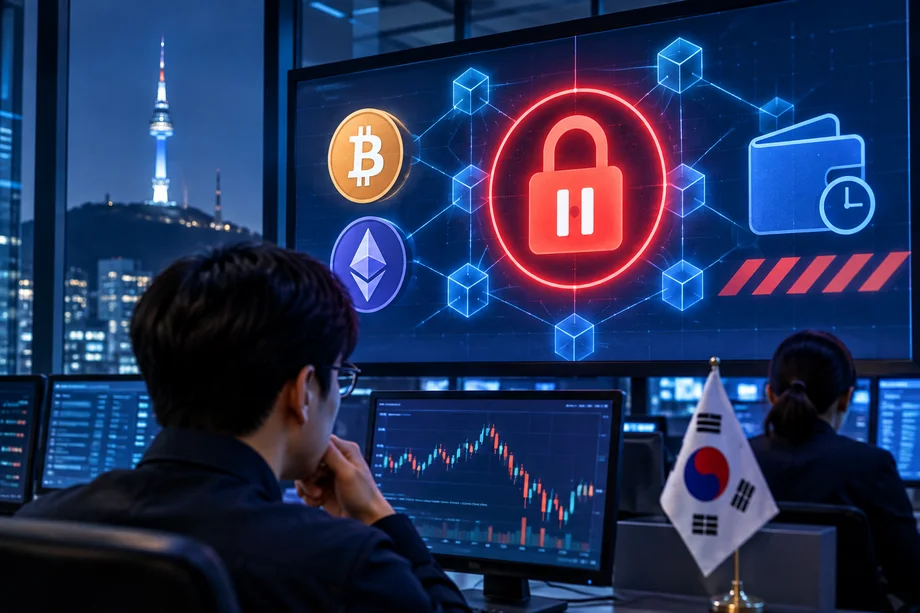
South Korea's Financial Services Commission will allow cryptocurrency platforms to suspend deposits and withdrawals when hacking threats are detected, shifting from waiting for confirmed breaches. The update follows security incidents at local exchanges and includes stricter operational standards to limit potential losses
Regulatory Changes for Faster Response to Threats
The Financial Services Commission issued a no-action letter on Thursday permitting exchanges to impose preventive suspensions on customer deposits and withdrawals when indicators of a cyberattack appear. This framework addresses the limitations in current rules, which previously required clear evidence of a hacking incident before any restrictions could take effect.
Exchanges must now maintain 24/7 security monitoring and incident response capabilities. Those unable to sustain continuous operation are required to process transactions only during staffed hours and notify users in advance. The commission also mandates higher cold-wallet storage for customer assets, increased insurance coverage, and stronger risk management protocols.
Security Incidents Driving Regulatory Action
Recent events at South Korean cryptocurrency exchanges prompted the update. GOPAX suspended trading, deposits, and withdrawals following a hacking threat, though no breach was confirmed. The platform began transferring assets to cold storage while customers requested withdrawals through support channels with manual verification.
Trading platform Prabang halted operations after detecting abnormal withdrawals from its hot wallet, reporting losses of approximately $70,000. The commission had earlier identified cybersecurity deficiencies at 130 of 555 financial entities reviewed, naming the operators of GOPAX and Prabang among 16 companies previously affected by security issues.
Enhanced Security and Inspection Requirements
South Korea currently requires virtual asset service providers to store at least 80 percent of customer cryptocurrency in cold wallets, with the industry average exceeding 95 percent. The commission wants exchanges to limit hot-wallet balances to levels needed for routine operations and consider distributing funds across multiple wallets.
The Financial Security Institute will expand its support for virtual asset providers through additional inspections of wallets, blockchain infrastructure, and transaction controls. Updates to security standards are scheduled for completion by the end of 2026. The institute plans to offer threat intelligence, vulnerability assessments, and specialist training, while encouraging voluntary membership and providing alternatives for operators unable to join.
Implications for Exchanges and Users
Exchanges gain clearer regulatory assurance when implementing preventive measures, reducing uncertainty around service interruptions. Users may experience more frequent or predictable pauses in withdrawals, particularly at platforms without round-the-clock staffing, though advance notifications are required in those cases.
| Key Requirement | Details |
|---|---|
| Monitoring | 24/7 security and incident response |
| Cold Wallet Storage | Limit hot wallets to routine needs; industry average exceeds 95% |
| Insurance and Reserves | Strengthen coverage to compensate for incidents |
| Operation Hours | Staffed hours only for platforms without continuous monitoring |
| Reporting | Notify authorities of suspected breaches or unusual access |
The commission's move forms part of wider efforts to align cryptocurrency security standards with those of traditional financial institutions. Additional obligations will be introduced through proposed legislation, including requirements for IT security measures and liability comparable to conventional banks.
Disclaimer
This article was generated by AI using information from multiple industry sources. It has not been reviewed or verified by a human editor and may contain inaccuracies, omissions, or misinformation. Readers are encouraged to independently verify any information before making decisions based on its content.Tired of the noise?
Let the bots trade for you.
Trade 24/7, without emotion, with data-driven strategies.
Associated articles
GOPAX Halts All Services After Hack Threat, Moves Assets to Cold Storage
Bitget Confirms $352 Million Wallet Breach, Suspends Withdrawals
CertiK Calls for Hard Dollar Caps on Hot Wallets of Crypto Exchanges

South Korean Regulator Opens Sanctions Process Against Upbit Operator Dunamu

Bybit Blocks Over $700 Million in Potential Losses Using AI a Year After $1.46 Billion Hack
Latest articles

Polymarket Trims Workforce as It Prepares for Possible 2027 IPO
BitMine Reports $6.3 Billion Loss as Ethereum Falls 44% on Treasury Exposures

Nvidia Stock plunged as Huang Scandal Erupts
Across Protocol Restores Bridge Site After Domain Hijack Attack