Newsroom
BitMine Reports $6.3 Billion Loss as Ethereum Falls 44% on Treasury Exposures
12 November, 2026 / News / AI / Tags: bitmine, ethereum, percent, staking, fiscal
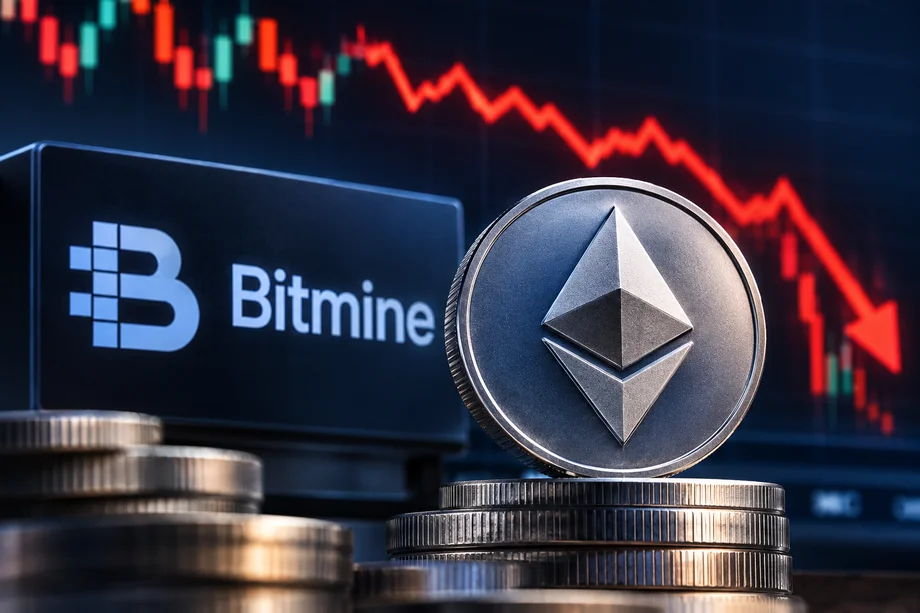
BitMine Immersion Technologies posted a $6.313 billion net loss for its fiscal year ended August 31, 2026, driven by unrealized declines in its Ethereum holdings, which fell 44 percent from around $4,300 to $2,467
BitMine’s Treasury Strategy and Price Impact
BitMine Immersion Technologies filed its Form 10-K on November 10, revealing a sharp reversal from the previous year’s $348.6 million profit to a $6.313 billion net loss. The bulk of this shortfall stemmed from unrealized fair-value losses of $6.229 billion on digital-asset holdings, with Ethereum accounting for the overwhelming majority.
The company’s treasury expanded during the period, holding 5,901,837 ETH at fiscal year-end. These holdings were valued at $14.56 billion against a cost basis of $19.95 billion, creating a $5.39 billion gap or approximately 26.6 percent below acquisition cost. The position represented about 4.9 percent of Ethereum’s circulating supply at the time.
This accumulation occurred as Ethereum’s price declined roughly 44 percent over the fiscal year, from approximately $4,391.91 at the start to $2,467.65 by August 31. The valuation shift produced paper losses that outweighed operational gains, despite no sales of the underlying assets.
Revenue from Staking Offset by Volatility
Revenue rose to $124.8 million in fiscal 2026 from $6.095 million the prior year. Staking and validation activities generated $121.4 million, or 97 percent of total income, while mining contributed the remaining $1.4 million, down 56.7 percent.
General and administrative expenses reached $376.9 million, exceeding revenue. The firm recorded additional losses of $143.7 million on derivative contracts and a $22.9 million decline in its investment in Eightco Holdings. Total assets stood at $15.4 billion, with liabilities of $33.7 million, reflecting a balance sheet dominated by cryptocurrency holdings and cash equivalents.
BitMine holds 211 BTC valued at $16.6 million, $545 million in cash and cash equivalents, and equity positions in Beast Industries and Eightco Holdings. The company’s model relies on staking rewards paid in ETH, so price movements directly affect both revenue valuation and treasury exposure.
Growth Toward 5 Percent Ethereum Supply Target
BitMine continues its strategy of weekly Ethereum purchases, funded partly through share sales. It raised $13.2 billion from an at-the-market offering of 395.1 million shares and repurchased 20.8 million shares in July and August for an average price of $17. The firm estimates annualized staking rewards of $309 million on 5.23 million staked ETH at a 2.65 percent yield.
Management views 5 percent of circulating supply as a long-term target. With holdings now at 4.97 percent, the company plans to cease additional purchases once this level is reached. This milestone signals the firm’s intent to stabilize its treasury rather than expand further through market purchases.
Operational and Governance Updates
BitMine identified material weaknesses in internal controls over financial reporting for the second consecutive year as of August 31, 2026. The company enlisted external advisors, implemented an enterprise resource planning system, and added accounting staff, yet new controls had not demonstrated effectiveness long enough to resolve the issues.
In April, BitMine replaced its prior auditor with KPMG. The firm also terminated its management services agreement with Ethereum Tower LLC effective September 3 without a termination fee. It entered a new 10-year advisory arrangement with American Validator LLC, an affiliate of Ethereum Tower, at a simplified 1.5 percent fee on staking rewards.
The company is transitioning its fiscal year-end to December 31 and will file a transition report covering the period from September 1 to December 31, 2026. This change aligns with broader operational streamlining.
Market Reaction and Strategic Outlook
Shares of BitMine fell 2.8 percent to close at $18.08 following the filing, extending a year-to-date decline of 33 percent. The results highlight the risks associated with concentrated exposure to a single cryptocurrency, even as staking provides recurring income.
Chairman Tom Lee has maintained an optimistic stance, describing Vitalik Buterin’s characterization of Ethereum as a store of value as a significant development for the network’s role in tokenized finance. The company’s treasury strategy underscores institutional interest in Ethereum accumulation, yet the reported outcomes illustrate how price volatility can still dominate financial statements.
Future quarters will reflect continued staking activities alongside potential price recovery. BitMine’s balance sheet remains heavily weighted toward digital assets, with valuation adjustments expected to drive ongoing volatility in reported results.


Disclaimer
This article was generated by AI using information from multiple industry sources. It has not been reviewed or verified by a human editor and may contain inaccuracies, omissions, or misinformation. Readers are encouraged to independently verify any information before making decisions based on its content.Tired of the noise?
Let the bots trade for you.
Trade 24/7, without emotion, with data-driven strategies.
Associated articles

Bitmine Launches $300M Preferred Stock Raise as Ethereum Treasury Nears 5% Milestone
BitMine Holds Nearly 5% of Ethereum With $16.2 Billion Treasury

Bitmine Expands Ethereum Treasury to 5.77 Million ETH on Robinhood Chain Momentum

BitMine Expands Ethereum Treasury to 5.78 Million ETH While Executing Major Share Buyback

Bitmine Nears 5% Ethereum Supply Target With 5.74 Million ETH Holdings
Latest articles

Polymarket Trims Workforce as It Prepares for Possible 2027 IPO

Nvidia Stock plunged as Huang Scandal Erupts

South Korea to Permit Crypto Exchanges to Freeze Withdrawals on Suspected Hacks
Across Protocol Restores Bridge Site After Domain Hijack Attack