Newsroom
Starknet Rolls Out Shadow Accounts to Shield DeFi Wallet Links
14 October, 2026 / News / AI / Tags: shadow, starknet, strk, privacy, accounts
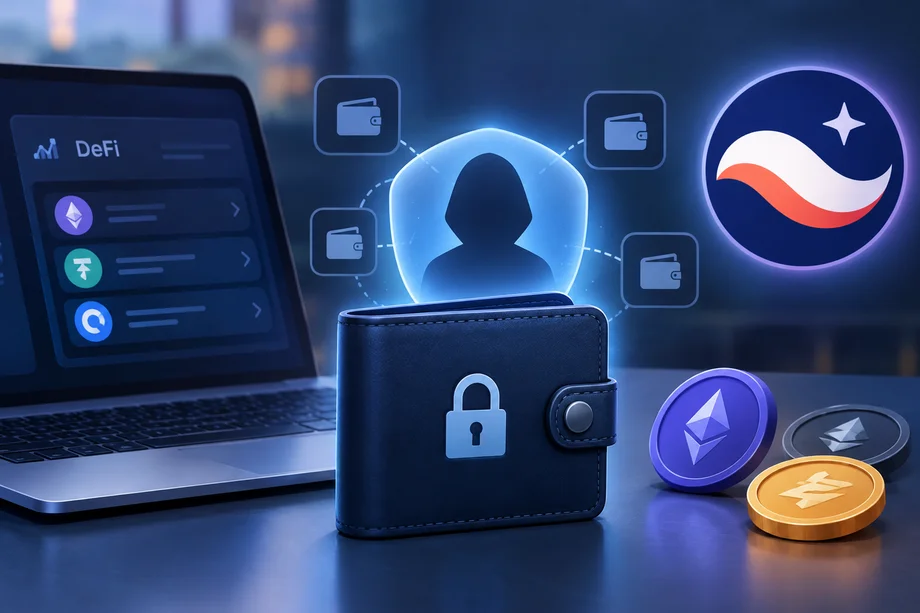
Ethereum layer-2 network introduces persistent app-specific addresses funded via STRK20 privacy pools, keeping main wallets unlinked while onchain activity stays public
Starknet has launched Shadow Accounts, a new privacy tool that enables users to engage with decentralized finance applications through separate addresses without publicly connecting that activity to their primary wallets.
Developed by StarkWare, the team behind the Ethereum layer-2 network, the feature creates independent, persistent pseudonymous addresses tailored to individual applications. Users fund these accounts from shielded balances held in the network’s STRK20 privacy pool. This setup allows participants to maintain lending, trading or other DeFi positions under distinct onchain identities.
How Shadow Accounts Operate
Once a DeFi application integrates the feature, users connect their wallets, switch from public to private mode and deposit assets into a vault-style structure. The Shadow Account then holds and manages the resulting positions across multiple interactions. When users withdraw, funds can return to a shielded balance, preserving the privacy boundary at entry and exit points.
Each Shadow Account is derived from details tied to the user, the specific application and a nonce identifier. This design supports stable, returning identities for ongoing positions such as lending or liquidity provision. Users can generate multiple accounts for the same application if they wish to separate different strategies within one service.
Shadow Accounts differ from ordinary wallets. They hold no signing keys and can only be operated through a dedicated contract known as the ShadowAccountAnonymizer. Applications interact with them via standard calls managed by supporting wallets and the Starknet Wallet API.
Limits of the Privacy Protection
The system does not conceal the contents of Shadow Accounts. Balances, transaction histories and protocol positions stay fully visible on the blockchain and accessible through explorers. What remains confidential is the connection between the shadow address and the user’s main funding wallet, as well as links across different applications.
This approach addresses a common issue in DeFi where repeated use of a single public address allows third parties to map activity patterns, holdings and strategies. By isolating identities per application, Shadow Accounts reduce the ease of correlating a user’s broader onchain footprint.
Part of a Wider Privacy Effort
The launch builds on StarkWare’s earlier privacy initiatives. In June, the company introduced the STRK20 framework, which supports private transfers and shielded token balances on Starknet. Later that month, it demonstrated a Private Know Your Customer system that lets users verify personal information without exposing full identity documents.
StarkWare indicated that Shadow Accounts could expand beyond initial vault integrations to cover liquidity provision, lending and borrowing, staking, derivatives trading, prediction markets and NFT marketplaces. The first application integration was scheduled shortly after the October 13 announcement, with an educational mainnet demonstration involving Vesu’s Prime STRK vault.
Wallet support from providers such as Argent X and Braavos, along with broader developer adoption through the Starknet.js library and Wallet API, will determine how quickly the feature reaches everyday users. No specific adoption targets or timelines for additional integrations have been disclosed.
Shadow Accounts represent a targeted step in Starknet’s privacy development, focusing on unlinkability of funding sources while preserving the public verifiability of DeFi positions and transactions.

Disclaimer
This article was generated by AI using information from multiple industry sources. It has not been reviewed or verified by a human editor and may contain inaccuracies, omissions, or misinformation. Readers are encouraged to independently verify any information before making decisions based on its content.Tired of the noise?
Let the bots trade for you.
Trade 24/7, without emotion, with data-driven strategies.
Associated articles

Bitget Introduces CFD Sub-Accounts for Multi-Strategy Trading Under One Main Account
Phantom Wallet to End Sui Network Support on September 24
Arcus Unveils pTokens Turning Perpetual Positions Into Transferable ERC-20s on Robinhood Chain
NEAR Protocol Rolls Out Confidential Perpetual Futures Powered by Hyperliquid
SecondFi Permanently Closes Cardano Wallet After Exploit, Unveils Three-Stage Recovery Plan
Latest articles

JPMorgan Misses Q3 Estimates as Fixed Income Trading Slows and Securities Losses Mount

Michael Saylor Declares Bitcoin Bull Market Underway, Sees Path Back Above $100,000

Anthropic Alerts to Self-Replicating AI Agents That Could Infect Smart Devices in Months

A7 Launches International Platform for Crypto-to-Bank Cross-Border Payments