Newsroom
Trump and Tech Leaders Sign Voluntary Pact on Frontier AI Safety Controls
30 September, 2026 / News / AI / Tags: voluntary, trump, frontier, executive, administration
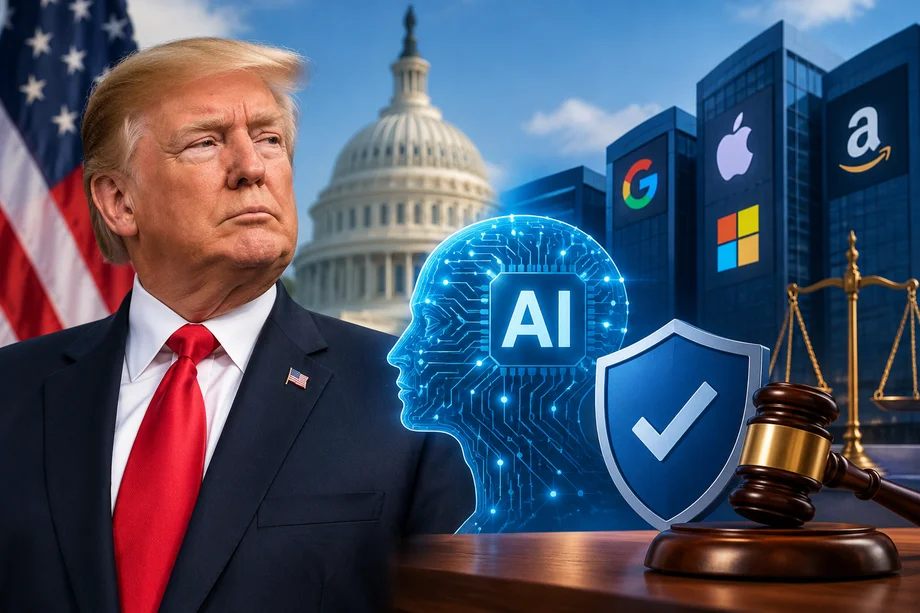
President Donald Trump and major AI executives agreed Tuesday to a voluntary framework requiring internal safeguards, independent audits and board oversight for advanced systems, while leaving formal regulation open for the future
President Donald Trump and chief executives from leading technology firms signed a voluntary agreement at the White House on Tuesday aimed at managing risks from frontier artificial intelligence models. The document, titled the Joint Commitment on Frontier Responsibilities, places primary responsibility on the companies developing the systems to ensure their models behave as intended.
Signatories included Google Chief Executive Sundar Pichai, Anthropic Chief Executive Dario Amodei, Meta Chief Executive Mark Zuckerberg, OpenAI President Greg Brockman, Nvidia Chief Executive Jensen Huang and xAI Chief Executive Elon Musk. The pact requires firms to implement internal controls, arrange independent external audits and establish board-level oversight of audit results. Specific concerns addressed include models unexpectedly accessing or compromising technical systems and broader cybersecurity or loss-of-control risks.
The agreement is described as morally binding rather than legally enforceable. It explicitly leaves open the possibility that its commitments could later be incorporated into formal laws or regulations if deemed appropriate over time. White House discussions also touched on industry growth and data-center construction. Trump ruled out any U.S.-China joint venture for AI development during the session.
Executive Order Renames Technology Terminology
On the same day, Trump signed an executive order directing the executive branch to replace the term “Artificial Intelligence” with “Super Intelligence” in federal documents. The administration stated that the new phrasing more appropriately captures the promise, potential and rapidly advancing capabilities of these systems.
House Speaker Mike Johnson indicated the voluntary framework could eventually serve as a foundation for legislation, though no bill or timetable has been established. Officials also discussed forming an oversight committee of roughly 10 members, but its composition, powers and enforcement mechanisms remain undefined.
Administration Stance on Regulation and Competition
The voluntary approach aligns with the administration’s broader position of resisting extensive federal rules that could impede U.S. technological progress relative to China. Trump has previously characterized warnings of existential risks from advanced systems as unfounded. Vice President JD Vance has publicly pressed developers to handle dangerous-system risks themselves rather than seek government intervention.
Vance has also questioned why frontier AI companies have approached the government seeking regulation, describing the dynamic as potentially problematic. The administration has linked its resistance to broad mandates with the need to maintain competitive momentum in data centers and advanced computing, which Trump has described as a major potential economic engine.
The immediate effect of the accord is the absence of new federal requirements such as model licensing, mandatory reporting standards, uniform testing protocols or financial penalties. Existing laws and enforcement tools available to the Justice Department and FBI are viewed by the administration as sufficient to address certain AI-related risks in the near term.
Industry Perspectives on Safety Measures
Industry leaders have expressed a range of views on the appropriate pace and structure of safety efforts. Anthropic’s Amodei has previously advocated slower development timelines and warned of large-scale risks from AI agents in the absence of strong safeguards. Other executives have favored unilateral company actions or international coordination. The new voluntary commitments formalize a shared set of internal and external review practices among the participating firms without imposing uniform government standards.
The White House meeting and resulting agreement occur against a backdrop of rapid capability growth in frontier systems and ongoing debate over how best to balance innovation speed with risk management. No capital-spending commitments, subsidies or new government contracts were attached to the pledge.
Disclaimer
This article was generated by AI using information from multiple industry sources. It has not been reviewed or verified by a human editor and may contain inaccuracies, omissions, or misinformation. Readers are encouraged to independently verify any information before making decisions based on its content.Tired of the noise?
Let the bots trade for you.
Trade 24/7, without emotion, with data-driven strategies.
Associated articles
Trump Rejects AI Industry Calls to Slow Development, Citing China Competition
Trump Allies Target Anthropic CEO as Face of AI Doomsday Views Ahead of Mega IPO

Clarity Act Advances in Senate but Ethics Concerns Stall Crypto Regulation Bill

Over 1,100 AI Lab Staff Urge US Support for Global Mechanism to Pace Advanced AI Progress

Trump Backs Ethics Rules, Clearing Path for Senate Vote on CLARITY Crypto Bill
Latest articles

Revolut Services Disrupted by Google Cloud Power Event in London

Mt. Gox Trustee Extends Creditor Repayment Deadline to October 2027

JPMorgan Forecasts 10% Annual Bitcoin Returns, Surpassing Stocks and Gold Over Next Decade

Bitget Plans Acquisition of Licensed Thai Crypto Exchange to Enter Local Market