Newsroom
Meritz Securities Teams With Ripple on Digital Asset Custody and Tokenization Review in South Korea
7 October, 2026 / News / AI / Tags: meritz, ripple, south, korea, xrp
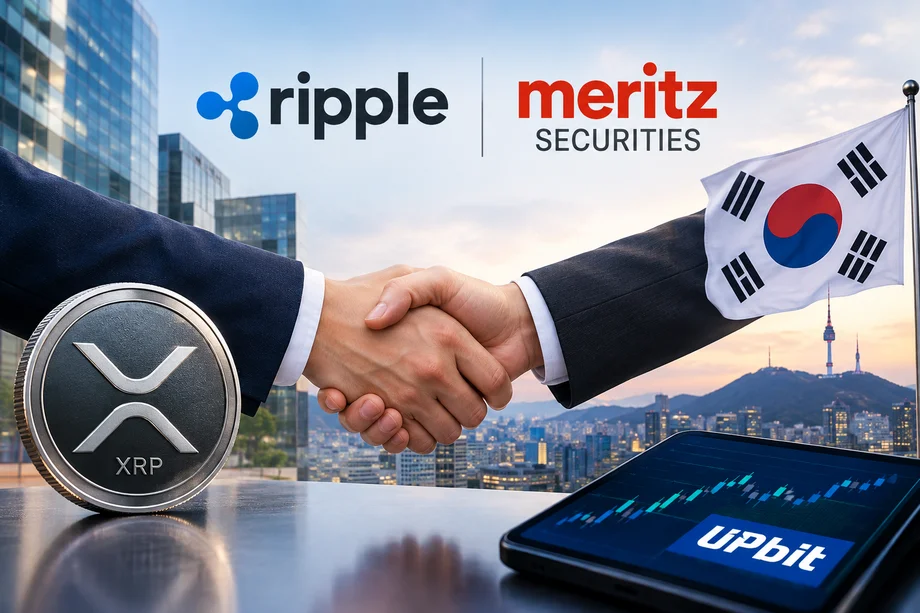
South Korean brokerage Meritz Securities has signed a strategic partnership with Ripple to assess institutional custody and tokenization tools for the country’s capital markets as local regulations advance
Meritz Securities and Ripple formalized a strategic partnership on October 1 at Meritz’s headquarters in Yeouido, Seoul. Meritz Chief Executive Jang Won-jae and Ripple President Monica Long attended the signing. The arrangement centers on reviewing whether Ripple Custody and the company’s tokenization infrastructure can operate within South Korea’s existing securities and digital-asset rules.
The companies described the initial phase as exploratory. Cooperation is expected to broaden in stages as South Korea’s regulatory framework for digital assets matures. The agreement does not commit either side to a commercial product launch, a specific customer base, or a timeline.
Scope of the Review
Meritz is examining several potential digital-asset businesses alongside the Ripple review. These include spot digital-asset exchange-traded funds, fractional investment products, tokenized securities, digital-asset trading platforms, and won-denominated stablecoins. None of these have been announced as active offerings.
Ripple Custody forms a core part of the discussion. The service provides institutional storage and management of digital assets and has been paired with tokenization capabilities in other markets. The partnership leaves open whether any future service would involve XRP, Ripple USD (RLUSD),or the XRP Ledger.
Ripple’s Earlier Activity in South Korea
Ripple has previously collaborated with Korean financial institutions. In April, the company and Kyobo Life Insurance began testing blockchain-based settlement for tokenized South Korean government bonds that used Ripple Custody. The project aimed to move holding, transfer, and settlement closer to real time. The firms also explored RLUSD for related payment rails. That earlier work did not require XRP as a settlement asset.
Fiona Murray, Ripple’s managing director for Asia Pacific, said the company would examine with Meritz how digital-asset infrastructure could support the further development of South Korea’s capital markets.
Regulatory Backdrop
South Korea is advancing a formal framework for tokenized securities that would cover stocks, bonds, and funds. The rules are scheduled to take effect on February 4, 2027, beginning with institutional products. The Meritz-Ripple review is positioned to operate first inside current permissions and later expand as the new framework becomes available.
Other Korean financial firms have also begun related pilots. KB Securities has worked with Securitize and the Optimism Foundation on tokenized funds, while Shinhan Asset Management has tested a won-denominated tokenized fund structure offshore.
Market Context on Upbit
On October 7, XRP recorded approximately $111.4 million in 24-hour trading value on Upbit, ahead of Bitcoin’s roughly $104.7 million and Ether’s about $59.2 million at the recorded snapshot. XRP traded near $1.46–$1.47. The partnership announcement itself did not specify any role for XRP in potential Meritz services.
The agreement adds to Ripple’s institutional presence in the Asia-Pacific region, where the company has also expanded custody and tokenization offerings through other partnerships. For Meritz, the review forms part of broader preparation for regulated digital-asset products as South Korea’s legal structure continues to take shape.

Disclaimer
This article was generated by AI using information from multiple industry sources. It has not been reviewed or verified by a human editor and may contain inaccuracies, omissions, or misinformation. Readers are encouraged to independently verify any information before making decisions based on its content.Tired of the noise?
Let the bots trade for you.
Trade 24/7, without emotion, with data-driven strategies.
Associated articles
Ripple and SettleMint Launch Unified Custody and Tokenization Platform for APAC Institutions

Jeonbuk Bank Deploys Ripple Payments for Faster Business Cross-Border Transfers
Injective Partners with BDACS to Launch KRW1 Won Stablecoin for Tokenized Asset Settlement
KB Securities Partners With Securitize and Optimism to Tokenize Korean Funds on OP Mainnet
Chainlink Teams With LG CNS to Advance Korean Stablecoins and Tokenization
Latest articles

Zcash Co-Founder Proposes Redirecting 8% of Block Subsidies to Network Reserve

Bitcoin Monte Carlo Simulations Point to Median Value of $1.03 Million in 2033

S&P Global Completes Acquisition of OpenZeppelin Smart Contract Security Firm
Franklin Templeton Files Two ETFs to Convert US Stock Dividends into Bitcoin