Newsroom
KuCoin Ends All Crypto Services in Russia and Belarus Amid Growing Regulatory Pressure
30 October, 2026 / News / AI / Tags: kucoin, russia, belarus, restrictions, customers
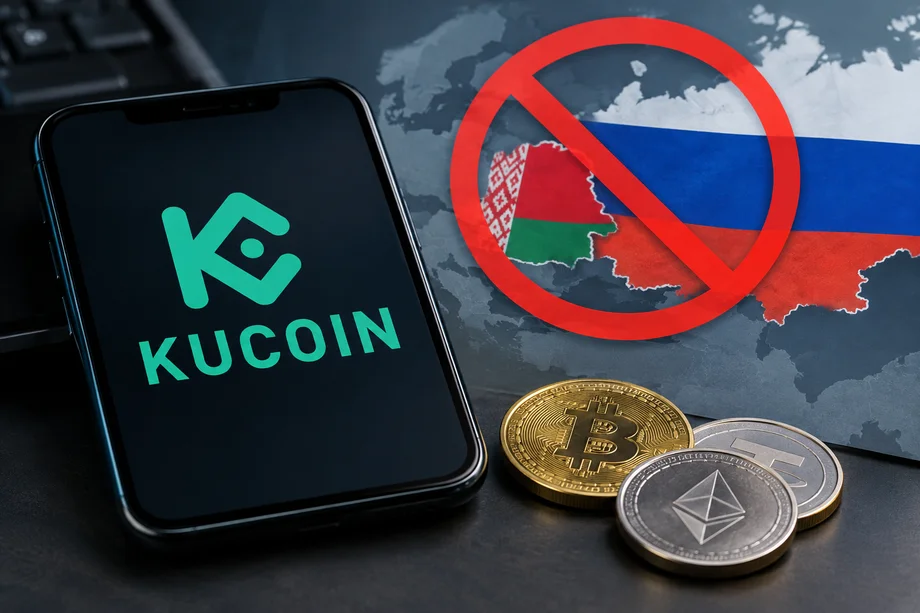
KuCoin has immediately suspended all products and services for customers in Russia and Belarus, joining MEXC and Bitget in restricting access as international regulatory and sanctions pressures intensify
KuCoin Implements Immediate Withdrawal From Two Markets
Cryptocurrency exchange KuCoin has announced the immediate termination of all services for customers based in Russia and Belarus, citing its obligations to comply with applicable legal and regulatory requirements. The decision covers the exchange's entire range of products, services and platform features in both countries.
The Seychelles-headquartered company announced the restrictions on October 29, stating that compliance considerations played a central role in determining where it could continue providing services.
KuCoin described the decision as part of its commitment to operating within applicable regulatory frameworks. However, the exchange did not identify a specific sanctions designation, government directive, licensing requirement or regulatory order that directly triggered the withdrawal.
Key announcement: All KuCoin services for users based in Russia and Belarus have been suspended with immediate effect. Affected customers will receive individual instructions covering account closures, open positions and asset withdrawals.
The company said it would facilitate an orderly termination process, allowing affected customers to settle their positions and retrieve their remaining assets within the applicable deadlines.
Individual Withdrawal Deadlines for Affected Customers
Rather than establishing one universal deadline for all Russian and Belarusian accounts, KuCoin will communicate directly with affected customers through individual account notifications.
These notices will contain information about the applicable closure dates, procedures for managing open trading positions and instructions for withdrawing funds from the platform.
The exchange has not published an overall withdrawal timetable or disclosed how many customers will be affected. It has also not provided figures for the total value of assets held by users in the two countries.
Customers who have not received an official notification are not required to take immediate action, according to the company's guidance. Nevertheless, their accounts remain subject to the exchange's applicable terms and restrictions.
KuCoin has also advised customers to contact its support team through official communication channels when seeking clarification about their account status. The warning is particularly relevant during the transition period, when fraudulent messages and phishing attempts could target users expecting withdrawal instructions.
MEXC and Bitget Have Already Introduced Similar Restrictions
KuCoin's announcement follows a series of restrictions introduced by other major cryptocurrency trading platforms during October, indicating a broader reduction in access to centralized exchanges for customers in Russia and Belarus.
MEXC announced on October 20 that it would terminate services for users in both countries as part of its global compliance efforts. The exchange adopted a notification-based approach, informing affected customers individually about the procedures and deadlines for closing positions and withdrawing assets.
MEXC stated that customer assets remained safe and directed users to its support team for assistance with account eligibility and withdrawal procedures. Its announcement did not identify a particular regulatory order as the reason for the decision.
Bitget had introduced restrictions even earlier. Its revised terms of service, dated October 16, added Russia and Belarus to its list of prohibited jurisdictions.
The exchange subsequently described the account closures as a limited exercise affecting certain users rather than a complete shutdown of its platform. Customers subject to the restrictions were expected to receive individual instructions and deadlines.
Bitget's restrictions also covered Kazakhstan, making its policy broader geographically than the measures announced by KuCoin and MEXC.
HTX has taken a separate approach by adding Russia to its restricted-jurisdiction list, although this measure did not amount to a complete withdrawal from the market.
| Exchange | Announcement | Restrictions |
|---|---|---|
| Bitget | October 16 | Added Russia and Belarus to prohibited jurisdictions and restricted certain accounts. Kazakhstan was also included. |
| MEXC | October 20 | Announced the termination of services for users in Russia and Belarus. |
| KuCoin | October 29 | Immediately suspended all products and services for users in both countries. |
| HTX | Previously announced | Added Russia to its restricted-jurisdiction list without announcing a complete market exit. |
European Sanctions Increase Pressure on Crypto Service Providers
The latest exchange restrictions come against the backdrop of expanding Western sanctions targeting Russia's financial sector following its invasion of Ukraine in February 2022.
Governments in the United States and Europe have progressively introduced measures targeting Russian financial institutions, transactions and entities suspected of helping sanctioned parties access international financial networks.
Cryptocurrency infrastructure has also become part of this regulatory effort. Authorities have increasingly focused on digital-asset platforms and cross-border payment networks that could facilitate transactions involving restricted individuals, businesses or institutions.
On July 23, the European Union adopted its 21st sanctions package, extending transaction restrictions to 14 cryptocurrency-related service platforms operating from several jurisdictions, including Georgia, Panama, the United Arab Emirates, the Marshall Islands, Kyrgyzstan and Belarus.
The package introduced additional mechanisms for restricting transactions between European operators and third-country cryptocurrency service providers considered relevant to Russian sanctions evasion.
Among the measures was action targeting entities associated with the A7 cross-border financial network. The network, which has been linked to transactions involving Russia, was estimated to be worth approximately $120 billion.
The European measures also sought to strengthen restrictions affecting Belarus, aligning several provisions with existing measures against Russia.
Although the broader regulatory environment provides important context for the recent exchange departures, KuCoin has not confirmed that the European sanctions package directly caused its decision.
Binance's Earlier Departure From Russia
KuCoin's withdrawal also follows an earlier exit by Binance, the world's largest cryptocurrency exchange by trading volume.
In September 2023, Binance announced its departure from Russia and sold its local operations to CommEX, citing compliance concerns surrounding its activities in the country.
However, the successor platform did not remain operational for long. CommEX announced its shutdown approximately six months after acquiring the Russian business.
The developments illustrate how international cryptocurrency companies have progressively reduced their exposure to the Russian market as regulatory requirements and sanctions-related risks have become more demanding.
KuCoin's Existing Regulatory Challenges in the United States
The latest market exit comes as KuCoin continues to face regulatory scrutiny in other major jurisdictions, particularly the United States.
In January 2025, Peken Global Limited, the operating company behind KuCoin, pleaded guilty to running an unlicensed money-transmitting business in the United States. The resolution required the company to pay more than $297 million and withdraw its services from the American market for at least two years.
The settlement included approximately $184.5 million in criminal forfeiture and a criminal fine of around $112.9 million.
US prosecutors alleged that the company had failed to maintain adequate anti-money-laundering and customer-identification procedures, register with the Financial Crimes Enforcement Network and submit required suspicious activity reports.
KuCoin's co-founders, Chun Gan and Ke Tang, also agreed to relinquish their roles in the company's management and operations as part of the resolution.
Further regulatory action followed in March 2026, when the Commodity Futures Trading Commission restricted the company's operator from serving US customers unless it registered as a foreign board of trade.
These developments form part of the broader regulatory challenges facing the exchange, although no direct connection has been established between its previous US settlement and the decision to discontinue services in Russia and Belarus.
Russian Crypto Regulation Develops Alongside International Restrictions
While international exchanges are reducing their exposure to Russian and Belarusian customers, Russia is also advancing its domestic framework for cryptocurrency market participants.
On October 29, the Central Bank of Russia approved the National Association of Securities Market Participants, known as NAUFOR, as a self-regulatory organization for cryptocurrency exchanges and digital asset custodians.
The central bank's registry currently includes 23 cryptocurrency exchanges and eight digital custody institutions. Registered entities are required to join a recognized self-regulatory organization within 90 days.
The development represents a separate domestic regulatory initiative aimed at organizing the country's cryptocurrency sector. It comes at a time when international platforms are increasingly reassessing their operations in jurisdictions affected by Western financial restrictions.
Centralized Exchange Access Continues to Narrow
The latest developments indicate a growing separation between international cryptocurrency platforms and customers in Russia and Belarus. KuCoin's decision is particularly significant because it applies to the full range of services rather than selected trading products or account categories.
The different approaches adopted by exchanges also demonstrate that restrictions are not being implemented uniformly. Some platforms have introduced targeted account closures, while others have announced broader service terminations covering entire jurisdictions.
For affected KuCoin customers, the immediate priority is the individual notification process and the deadlines established for closing positions and withdrawing assets. The company has not yet provided a consolidated timetable or disclosed the number of accounts covered by its decision.
With MEXC and KuCoin announcing full service exits and Bitget introducing jurisdiction-based restrictions, access to several major centralized cryptocurrency platforms has become more limited for users in Russia and Belarus.
Disclaimer
This article was generated by AI using information from multiple industry sources. It has not been reviewed or verified by a human editor and may contain inaccuracies, omissions, or misinformation. Readers are encouraged to independently verify any information before making decisions based on its content.Tired of the noise?
Let the bots trade for you.
Trade 24/7, without emotion, with data-driven strategies.
Associated articles
MEXC Ends Services for Users in Russia and Belarus Amid Compliance Push
Bitget Ends Services for Selected Users and Restricts Japan Accounts

EU Adds 14 Crypto Platforms to Russia Sanctions Package

EU Imposes Sweeping 21st Sanctions Package Targeting Russian Banks and Crypto Operators
Japan Regulators Urge Crypto Exchanges to Delay Withdrawals Amid Rising Scam Losses
Latest articles
Amplify Announces Monthly Dividends for Four ETFs, With Payments Scheduled for October 30

Binance Faces $6.3 Billion Security Breach, Freezes $3 Billion in Crypto Assets
Polymarket Halts International Trading After Third-Party Breach Drains User Funds
$11 Billion Bitcoin Options Expire as Price Hovers Near $80,000