Newsroom
Japan Regulators Urge Crypto Exchanges to Delay Withdrawals Amid Rising Scam Losses
8 August, 2026 / News / AI / Tags: withdrawals, request, police, exchanges, asked
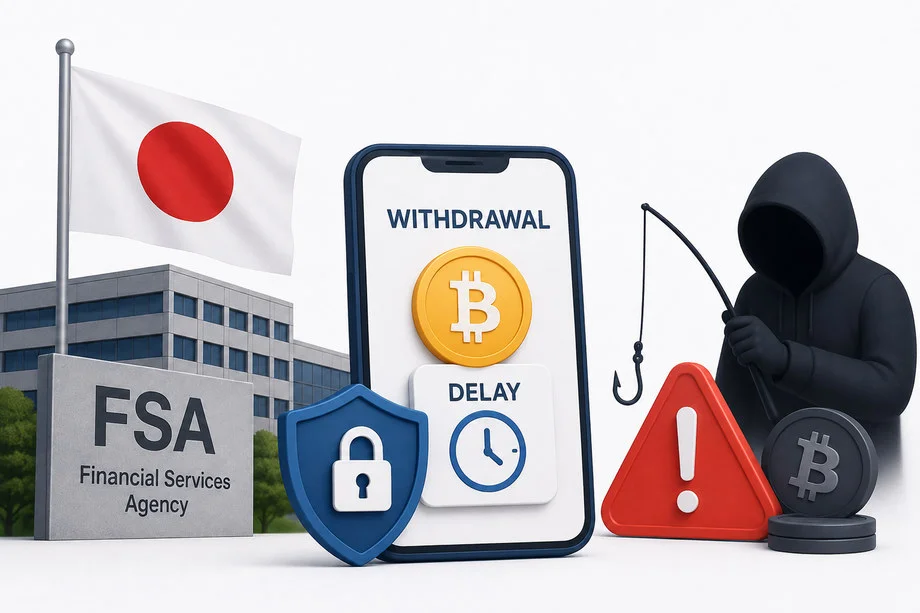
FSA and police request 11 measures including waiting periods after deposits and address registration to slow movement of fraud proceeds through digital asset platforms
Japan’s Financial Services Agency and National Police Agency have jointly asked the country’s cryptocurrency industry self-regulatory body to introduce a series of controls aimed at disrupting the rapid transfer of funds linked to scams. The request, issued on August 6, targets registered exchanges and focuses on adding friction to withdrawals while strengthening monitoring and verification processes.
The measures were directed to the Japan Virtual and Crypto Assets Exchange Association. Officials described them as requests rather than binding regulations, leaving individual platforms to determine specific implementation details according to their services, risk profiles and operational capabilities. System changes may be introduced in phases where immediate technical adjustments prove difficult.
Core Withdrawal Restrictions and Address Controls
Among the 11 points, authorities asked exchanges to restrict cryptocurrency withdrawals for a period after customers deposit fiat currency or purchase digital assets. Platforms were also urged to require users to pre-register withdrawal destinations and apply a further waiting period before newly added addresses become usable for transfers.
No uniform waiting period was specified. Regulators indicated that the length of any delay should be set by each exchange based on its own assessment of risk and business model. Some operators already apply similar restrictions; one platform, for example, has long delayed certain withdrawals linked to rapid deposits until the eighth day.
Additional guidance calls for withdrawal limits tailored to individual customers, taking into account factors such as risk profile, assets held, stated transaction purposes and historical activity. Exchanges were also asked to review customers who make large or frequent withdrawals soon after any temporary restrictions expire.
Broader Monitoring, Authentication and Information Sharing
Beyond timing controls, the request covers the full account lifecycle. Exchanges should reinforce checks at account opening, issue clear warnings that opening accounts or moving assets at another person’s instruction may indicate fraud, and strengthen both transaction monitoring and access-environment monitoring to detect activity inconsistent with a customer’s profile or linked to devices associated with known misuse.
When suspicious patterns appear, platforms are expected to respond more quickly with customer verification, temporary restrictions or account freezes. For higher-risk situations, authorities recommended phishing-resistant multifactor authentication and stronger checks against impersonation. Exchanges should also verify that the name of a bank remitter matches the name of the cryptocurrency account holder and act on mismatches.
The final points emphasize faster information sharing of fraud indicators among exchanges and more rapid cooperation with police investigations.
Context of Rising Losses and Prior Actions
The request follows a documented increase in special fraud cases in which proceeds are moved into cryptocurrency exchange accounts. National Police Agency figures show the scale of the problem in the first five months of 2026. Earlier data for 2025 recorded thousands of social media investment and romance scams, including a notable rise in cases involving cryptocurrency transfers.
Similar pressure had already been applied on the banking side. In prior guidance, the Financial Services Agency and police urged financial institutions to block or scrutinize transfers into crypto exchange accounts when the sender name did not match the originating bank account. The latest request extends comparable name-matching and monitoring requirements into the exchange withdrawal process itself.
A comparable informal request issued to the same industry body in 2021 concerning the Travel Rule was later incorporated into binding self-regulatory rules roughly thirteen months afterward. Whether the current measures follow a similar path remains to be determined by the association and its member exchanges.
Implications for Users and Next Steps
Practical effects will vary by platform. Users may encounter longer waits for first-time or post-deposit withdrawals, mandatory address registration with subsequent delays, personalized limits and additional verification when activity diverges from normal patterns. Legitimate customers seeking rapid transfers to self-custody wallets could face temporary friction, though regulators stated that implementation should remain proportionate to each operator’s risk experience rather than imposing a blanket freeze on all withdrawals.
Exchanges have been asked to begin strengthening the measures from August onward. The association has not yet published a detailed public timetable. Future developments are expected to include platform-specific notices and possible conversion of parts of the request into formal industry self-regulatory standards. Until then, the degree and speed of adoption will depend on individual operators.
Disclaimer
This article was generated by AI using information from multiple industry sources. It has not been reviewed or verified by a human editor and may contain inaccuracies, omissions, or misinformation. Readers are encouraged to independently verify any information before making decisions based on its content.Tired of the noise?
Let the bots trade for you.
Trade 24/7, without emotion, with data-driven strategies.
Associated articles

Bitget Ends Crypto Services for Japan Residents by Year-End

Brazil Central Bank Mandates 24-Hour Hold on Large Crypto Transfers Starting 2027

Hong Kong Records 25 Crypto Romance Scams With Nearly $9 Million in Losses

CFTC Alerts Public to $388 Million Crypto ATM Scam Losses in 2025

Tokyo Police Arrest Two in Cambodia-Based Crypto Fraud Targeting Japanese Victim
Latest articles
CoinDCX Confirms Losses After Suspicious $16M Transfers From 2025 Hack Wallets

Robinhood Secures Dubai License for Crypto and Stock Trading, Middle East Launch Delayed to 2027

CZ Warns Crypto Users Over Two Critical PHP Vulnerabilities

Bybit Fintech FZE Receives VARA Licence for Dubai Spot Trading