Newsroom
Intel Stock Tumbles Nearly 30% on Weak Q4 Guidance as PC Demand Slumps
30 October, 2026 / News / AI / Tags: dollars, percent, intel, revenue, billion
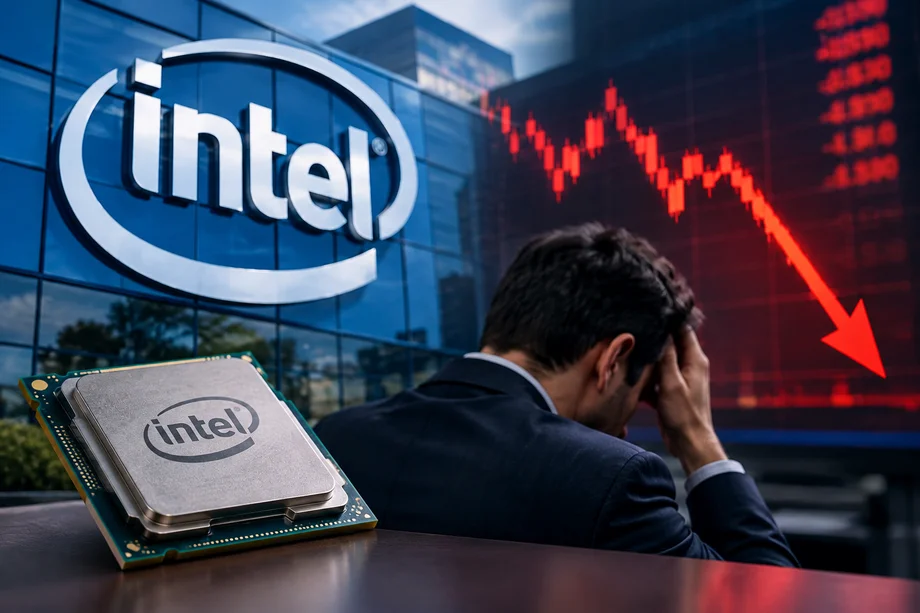
Intel shares dropped more than 28 percent intraday after the chipmaker issued fourth-quarter forecasts well below Wall Street estimates, triggering a sharp selloff across technology and semiconductor stocks
Earnings Beat Masked by Disappointing Outlook
Intel reported third-quarter revenue of 16.51 billion dollars, a 21 percent rise from the prior year, with adjusted earnings per share reaching 0.52 dollars. The results surpassed analyst expectations of 16.48 billion dollars in revenue and 0.40 dollars in per-share earnings. Data center and artificial intelligence revenue climbed 78 percent to 7.3 billion dollars, while foundry revenue grew 58 percent to 6.7 billion dollars.
Yet investors zeroed in on what came next. The company guided fourth-quarter revenue to between 15 billion and 16 billion dollars, falling short of the approximately 17.07 billion dollars expected. Adjusted earnings per share were forecast at 0.25 dollars, well below the roughly 0.43 dollars consensus. The outlook also signaled client computing revenue, or PC chip sales, would fall more than 20 percent from the third quarter.
Client computing revenue, which had already slipped 5 percent to 8.1 billion dollars in the latest quarter, faced ongoing headwinds from elevated memory costs and constrained IT budgets.
Manufacturing Setbacks and Industry-Wide Weakness
A production disruption at Intel’s Fab 28 plant in Israel following an October explosion is expected to cut revenue by about 300 million dollars in the fourth quarter and another 300 million dollars in the first quarter of 2027. The setback compounds broader manufacturing constraints, including packaging shortages, that limit the company’s ability to ramp up output for server processors.
Intel forecasts capital expenditures near 20 billion dollars in 2026, with spending rising further in 2027. The company stated it does not expect to generate positive free cash flow next year, describing 2027 as an investment year focused on rebuilding its manufacturing capabilities and competing with leaders such as Taiwan Semiconductor Manufacturing Company.
The decline rippled through the sector. Shares of SK Hynix fell more than 6 percent, SanDisk dropped over 3 percent, and the Philadelphia Semiconductor Index slid 5.7 percent. Nvidia lost 3.3 percent, AMD about 10 percent, and Arm more than 9 percent as the broader Nasdaq fell 2.2 percent and the S&P 500 slipped 1.1 percent.
AI Demand Offers Long-Term Upside
Despite near-term pressures, Intel highlighted strong momentum in its AI business. Data center and artificial intelligence revenue surged to 7.3 billion dollars, supported by robust demand for Xeon processors. The foundry segment also posted healthy gains, reaching 6.7 billion dollars on improved yields from advanced nodes such as Intel 3 and Intel 18A.
Analysts maintained an average overweight rating, with a consensus price target near 120 dollars, reflecting confidence in the company’s turnaround strategy under CEO Lip-Bu Tan. CFO David Zinsner noted server CPU demand tied to AI infrastructure had posted its strongest quarterly growth in 15 years.
| Date | Key Event |
|---|---|
| October 2026 | Factory explosion at Kiryat Gat plant disrupts production |
| Q3 2026 | Revenue 16.51 billion dollars, adjusted EPS 0.52 dollars |
| October 30, 2026 | Stock falls nearly 30 percent on weak Q4 guidance |
| 2027 outlook | PC market weakness expected to persist through first half |
Broader Market Impact
The Intel selloff contributed to a wider retreat in U.S. tech stocks. Amazon shares dropped more than 7 percent after its third-quarter sales of 201.9 billion dollars missed expectations, with earnings per share falling 3 percent year over year. The move highlighted concerns about returns on artificial intelligence investments across the sector.
Intel’s stock had climbed roughly 150 percent year to date before the recent slide. Earlier milestones included a 2025 investment of 5 billion dollars from Nvidia and a preliminary agreement with Apple to manufacture some chips. Shares had briefly topped 130 dollars in May after those developments.

Disclaimer
This article was generated by AI using information from multiple industry sources. It has not been reviewed or verified by a human editor and may contain inaccuracies, omissions, or misinformation. Readers are encouraged to independently verify any information before making decisions based on its content.Tired of the noise?
Let the bots trade for you.
Trade 24/7, without emotion, with data-driven strategies.
Associated articles

Dell Shares Rally Nearly 9% After Record AI Server Orders and Raised Forecast
Samsung Forecasts Record $80 Billion Quarterly Profit on AI Memory Demand
Nvidia’s $92 Billion Earnings Test AI Infrastructure Boom Amid Rising Costs

Verizon Raises 2026 Outlook After Strong Subscriber Gains and $2 Billion AWS AI Deal

Palantir Beats Earnings Estimates, Raises Guidance as Shares Surge After Hours
Latest articles

Binance Confirms EIP-7702 Use in Record $6.3 Billion Hot Wallet Theft

Aave Freezes 292 Lending Reserves After Binance-Linked Wallet Borrows Against Stolen USDT

Binance Partners With FBI and Secret Service After $6.3 Billion Security Breach

CZ Rebukes Musk Over Binance Hack Jabs, Cites $1 Billion SpaceX Stake