Newsroom
Injective Partners with BDACS to Launch KRW1 Won Stablecoin for Tokenized Asset Settlement
21 October, 2026 / News / AI / Tags: injective, bdacs, krw, won, south
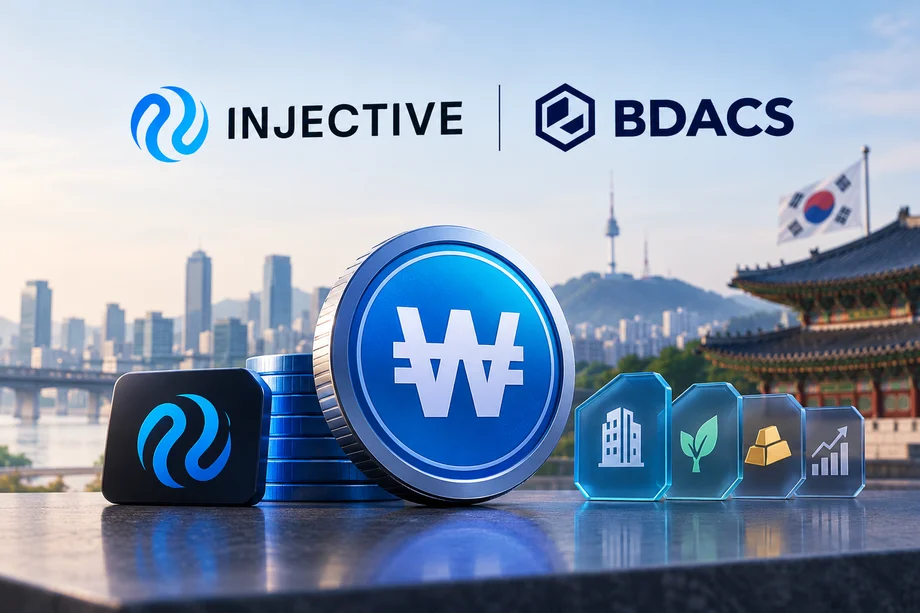
Injective and South Korean custodian BDACS have signed a memorandum of understanding to use the KRW1 won-backed stablecoin as the exclusive settlement asset for real-world asset trades on the Injective blockchain, offering institutions a local-currency option amid South Korea's developing regulations
Partnership to Enable Won-Denominated Settlements
Injective, a layer-1 blockchain protocol, has entered into a memorandum of understanding with BDACS, a South Korean digital asset custodian, to bring KRW1 to its tokenized asset markets. Under the agreement, BDACS’s KRW1 stablecoin will serve as the sole Korean won-denominated settlement asset for real-world assets traded on the Injective network.
Institutions will be able to trade and settle tokenized assets directly in won rather than routing transactions through US dollar-backed stablecoins. BDACS has confirmed that KRW1 is fully backed by reserves held in Korean won. Minting and redemption of the token will initially be open only to selected institutional clients, subject to regulatory approval before direct access is granted.
The arrangement targets approved institutional partners and does not yet represent a live market, but it is positioned to streamline settlement processes for domestic firms using the Injective platform.
South Korea’s Regulatory Developments
South Korea is advancing a Digital Asset Basic Act that lawmakers aim to finalize by the end of 2026. The legislation is expected to establish the legal framework for digital asset issuance and operations, including rules for won-backed stablecoins.
During the policy discussions, the five largest crypto exchanges in the country recorded net stablecoin outflows for 18 consecutive months through June. Industry researchers note the transfers totaled roughly 14.9 trillion won, or about 10.4 billion USD, though the data reflects movements between exchanges and does not confirm permanent capital flight.
The trend aligns with South Korea’s efforts to create a regulatory environment that mirrors international standards, such as the US GENIUS Act and the European Union’s MiCA framework. The stablecoin market overall remains dominated by dollar-denominated tokens, which account for more than 99 percent of total supply.
Injective’s Institutional Expansion
Injective has been expanding its institutional services in recent months. In August, the company’s institutional division registered with the US Securities and Exchange Commission as a transfer agent, enabling it to maintain ownership records and facilitate the transfer of securities.
Injective’s native INJ token currently holds a market capitalization of approximately 887 million USD. The partnership with BDACS builds on this infrastructure, which already includes work with Korean financial institutions to support tokenized trade receivables.
| Stablecoin | Backing Currency | Main Markets | Issuer |
|---|---|---|---|
| KRW1 | Korean won (KRW) | South Korea, Injective | BDACS |
| USDT | US dollar (USD) | Global | Tether |
| USDC | US dollar (USD) | Global | Circle |
Implications for Institutional Adoption
The initiative addresses a practical need in South Korea’s digital asset ecosystem, where reliance on US dollar stablecoins has created settlement frictions for local participants. By enabling direct KRW settlement, the collaboration could reduce cross-currency steps and better align with domestic cash management practices.
BDACS, focused on secure custody for institutional clients, will handle the KRW1 reserves and compliance elements. The partnership reflects broader industry momentum toward tokenized real-world assets, including Injective’s selection by companies such as POSCO International and LG CNS to issue, transfer, administer, and settle trade receivables.
While regulatory approval remains a prerequisite for full rollout, the agreement positions KRW1 as a targeted solution for institutional tokenized asset markets. South Korea’s evolving framework, expected to clarify issuer eligibility and operational standards, will ultimately determine the pace and scope of adoption.

Disclaimer
This article was generated by AI using information from multiple industry sources. It has not been reviewed or verified by a human editor and may contain inaccuracies, omissions, or misinformation. Readers are encouraged to independently verify any information before making decisions based on its content.Tired of the noise?
Let the bots trade for you.
Trade 24/7, without emotion, with data-driven strategies.
Associated articles
Meritz Securities Teams With Ripple on Digital Asset Custody and Tokenization Review in South Korea
Securitize Partners with LG CNS on Tokenized Assets as South Korea Prepares 2027 Framework
MoonPay Opens Seoul Hub With Major Korean Banks for Won Stablecoin Expansion
Shinhan Financial Partners With Visa to Build Stablecoin Payment Infrastructure
SBI Group and Kyobo Life Complete Direct Yen-Won Stablecoin Cross-Border Pilot
Latest articles
Ripple Backs SEC Proposed Crypto Asset Rules After $150 Million Legal Battle
Blockchain.com Introduces Options Trading on Seven Major Crypto Assets
Solana Activates Alpenglow Upgrade for Sub-Second Transaction Finality
Microsoft, Alphabet and Goldman Sachs Join 16 Issuers Objecting to OKX-ICE Tokenized Stock Plans