Newsroom
Heatbit Launches $899 Bitcoin-Mining Water Heater Element for Existing Tanks
23 October, 2026 / News / AI / Tags: heatbit, bitwater, water, mining, heating
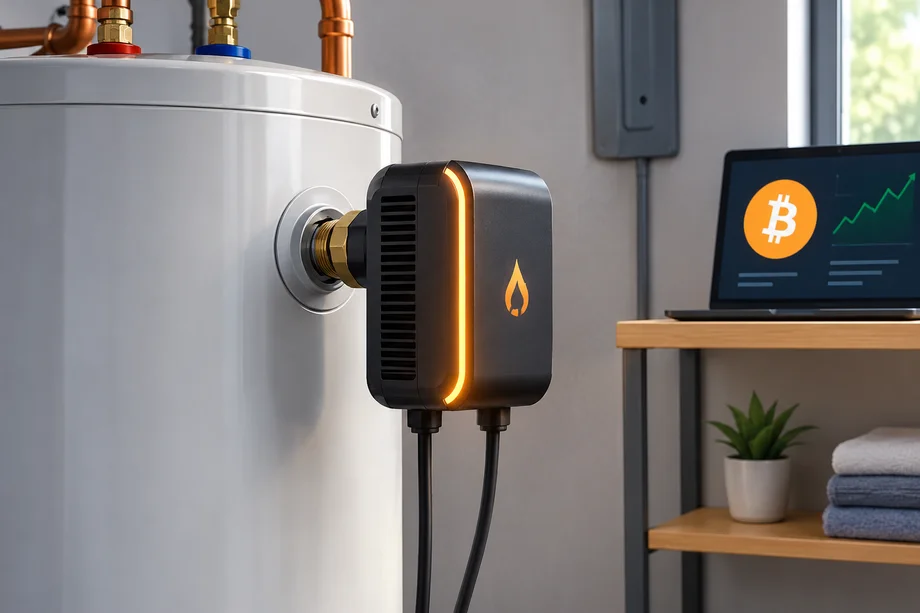
The Bitwater unit replaces a standard electric heating element with 20 mining chips, producing heat for household water while generating Bitcoin on the same power draw
Heatbit has introduced Bitwater, a screw-in water heater element that mines Bitcoin while warming the contents of an existing electric storage tank. The device swaps the conventional resistance wire for 20 mining chips so that the heat generated during hashing warms the water instead of being discarded.
Priced at $899 for the initial Genesis production run, with subsequent batches listed at up to $1,299, the refundable preorders opened on October 22, 2026. First units are scheduled to ship in the first quarter of 2027. The product is designed for standard 30- to 80-gallon electric tanks common in the United States and Canada that use a one-inch screw-in port, including models from A. O. Smith, Rheem, Bradford White, Whirlpool, GE and others.
How the Element Works
Bitwater incorporates 20 Bitmain BM1370 chips rated for a maximum of 34 terahashes per second while drawing up to 600 watts at an efficiency starting at 12 joules per terahash. The surrounding water cools the chips, eliminating the need for fans and resulting in silent operation. Because the unit operates at far lower power than the typical 4,500-watt residential element, it heats more gradually and remains active for longer periods. The tank’s original upper element and thermostat stay in place to supply backup heat during periods of high demand.
Installation is presented as a do-it-yourself process: shut off the circuit breaker, drain the tank, remove the lower element with the included wrench, and thread in Bitwater. The controller plugs into a standard 110–240 volt outlet; no new plumbing or dedicated circuit is required. An optional one-hour video consultation with an installer is offered for $99 once the unit arrives.
Monitoring, Features and Expected Output
Owners track water temperature, hashrate and estimated earnings through a companion app and can select solo mining or a mining pool. Mined Bitcoin is sent to an address controlled by the user. The system includes Autotune software that continuously adjusts power and mining parameters according to hot-water demand, aiming for utilization above 80 percent of the time.
Additional features include a titanium powered anode that does not require periodic replacement, a surface temperature kept low enough to limit limescale buildup, a floor-mounted leak sensor that sends app and email alerts, and automatic weekly disinfection cycles that raise the tank to 140 degrees Fahrenheit.
At prevailing hashprice levels, a unit running at its full 34 TH/s rating would generate roughly $1 to $1.25 worth of Bitcoin per day, or about $455 over a year. Actual results will vary with Bitcoin price, network difficulty and the share of time the device is hashing. Heatbit has tested the element through winter conditions with four- and five-person households in New York and Florida.
Decentralization Argument
Heatbit positions Bitwater as a means of distributing Bitcoin mining across ordinary homes rather than concentrating it in large industrial facilities. The company notes that residential water heating worldwide consumes approximately 300 terawatt-hours of electricity annually, exceeding the roughly 170 terawatt-hours used by the entire Bitcoin network. Because the power would be consumed for hot water regardless, the mining occurs at no incremental energy cost to the household.
The firm contrasts this approach with public mining companies that have increasingly redirected capacity toward artificial-intelligence workloads. Heatbit previously released space heaters that incorporate mining chips; Bitwater extends the same principle to water heating. The company has also indicated it is developing a version suitable for homes with gas water heaters.
A competing product, Superheat’s H1C Bitcoin-mining water heater, was listed earlier at $2,999 with projected deliveries in the fourth quarter of 2026. Bitwater’s lower entry price and later shipping window place it in a different segment of the emerging home-mining hardware market.

Disclaimer
This article was generated by AI using information from multiple industry sources. It has not been reviewed or verified by a human editor and may contain inaccuracies, omissions, or misinformation. Readers are encouraged to independently verify any information before making decisions based on its content.Tired of the noise?
Let the bots trade for you.
Trade 24/7, without emotion, with data-driven strategies.
Associated articles


Latest articles

Singapore, Malaysia and Thailand Central Banks Expand BLOOM for Cross-Border Digital Money Settlement

Underdog Partners With Zerohash for Crypto and Stablecoin Account Funding

Chainlink Teams With LG CNS to Advance Korean Stablecoins and Tokenization
JPMorgan Expands Tokenized Money Market Funds to Solana Blockchain