Newsroom
ENS Founder Files Proposal to Activate ENSv2 Upgrade on Ethereum Mainnet
13 October, 2026 / News / AI / Tags: ensv, johnson, upgraded, synchronization, domain
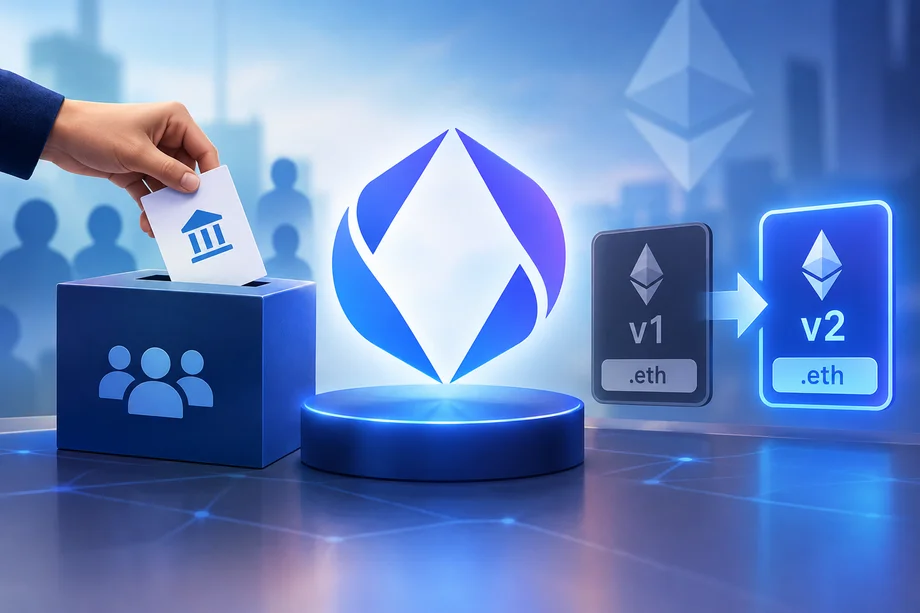
ENS founder Nick Johnson submitted an executable draft proposal to activate ENSv2 on Ethereum mainnet, seeking DAO approval while temporarily freezing new .eth registrations and ensuring existing domain holders face no migration deadline
ENSv2 Activation Proposal Submitted by Founder
ENS founder Nick Johnson filed an executable draft proposal on October 11 to activate the upgraded Ethereum Name Service protocol on the mainnet. The measure would direct future registrations to the new system after a synchronization process and requires passage through decentralized governance voting.
The draft consolidates 15 smart contract calls into a single transaction to remove five authorized controllers from the legacy BaseRegistrar and reinstate only two specific ones: ETHRenewerV1 for renewals and a Graveyard contract for expired names. This structure aims to streamline operations ahead of the handover.
Transition Details Including Registration Pause
New .eth registrations on the original registrar would halt temporarily during the final synchronization of domain records. The window is expected to last several hours, during which neither system would accept fresh names.
ENS Labs has already deployed the ENSv2 contracts to mainnet. The plan calls for the legacy registrar to stop processing registrations once the DAO approves and executes the proposal, followed by record synchronization, activation of the upgraded registrar, and updates to the Universal Resolver for lookups.
Existing Domain Holders Unaffected
Owners of existing .eth names would not need to migrate immediately. Their domains would continue functioning through current records, with ENS Labs reserving eligible names on the upgraded registry for current holders.
Names that have expired beyond the grace period under the current rules would not be reserved and could become available for registration on the new system. The proposal adjusts expiration timelines by extending migrated domain dates by 62 days to maintain consistent effective expiry periods.
| Version | Grace Period After Expiry | Migration Policy |
|---|---|---|
| v1 | 90 days | Optional, remains valid |
| v2 | 28 days (+62 days added to expiry) | Available for migration anytime |
New Features in ENSv2 Registry Architecture
ENSv2 replaces the legacy flat registry structure with connected registries that grant domain owners greater control. Owners could assign custom implementations to subdomains and use role-based permissions for actions such as resolver updates without full ownership transfer.
The redesigned system supports more precise access controls and simplifies management for subdomains. Developers would need to update applications through the Universal Resolver, though most integrations are already prepared.
Governance Requirements and Control Handover
Executable proposals must achieve at least 1 percent participation, equivalent to one million affirmative votes, and majority approval during a seven-day onchain voting period. Successful passage would trigger a minimum two-day timelock before execution.
Once ENSv2 activates, ENS Labs plans to transfer its remaining administrative rights over the upgraded contracts to the DAO timelock, removing all privileged positions. Registration fees would continue directing to the DAO-controlled system.
No Fixed Date for Voting or Activation
The proposal remains in draft form with no announced voting date. ENS Labs would publish transaction records and a verification script after the administrative handover to confirm the DAO controls the system.
ENSv2 development began as a layer-2 proposal but shifted to mainnet deployment. The October governance bulletin lists the activation as pending, with community discussion open and no completed vote recorded.


Disclaimer
This article was generated by AI using information from multiple industry sources. It has not been reviewed or verified by a human editor and may contain inaccuracies, omissions, or misinformation. Readers are encouraged to independently verify any information before making decisions based on its content.Tired of the noise?
Let the bots trade for you.
Trade 24/7, without emotion, with data-driven strategies.
Associated articles
Governance Attack Drains $1.58 Million from Token of Power Protocol
Uniswap Governance Votes on V4 Fees and Robinhood Chain Expansion

Telegram Seeks .gram Domain to Give Users Personal Websites

Optimism Governance Approves Shift of 546.9 Million OP to Strategic Ecosystem Fund
Orbs Opens Community Vote on OIP-9 to Form DAO Governance Framework
Latest articles

Strive Expands Bitcoin Treasury with 3,311 Coin Purchase

Hidden Chip in CryptoBilis Sold Ledger Signers Captures Recovery Phrases and Sends Them Over LTE

Four Firms Test AI Agents for Secure Crypto Payments Aimed at Japanese Tourists in South Korea

Metaplanet to Raise $329 Million via Zero-Coupon Convertible Bonds for Debt Repayment and Buybacks