Newsroom
Connecticut Officials Warn Residents About Offshore DeFi Platforms After $200,000 Loss
5 September, 2026 / News / AI / Tags: alert, connecticut, perez, offshore, jorge
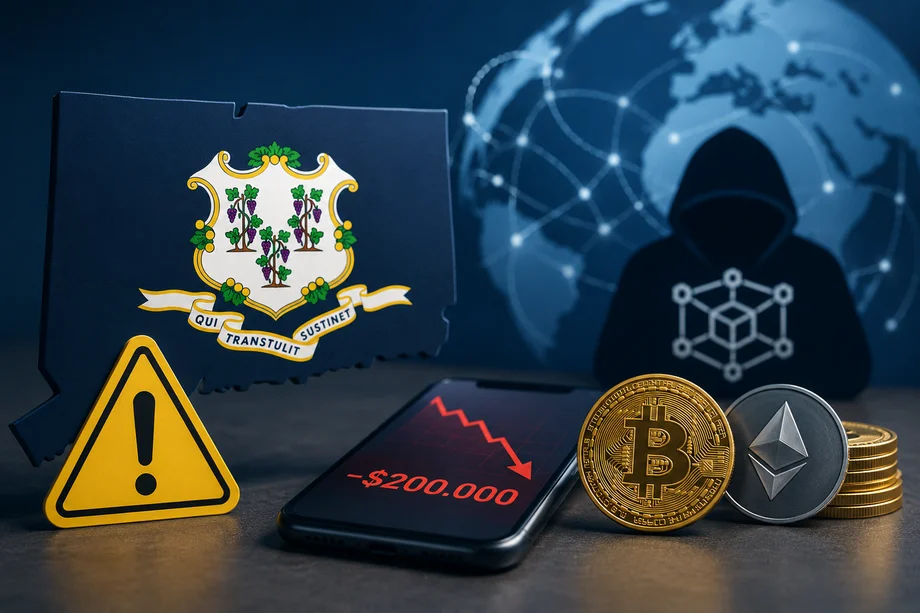
Attorney General William Tong and Banking Commissioner Jorge Perez issued a consumer alert after a resident deposited funds into an unregulated exchange and could not recover them
Connecticut authorities have cautioned residents about the risks of using unregulated offshore decentralized finance platforms following a report that one state resident lost $200,000. The funds were deposited after a solicitation by a person claiming familiarity with the individual, according to a consumer alert released by the Attorney General’s Office on September 3.
The resident has been unable to recover the money. Officials did not name the specific platform involved in the deposit or the individual who encouraged the transfer. Attorney General William Tong and Banking Commissioner Jorge Perez jointly highlighted the case as an example of the limited recovery options available when problems arise on platforms operating outside U.S. regulatory frameworks.
Platforms Named as Examples of Offshore Operations
The alert identified seven platforms as examples of offshore DeFi services that operate beyond U.S. regulatory safeguards: GMX, Gains Network, dYdX, Aevo, Drift Protocol, Vertex Protocol, and Hyperliquid. Officials made clear that naming these platforms does not mean any of them received the resident’s $200,000 or participated in the alleged deception.
Many of these services describe themselves as decentralized, allowing traders to interact through digital wallets and software systems. State officials noted that elements of their operations can still rely on corporate entities, private management teams, or other centralized controls. Access typically requires only a connected crypto wallet rather than the identity verification standard at registered U.S. financial institutions.
Commissioner Perez urged residents to confirm a service’s registration status before sending funds, stating that platforms outside U.S. oversight do not offer the protections required of regulated financial firms.
High Leverage and Synthetic Exposure Draw Scrutiny
A central focus of the warning involves perpetual contracts, which allow traders to take leveraged positions without buying the underlying asset. These contracts have no fixed expiration and rely on recurring funding payments to track market prices. Some offshore platforms offer leverage of 50x, 100x, or as high as 250x. At elevated levels, a modest price movement against a position can eliminate the trader’s collateral.
The Commodity Futures Trading Commission has advised Americans to use registered exchanges when trading crypto perpetual contracts. The agency notes that leverage limits on regulated venues are set through each exchange’s risk-management rules, while high-leverage offerings are more common outside its jurisdiction.
Officials also addressed products that track prices of companies such as Apple, Tesla, Nvidia, and SpaceX, along with foreign currencies and commodities. These synthetic contracts provide price exposure only. They do not confer ownership rights, dividends, voting power, or legal claims on company assets. Centralized operators, the alert stated, may alter pricing mechanisms, remove products, suspend trading, or halt withdrawals.
Access Restrictions and International Warnings
Many offshore platforms claim to restrict access by U.S. users. Officials observed that some individuals bypass these measures through virtual private networks or public application programming interfaces. Web-traffic data cited in the alert indicated that approximately 22.6 percent of Hyperliquid’s traffic originates from the United States.
Similar concerns have appeared internationally. The U.K. Financial Conduct Authority listed Hyperliquid as unauthorized in May 2026 and advised consumers to avoid dealing with the firm. Users of unauthorized companies in Britain cannot bring complaints to the Financial Ombudsman Service and lack coverage from the Financial Services Compensation Scheme. Singapore’s Monetary Authority has placed Hyperliquid on its Investor Alert List over unauthorized derivatives activity.
Broader Fraud Risks and Recovery Scams
The alert occurs against a backdrop of significant cryptocurrency investment fraud losses. The FBI’s 2025 Internet Crime Report recorded $7.2 billion in reported U.S. losses in this category, the largest source of financial harm within the bureau’s fraud statistics. Scammers often initiate contact through social media, text messages, advertisements, or dating apps before directing victims to fraudulent platforms.
Authorities also warned that individuals who have already lost funds may later be contacted by people posing as recovery specialists or attorneys who demand advance fees. A July FBI notice described scammers impersonating federal agents and using artificial intelligence tools to target previous victims with false claims of recovered money.
Connecticut has previously acted on related risks, prohibiting cryptocurrency kiosks since January 2026. Officials advised residents who believe they have been targeted to preserve wallet records, transaction details, messages, and emails, and to report suspected fraud to the Attorney General’s Office. They cautioned against paying any party claiming the ability to retrieve lost funds.
In a separate 2025 case, another Connecticut resident reported losing $228,000 in a fraudulent cryptocurrency scheme that depleted investment and retirement accounts. The latest alert reinforces the state’s message that transactions on unregulated platforms are generally irreversible and leave users with few practical avenues for redress.
Disclaimer
This article was generated by AI using information from multiple industry sources. It has not been reviewed or verified by a human editor and may contain inaccuracies, omissions, or misinformation. Readers are encouraged to independently verify any information before making decisions based on its content.Tired of the noise?
Let the bots trade for you.
Trade 24/7, without emotion, with data-driven strategies.
Associated articles

US Authorities Seize Over $25 Million in Crypto From Five Fraud Probes

Federal Prosecutors Move to Seize Crypto Linked to Massachusetts Tech Scams

Arizona Recovers $171,332 for Crypto ATM Scam Victims Under Refund Law
Missouri Sues CoinFlip Over Crypto ATM Fraud and Hidden Fees

U.S. Authorities Seek Forfeiture of $25 Million in Crypto from Romance and Investment Scams
Latest articles

SpaceX and Tesla Set Up Committees to Explore Merger That Would Combine Holdings of Over 30,000 Bitcoins

UK Banks Face Thousands of Complaints Over Crypto Transfer Restrictions
Ripple Backs SEC Proposed Crypto Asset Rules After $150 Million Legal Battle

Blockchain.com Introduces Options Trading on Seven Major Crypto Assets