Newsroom
Charles Schwab Expands Crypto Trading to Include Solana, Avalanche and Chainlink
27 August, 2026 / News / AI / Tags: schwab, charles, clients, chainlink, avalanche
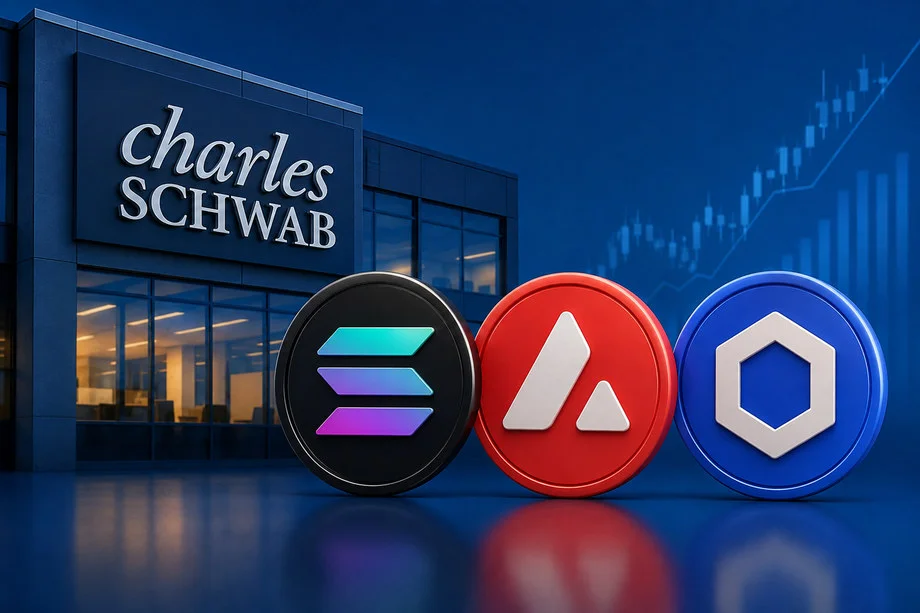
Brokerage firm plans to let clients buy and sell the three tokens on its Schwab Crypto platform in the coming months, building on existing Bitcoin and Ethereum access
Charles Schwab announced on August 27, 2026, that it will expand the digital assets available on its Schwab Crypto platform to include Solana, Avalanche and Chainlink. Clients will be able to buy and sell the tokens through their Schwab Crypto accounts in the coming months.
The platform, which began rolling out in May 2026, currently provides direct trading access only to Bitcoin and Ethereum. The new additions form part of the firm’s stated plan to broaden its offerings with established cryptocurrencies that match client demand. No exact launch date has been set, and the company has not specified whether the three assets will become available simultaneously or in stages.
Details of the Expansion
Schwab Crypto accounts are offered through Charles Schwab Premier Bank. Trade execution and sub-custody are handled by Paxos. Clients can view and manage their cryptocurrency holdings alongside traditional investments such as stocks, bonds and exchange-traded funds on Schwab.com, the Schwab Mobile app and the thinkorswim platform.
Transaction fees are set at 75 basis points of the dollar value of each trade. The firm describes this pricing as among the lowest in the industry for similar services. Educational resources accompany the trading product, including research from the Schwab Center for Financial Research and specialized content delivered through Schwab Coaching.
Schwab has confirmed it intends to introduce additional cryptocurrencies and digital assets to the platform over time. Selection will continue to be guided by client interest and a focus on established tokens.
Platform Scope and Limitations
At the end of the second quarter, Charles Schwab reported $13.1 trillion in total client assets and 39.8 million active brokerage accounts. The firm recorded $7.1 billion in quarterly revenue, a 21 percent increase from the prior year, while daily average trades rose 57 percent to 11.9 million.
Schwab Crypto accounts are available in all U.S. states except New York and Louisiana. They are not offered in U.S. territories or any international jurisdictions. Accounts may be restricted or closed if a client moves to an unsupported location. Not all applicants qualify.
The service does not currently support external deposits or withdrawals of cryptocurrency, though the company has begun testing transfer functionality. Staking, on-chain withdrawals and deposits for the newly announced tokens have not been confirmed for the initial rollout.
Market Response
Following the announcement, Solana advanced more than 9 percent over a 24-hour period, trading near $104.84 with an intraday range between $95.23 and $105.55. Reported trading volume for the token rose nearly 70 percent. Avalanche and Chainlink each posted gains of more than 2 percent within the first hour after the news, with Chainlink extending its 24-hour increase beyond 5 percent.
The broader cryptocurrency market also moved higher during the same period, so the full extent of any price impact specifically tied to the Schwab announcement cannot be isolated. The firm has previously enabled clients to gain cryptocurrency exposure through exchange-traded products, futures and a thematic ETF. Before the launch of direct trading, clients held roughly $25 billion in crypto exchange-traded products through the brokerage.
Schwab is separately developing additional market-related offerings, including participation in prediction-market contracts tied to the Mini-S&P 500 Index. A potential mid-2027 expansion of crypto services for registered investment advisers remains under consideration, subject to timing adjustments.
Cryptocurrency products involve significant risk, including the possibility of total loss of principal. The assets are not deposits, are not FDIC insured, are not SIPC protected and are highly volatile. Schwab may delay, modify or withdraw support for any announced asset based on market, regulatory, operational or risk-related developments.


Disclaimer
This article was generated by AI using information from multiple industry sources. It has not been reviewed or verified by a human editor and may contain inaccuracies, omissions, or misinformation. Readers are encouraged to independently verify any information before making decisions based on its content.Tired of the noise?
Let the bots trade for you.
Trade 24/7, without emotion, with data-driven strategies.
Associated articles

Schwab Rolls Out Bitcoin and Ether Trading to Millions of Retail Clients

Charles Schwab Activates Direct Bitcoin and Ether Trading for Nearly 40 Million Accounts

Coinbase Extends Webull Partnership for Crypto Services in Canada

Charles Schwab Rolls Out Direct Bitcoin and Ethereum Trading for Retail Investors

Interactive Brokers Launches Ethereum Staking to Boost Client Rewards on Holdings
Latest articles

SkyAI Exits Solana Holdings Completely, Launches $201 Million Share Buyback

Strategy Buys 267 Bitcoin and Raises Preferred Share Buyback Cap to $3 Billion

Dormant 2013 Bitcoin Wallets Shift Over $67 Million After More Than a Decade

Binance Rolls Out AI Pro Tool for Chat-Based Automated Trading Strategies