Newsroom
Chainlink Debuts CCIP Vault Adapters Enabling Deposits From Over 80 Chains
9 October, 2026 / News / AI / Tags: adapters, vault, vaults, ccip, deposits

New infrastructure lets DeFi vaults accept cross-chain deposits in a single step while keeping core operations on one home network, with early adoption by major protocols
New Adapters Simplify Multi-Chain Vault Access
Chainlink introduced CCIP Vault Adapters on October 8, allowing decentralized finance vaults deployed on a single network to receive deposits from users across more than 80 supported blockchains. The system relies on the company’s Cross-Chain Interoperability Protocol to handle messaging and token transfers, removing the need for users to bridge assets manually, switch networks, or complete multiple separate transactions.
The initial release focuses on ERC-4626 vaults, a common standard for tokenized vault products. Deposits can originate from other chains, yet accounting, governance, and risk controls remain concentrated on the vault’s primary network. Protocols integrate the adapters through a factory contract without writing custom cross-chain code.
Benefits for Users and Vault Operators
For users, the process collapses into one action. Instead of selecting a bridge, waiting for settlement, changing wallet networks, and then interacting with the target application, capital can move directly into the vault from the user’s current chain.
Vault operators gain a different advantage. Rather than launching duplicate vaults on multiple networks and fragmenting liquidity, a protocol can keep strategy logic, total value locked, and operational controls on one home chain. Cross-chain deposits are routed in through the standardized adapters, preserving a unified view of the vault’s state.
Early Adopters and Specific Use Cases
Several platforms have begun integrating or using the infrastructure. These include Aave, Lombard, Venus, Huma Finance, Veda, Accountable, Enzyme, United Stables, Re, World Liberty Financial, Turtle, Saturn, and RockawayX.
Lombard can route Bitcoin-related deposits from other networks into a strategy hosted on Ethereum. Aave can expand access to its sGHO vault beyond Ethereum while retaining the underlying architecture on its home chain. The design positions the adapters as a distribution layer for on-chain financial products that package lending, credit, tokenized assets, and structured yield.
Connection to Prior Protocol Upgrades
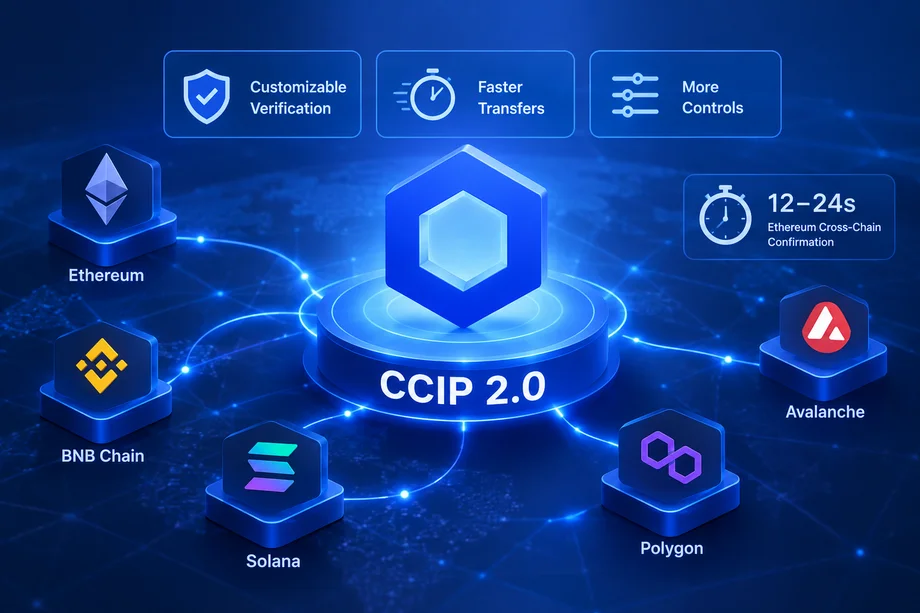
The launch builds on the September 28 release of CCIP 2.0. That upgrade introduced optional cross-chain verification, configurable confirmation speeds, modular fees, and additional compliance options aimed at institutions and asset issuers. The vault adapters extend those capabilities specifically to deposit flows into DeFi strategies.
LINK Market Activity on Launch Day
The announcement coincided with elevated large-transaction activity in LINK. On October 8, 681 transfers or transactions valued at $100,000 or more were recorded, the highest daily count in 2026 and the highest since November 19, 2025. The metric tracks size only and does not indicate whether tokens were purchased, sold, or moved between wallets.
LINK closed the day at $12.70. Market capitalization stood at $9.97 billion, with 24-hour trading volume of $369.34 million. Intraday prices ranged from a low of $12.114 to a high of $13.366.
By enabling vaults to reach users across dozens of networks without relocating the vaults themselves, the adapters aim to reduce one of the persistent frictions in multi-chain DeFi: fragmented capital and multi-step deposit paths.

Disclaimer
This article was generated by AI using information from multiple industry sources. It has not been reviewed or verified by a human editor and may contain inaccuracies, omissions, or misinformation. Readers are encouraged to independently verify any information before making decisions based on its content.Tired of the noise?
Let the bots trade for you.
Trade 24/7, without emotion, with data-driven strategies.
Associated articles
Chainlink Rolls Out CCIP 2.0 With Institutional Controls and Faster Cross-Chain Speeds

Solv Ditches LayerZero for Chainlink to Secure $700M+ in Tokenized Bitcoin

Nethermind Ends LayerZero Verifier Role, Joins Chainlink as Node Operator

THORChain Hit by Over $10M Exploit: Trading Halted Across Bitcoin, Ethereum and Base
Wyoming Migrates State Stablecoin FRNT to Chainlink CCIP After Security Review
Latest articles

Blockchain.com Seeks CFTC Approval to Launch U.S. Event Contracts and Crypto Derivatives

New York Bans Celsius Founder Mashinsky for Life, Secures Up to 35 Million in Settlement

Bessent Warns of $1 Billion Iran Crypto Seizure as US Tightens Sanctions

MARA Holdings Transfers 996 Bitcoin Worth $81 Million to Galaxy Digital