Newsroom
BIS Tests XRP Ledger to Verify Official Economic Statistics in Seconds
3 September, 2026 / News / AI / Tags: statistics, ledger, statistical, sdmx, xrp
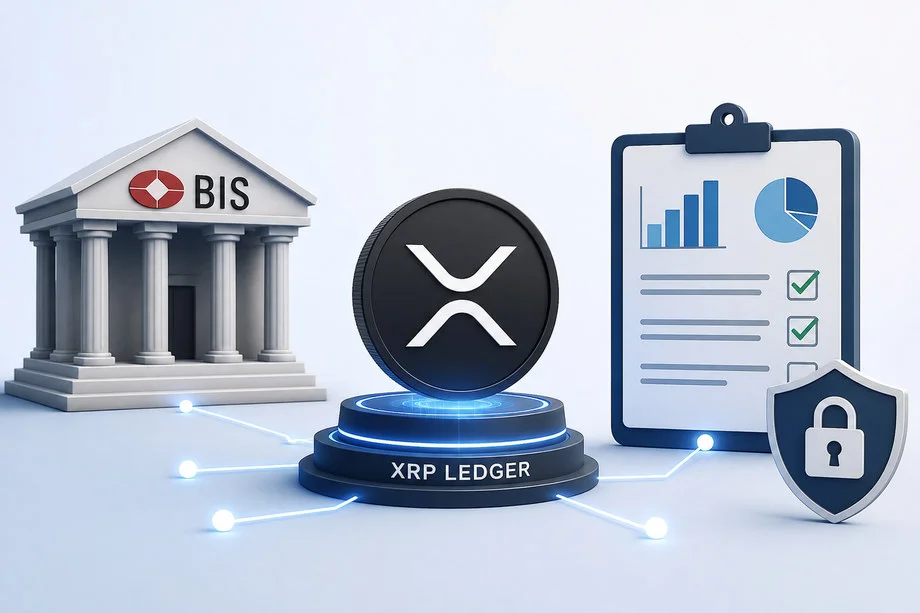
Researchers at the Bank for International Settlements developed a proof-of-concept system that anchors cryptographic fingerprints of statistical datasets on the XRP Ledger, enabling rapid integrity checks
The Bank for International Settlements has published a working paper detailing a blockchain-based prototype designed to let users independently confirm the origin and integrity of official economic statistics. The system records cryptographic fingerprints of datasets on the XRP Ledger rather than placing the underlying data on-chain, allowing any recipient to detect post-publication alterations.
Working Paper 1374, titled “Verifiable Official Statistics: A Blockchain-Based Approach,” was released on September 2, 2026. It describes a method that integrates with the Statistical Data and Metadata eXchange standard, widely used by the BIS, the International Monetary Fund, the European Central Bank and other institutions to distribute economic figures such as gross domestic product, inflation measures and banking statistics.
How the Verification System Works
Official statistics are routinely downloaded from websites, databases and automated feeds. Recipients currently have limited independent means to confirm that a file matches the version originally published and has not been modified, whether by error or by third parties. The prototype addresses this gap by computing a SHA3-512 cryptographic hash of each standardized SDMX dataset or of individual statistical series within it.
When multiple series are involved, the hashes are combined into a Merkle root. That single summary value is then recorded on the XRP Ledger through a Payment transaction that uses the memo field. A reference to the on-chain transaction, together with the ordered Merkle leaves and a W3C Verifiable Credential, is embedded in the published SDMX file itself. The credential links the publisher’s identity key to an XRP Ledger address via an on-chain attestation registry.
A user or automated system can therefore recompute the fingerprint from the received file and compare it against the immutable ledger record with a single lookup. The design confirms that the data matches the version tied to the original publication and that the publisher controlled the recognized address; it does not attest to the accuracy of the underlying statistics.
Performance Under Controlled Tests
Testing took place on the XRP Ledger DevNet environment. Researchers reported a median publication latency of three to five seconds for creating and confirming the on-chain record. Verification of a dataset fingerprint required approximately one to two seconds. Transaction costs were described as negligible, on the order of a fraction of a cent, and a single ledger entry can cover large batches of datasets through Merkle aggregation.
| Metric | Result |
|---|---|
| Median publication latency | 3–5 seconds |
| Verification time | 1–2 seconds |
| Environment | XRP Ledger DevNet |
| Data format | SDMX (extensible to others) |
The XRP Ledger was selected for the prototype because of its low transaction fees, rapid consensus finality and available developer resources. The architecture is intended to be blockchain-agnostic and could be adapted to other networks. The paper notes that the same pattern of canonicalization, hashing, aggregation and anchoring could extend beyond SDMX to formats such as XBRL.
Scope and Limitations
The authors emphasize that the work is an experimental proof of concept. The software has been released as open source under an Apache 2.0 license but is neither intended for production use nor actively maintained. Measurements reflect controlled DevNet conditions and should not be treated as guarantees of mainnet performance. The paper’s conclusions belong to the authors and do not necessarily represent the institutional position of the BIS.
Only cryptographic fingerprints are placed on-chain, preserving confidentiality of the statistical content. The system does not require the use of XRP for payments or settlement; the native asset serves solely to pay the minimal transaction fee associated with anchoring a record.
Possible Extensions
The researchers outline several avenues for further development. Zero-knowledge proofs could allow selective disclosure of individual series within a confidential batch. The verification artefacts are machine-readable, opening the possibility that artificial-intelligence agents retrieving official data could automatically reject altered or misattributed files. The paper also sketches a longer-term path in which verified on-chain statistics could support programmable financial instruments whose terms adjust automatically according to authenticated economic indicators.
The prototype demonstrates one practical application of public blockchain technology to the integrity of official data dissemination. By anchoring fingerprints rather than the data itself, the approach seeks to strengthen user confidence without altering existing statistical workflows.

Disclaimer
This article was generated by AI using information from multiple industry sources. It has not been reviewed or verified by a human editor and may contain inaccuracies, omissions, or misinformation. Readers are encouraged to independently verify any information before making decisions based on its content.Tired of the noise?
Let the bots trade for you.
Trade 24/7, without emotion, with data-driven strategies.
Associated articles

Ripple Teams with Clearpool and Cicada on Institutional Lending for XRP Ledger

XRP Ledger Shatters Records as 332,230 Whale Wallets Signal Strong Accumulation

Chainlink Delivers Official US Economic Data Feeds Across 10 Blockchains

XRP Ledger Mystery: 300,000 New Accounts Raise Questions About Unnatural Activity

RippleX Launches Ninth Smart Escrow Devnet with Rust Migration for XRPL
Latest articles

Blockchain Association Urges Clarity on DeFi and Stablecoin Rules Under GENIUS Act

XRP Launches Official X Account, Jointly Managed by Ripple and XRPL Foundation

ESMA Expands MiCA Register to 375 Providers as BingX, YouHodler and Openbank Join

France Narrowly Approves Crypto-to-Stablecoin Tax from 2027