Newsroom
Apple and Google Recruit Talent for Stablecoin and Blockchain Expertise in Payments
21 September, 2026 / News / AI / Tags: apple, google, kong, hong, cloud
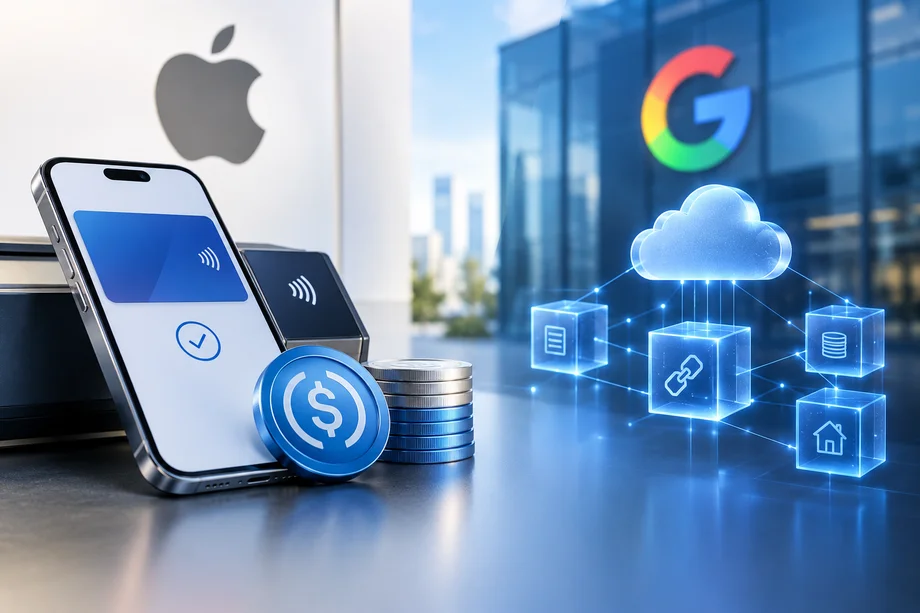
Apple seeks a financial product strategist for Apple Pay with preferred knowledge of stablecoins and tokenized deposits, while Google hires a Web3 architect in Hong Kong for institutional digital-asset systems
Apple and Google have posted senior job openings that list expertise in stablecoins, tokenized deposits, and blockchain technology among preferred qualifications. The roles focus on payments strategy and institutional infrastructure rather than any confirmed product launch.
Neither company has announced plans to issue a stablecoin or introduce a related consumer service. The postings indicate internal evaluation of digital-asset capabilities within existing financial and cloud businesses.
Apple Targets Strategy Role Within Apple Pay
Apple listed a U.S.-based Apple Pay Financial Product Strategy Lead position on August 26. The role sits within the Apple Card and Apple Cash group, which manages consumer credit cards, peer-to-peer transfers, stored value, and related financial products linked to Apple Pay.
Preferred qualifications include understanding of stablecoins, tokenized deposits, and blockchain technology. Core requirements call for at least six years of experience in consulting, investment banking, corporate strategy, strategic finance, or a comparable planning function, plus familiarity with consumer payment models, international payment systems, and financial modeling.
The hire will assess new product structures, commercial models, and potential partnerships while shaping long-term financial product strategy. Responsibilities include identifying growth opportunities, building business cases, and collaborating with product, business development, and data science teams across Wallets, Payments, and Commerce projects.
Base pay ranges from $149,700 to $280,000 depending on qualifications, experience, and location. Apple’s current public materials describe Apple Pay services around conventional card, merchant, peer-to-peer, and digital wallet rails. In January the company announced that Chase will become the new issuer of Apple Card, with the transition expected to take about 24 months; Mastercard remains the payment network during the change.
Google Seeks Institutional Web3 Architect in Hong Kong
Google is recruiting an Industry Principal Architect for Web3 based in Hong Kong. The position supports Google Cloud engagements across the Asia-Pacific region with blockchain foundations, institutional exchanges, digital-asset custodians, financial institutions, and decentralized applications.
Candidates need 10 years of experience in system architecture, distributed systems, or cloud infrastructure, plus at least four years working with production-grade Web3 systems, blockchain protocols, or smart-contract ecosystems. Preferred qualifications cover real-world asset tokenization, stablecoin rails, tokenized deposits, digital-asset custody architectures for regulated institutions, multi-party computation, hardware security modules, transaction-signing systems, and confidential computing.
The architect will help design systems involving validator operations, blockchain indexing, key management, and enterprise security. The role also includes guiding customers on virtual-asset risk, security, and compliance frameworks aligned with regional rules, including those of the Hong Kong Monetary Authority and the Securities and Futures Commission. The position is described as a bridge between customers and Google’s product and engineering teams, with potential to inform the company’s Web3 product roadmap by identifying recurring infrastructure needs.
Google’s Existing Digital-Asset Infrastructure
Google Cloud already offers products that support tokenized payments and blockchain systems. Its Universal Ledger is a managed distributed-ledger service that lets financial institutions create payment services, tokenize assets, and manage digital representations of commercial bank money. Operators can mint, transfer, and burn tokenized forms of value under defined permissions. The service is positioned for banks and intermediaries building payment and financial-market products.
Separately, Google developed the Agent Payments Protocol, or AP2, which includes extensions for stablecoins and cryptocurrencies. An extension developed with Coinbase, the Ethereum Foundation, MetaMask, and other participants supports agent-based crypto payments using cryptographically signed mandates. In May, Google Cloud and the Solana Foundation launched Pay.sh, which enables AI agents to pay for APIs and cloud resources using stablecoins on Solana.
A Google Cloud executive has described crypto payment rails as useful for autonomous agents that cannot open conventional bank accounts under existing technological and regulatory systems.
Hong Kong Regulatory Context
Google’s choice of Hong Kong places the role in a jurisdiction that regulates fiat-referenced stablecoin issuers. The Stablecoins Ordinance took effect on August 1, 2025, establishing a licensing regime for companies issuing such stablecoins in Hong Kong. The Hong Kong Monetary Authority has said it is processing applications and expects to grant only a small number of licenses initially. Rules cover reserve management, governance, risk controls, and anti-money-laundering obligations for issuers operating in Hong Kong, overseas issuers marketing Hong Kong dollar-pegged stablecoins, and firms marketing regulated issuance services to the local public.
The authority’s priorities for 2026 include processing applications, supervising licensed issuers, and monitoring the local market. It is also running a program through 2026 to test real-value transactions involving tokenized assets and tokenized deposits. A public register of licensed stablecoin issuers is planned for December 2026.
Broader Industry Interest
Consumer technology companies are examining stablecoin payments in different ways. Samsung has previously indicated plans to add stablecoin support to Samsung Wallet, though it has not disclosed supported assets, technology partners, or a launch timetable. An earlier Samsung U.S. unit recruitment for a business development manager in Samsung Wallet payments listed stablecoins among possible partnership areas alongside card issuers and fintech companies.
The Apple and Google openings share a focus on understanding how blockchain-based financial infrastructure could connect with existing payment and cloud services. Apple’s role centers on consumer financial products already in daily use. Google’s centers on enterprise infrastructure for institutional clients. Both represent talent acquisition and strategic evaluation rather than confirmed product decisions.
| Company | Role | Location | Key Preferred Expertise | Primary Focus |
|---|---|---|---|---|
| Apple | Apple Pay Financial Product Strategy Lead | United States | Stablecoins, tokenized deposits, blockchain | Consumer payments and financial services strategy |
| Industry Principal Architect, Web3 | Hong Kong | RWA tokenization, stablecoin rails, tokenized deposits, digital-asset custody | Institutional digital-asset infrastructure and compliance |
Any future partnerships, products, or services would require separate official announcements. The current postings establish only that both companies are building internal knowledge of stablecoin and tokenization technologies as these tools gain attention in payments and institutional finance.


Disclaimer
This article was generated by AI using information from multiple industry sources. It has not been reviewed or verified by a human editor and may contain inaccuracies, omissions, or misinformation. Readers are encouraged to independently verify any information before making decisions based on its content.Tired of the noise?
Let the bots trade for you.
Trade 24/7, without emotion, with data-driven strategies.
Associated articles

Kakao Pay and KakaoBank Partner With Fireblocks on Stablecoin Infrastructure Tests

Samsung Affiliates Acquire $408M Stake in Upbit Parent Dunamu

Mastercard Completes $1.8 Billion BVNK Acquisition to Link Crypto and Traditional Payments

Taurus Connects Tokenization Platforms to Swift Blockchain Ledger for Bank Tokenized Deposits
Securitize Partners with LG CNS on Tokenized Assets as South Korea Prepares 2027 Framework
Latest articles

Papertrade Restricts New Positions After Hyperliquid Price Manipulation Claims

Liquid Network Peg-Outs Remain Frozen 35 Days After Exploit Leaves 598.5 BTC Unreturned
Conflux Token Surges Over 35% as China Blockchain Network Proposal Sparks Rally
Coldcard Investigates Phishing Post on Official X Account After July Bitcoin Thefts