Newsroom
Anthropic Prepares IPO Pitch With $30 Trillion Market Claim and Strong Revenue Growth
26 August, 2026 / News / AI / Tags: anthropic, trillion, alger, claude, addressable

The AI firm eyes a record listing near a $2 trillion valuation after posting $11.6 billion in second-quarter sales and an annualized revenue run rate above $65 billion
Anthropic is advancing plans for a public offering that could rank among the largest in history, telling prospective investors it sees a total addressable market exceeding $30 trillion. The figure surpasses the $28.5 trillion opportunity outlined by SpaceX in its recent listing and rests on the potential for advanced AI models to perform substantial portions of human work across industries.
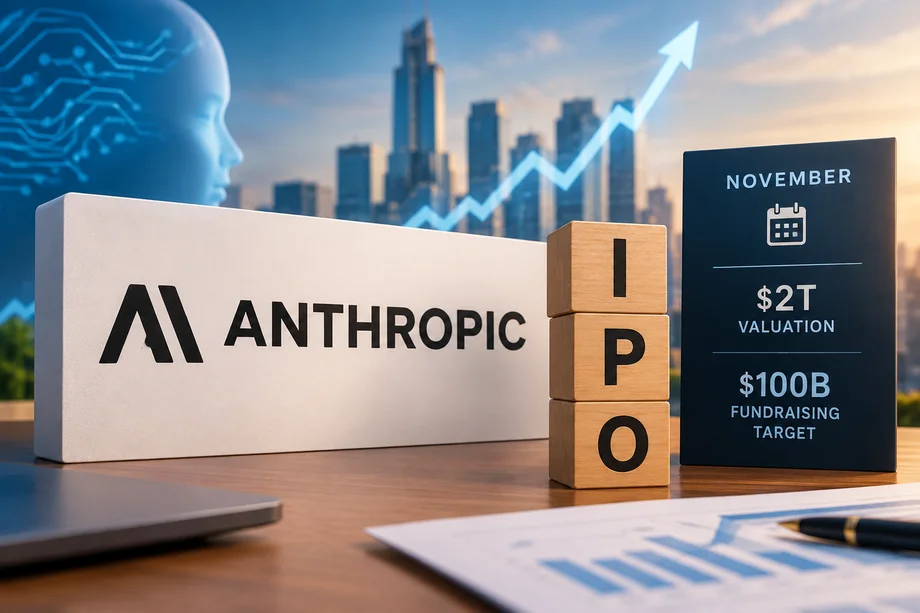
Bankers have discussed a capital raise above $100 billion at a valuation approaching $2 trillion. The company filed an early S-1 in June and could submit a full prospectus before the end of August, with some reports suggesting trading might begin as early as October. No official date has been set.
Rapid Revenue Expansion and First Positive Adjusted Results
Anthropic’s business has scaled sharply. Annualized revenue stood above $65 billion at the end of July, up from roughly $9 billion in late 2025. Preliminary second-quarter revenue reached $11.5 billion to $11.6 billion, more than doubling prior levels and exceeding OpenAI’s $6.7 billion for the same period for the first time.
The quarter also produced positive adjusted operating income, described as a first among frontier AI laboratories. The company has not detailed the precise calculation, though updates to investors have excluded stock-based compensation. Full-year 2025 results showed a $42 billion loss, and heavy compute expenses could return later periods to red ink. Unaudited figures may still be revised ahead of any formal filing.
Anthropic has forecast revenue of up to $200 billion by 2028. That total would represent less than 1 percent of the $30 trillion market it now cites. The 191 technology companies in the S&P 1500 generated about $2.4 trillion in combined revenue last year, making the AI firm’s projected opportunity more than twelve times larger.
Market Opportunity and Historical Comparisons
Total addressable market estimates for AI companies have expanded quickly. SpaceX described its $28.5 trillion figure, of which $26.5 trillion related to AI, as the largest actionable market in human history. Earlier IPOs set lower benchmarks: Uber valued its opportunity at $6 trillion in 2019, while WeWork pointed to $3 trillion before withdrawing its plans.
Anthropic’s calculation focuses on the value of work that sophisticated models could eventually handle in programming, research, customer service, finance, media, healthcare, logistics and other fields. The company continues to develop its Claude models and Claude Code tools while positioning itself in the enterprise AI segment.
Chief Financial Officer Krishna Rao has held early meetings with potential investors, discussing the Claude product suite, enterprise positioning, management team and recent launches.
Private Market Pricing and Retail Access Routes
As of August 11, Nasdaq Private Market estimated Anthropic shares at $692.39 each, drawing on private transactions and other data. An earlier private-market valuation stood near $965 billion in May. Later-stage private rounds typically remain limited to institutions, venture funds, founders, employees and high-net-worth individuals.
Retail investors seeking pre-IPO exposure can turn to several publicly listed vehicles that already hold Anthropic shares. These include the iShares AI Innovation and Tech Active ETF, the T. Rowe Price Technology ETF, the KraneShares Public-Private AI and Technology ETF, and three Alger funds: the Alger 35 ETF, the Alger AI Enablers and Adopters ETF, and the Alger Concentrated Equity ETF. The last of these carries the largest Anthropic weighting, still below 4 percent of assets.
Additional options are the ARK Venture Fund, a closed-end vehicle with a $500 minimum investment and a 2.9 percent net expense ratio, and the Fundrise Innovation Fund, which accepts investments starting at $10. Both closed-end structures limit liquidity. Positions in these funds provide only partial exposure to Anthropic alongside other holdings.
External Pressures and Competitive Dynamics
Several external factors could influence the timing and reception of an offering. Political resistance to data-center construction has appeared in multiple states. Texas paused new projects pending audits, Pennsylvania ended fast-track permitting, and New York imposed a one-year moratorium. Rising Treasury yields and concerns about AI-related debt issuance add further pressure.
Anthropic relies on Amazon and Google for compute capacity and lacks an investment-grade credit rating. The firm plans to list negative public sentiment toward AI as a risk factor in its prospectus. Competition from lower-priced Chinese models has also intensified, prompting price adjustments across the sector.
OpenAI, while still larger in user base, recorded slower growth and widening losses in the same quarter. Anthropic’s Claude Code tools have gained traction among developers, altering competitive dynamics in 2026. Both companies face ongoing capital needs for infrastructure long before sustained profitability is expected.
SpaceX shares rose after listing then retreated, trading below $105 intraday in early August before recovering near the offering price. Anthropic’s eventual reception is expected to influence subsequent AI company listings, including OpenAI’s anticipated 2027 timeline.
Disclaimer
This article was generated by AI using information from multiple industry sources. It has not been reviewed or verified by a human editor and may contain inaccuracies, omissions, or misinformation. Readers are encouraged to independently verify any information before making decisions based on its content.Tired of the noise?
Let the bots trade for you.
Trade 24/7, without emotion, with data-driven strategies.
Associated articles

Anthropic Prepares Mid-October IPO Push Targeting Near $2 Trillion Valuation

Anthropic Accelerates IPO Plans, Eyes Record Raise Surpassing SpaceX

Anthropic Reports $16.8 Billion Q3 Revenue and Adjusted Profit Ahead of Planned IPO
Anthropic Shifts Planned IPO to November Targeting $2 Trillion Valuation

OpenAI Targets $30 Billion Raise at $1.4 Trillion Valuation Ahead of Delayed IPO
Latest articles

SpaceX and Tesla Set Up Committees to Explore Merger That Would Combine Holdings of Over 30,000 Bitcoins

UK Banks Face Thousands of Complaints Over Crypto Transfer Restrictions

Ripple Backs SEC Proposed Crypto Asset Rules After $150 Million Legal Battle

Blockchain.com Introduces Options Trading on Seven Major Crypto Assets
