Newsroom
Anthropic Founders Seek 50.1% Voting Power Ahead of Planned IPO
25 September, 2026 / News / AI / Tags: founders, voting, anthropic, board, shareholder
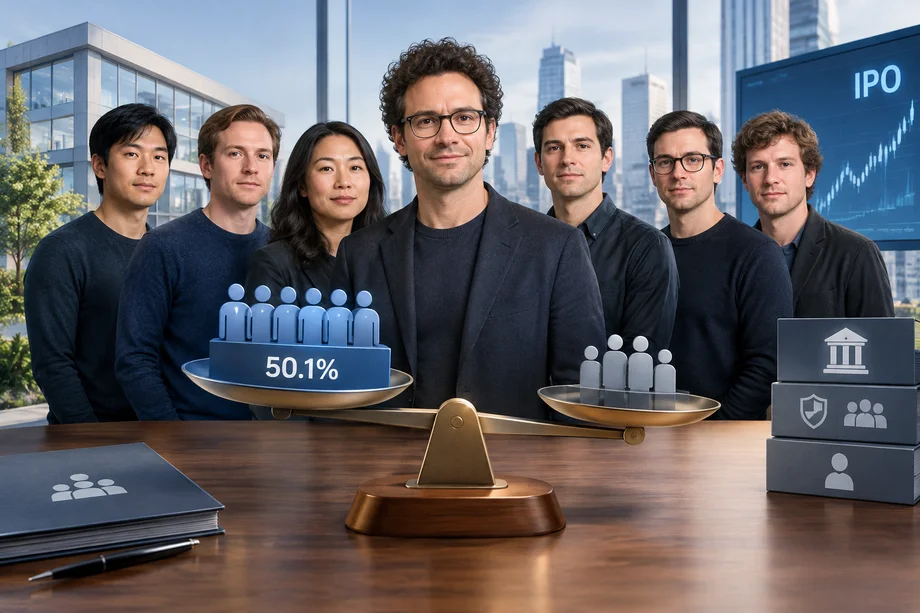
Seven co-founders, including CEO Dario Amodei, request special shares granting majority control on most matters while each holds about 2% equity
Anthropic is seeking shareholder approval for a governance plan that would grant its seven co-founders a combined 50.1% of voting power on most corporate decisions after a potential initial public offering. The arrangement would apply only if at least three of the founders continue to hold a minimum number of shares, a threshold the company has not disclosed.
Special Share Class Separates Voting from Economic Stakes
Each of the seven founders currently owns roughly 2% of the company. The proposed special class of shares would multiply their voting weight without increasing their economic ownership. This structure would allow the founding group to maintain collective control over shareholder votes even if their combined equity remains well below 50%.
The plan draws comparisons to founder-control mechanisms used by other technology firms, including a structure similar to that employed by Palantir. Unlike arrangements concentrated in a single individual, Anthropic’s proposal distributes control across the seven co-founders. Shareholder approval remains required before the structure can take effect.
Board Authority Stays with Long-Term Benefit Trust
While founders would gain majority voting power on most shareholder matters, board composition would follow a different path. Anthropic’s Long-Term Benefit Trust, an independent body whose members hold no financial interest in the company, would continue to elect most directors. The number of board seats elected by founders would rise from two to three on the seven-seat board, one of which is currently vacant.
Anthropic operates as a public benefit corporation. The trust holds a separate class of stock that authorizes it to elect and remove directors, with that authority designed to expand toward a majority of seats. Employees would receive another special class of shares capable of breaking ties on certain corporate decisions, without affecting the trust’s board-election powers.
The dual system places voting rights on ordinary shareholder matters with the founders while leaving board selection primarily under the trust’s control. Prospective investors would need to examine the eventual prospectus for details on how these authorities interact.
IPO Preparations and Valuation Context
Anthropic has confidentially filed for a U.S. listing. Timing and valuation figures have shifted in recent reports. A May funding round raised $65 billion at a post-money valuation of $965 billion, with annualized revenue reported above $47 billion at that time. Secondary-market estimates have since placed the company’s value near $1.5 trillion. Separate reports have discussed a possible November listing that could raise up to $100 billion at a valuation around $2 trillion, though those terms remain preliminary and subject to change.
Earlier indications pointed to a prospectus in late September and potential investor marketing in mid-October, both timelines remaining flexible. The Securities and Exchange Commission directs investors reviewing any IPO to study the prospectus for share-class details and voting rights, noting that amplified voting power can allow founders to steer decisions while holding a minority of equity.
Trading platforms have already introduced contracts linked to Anthropic’s private-market valuation. These instruments provide price exposure without conveying shares, dividends or voting rights. One platform excludes U.S. customers; another offers contracts to eligible European clients with leverage up to ten times, though prices on such products can diverge from both private valuations and any eventual public offering price.
The proposed voting structure, if approved, would codify founder influence over key shareholder votes while preserving the trust’s role in board selection as the company prepares for public markets.
Disclaimer
This article was generated by AI using information from multiple industry sources. It has not been reviewed or verified by a human editor and may contain inaccuracies, omissions, or misinformation. Readers are encouraged to independently verify any information before making decisions based on its content.Tired of the noise?
Let the bots trade for you.
Trade 24/7, without emotion, with data-driven strategies.
Associated articles

Anthropic Accelerates IPO Plans, Eyes Record Raise Surpassing SpaceX

OpenAI Targets $30 Billion Raise at $1.4 Trillion Valuation Ahead of Delayed IPO
Anthropic IPO Filing Details $4.59 Billion Revenue, $42 Billion Loss and $518 Billion Infrastructure Commitments

Kinetics Fund Discloses Stake in Private Ripple Labs Shares via SEC Filing

Anthropic Prepares Mid-October IPO Push Targeting Near $2 Trillion Valuation
Latest articles
Babylon Labs Advances Proposal for Native Bitcoin Lending on Aave V4

TSMC Posts Record Q3 Profit Surge on AI Chip Demand, Lifts Full-Year Outlook

ASIC Opens Consultation on Capital and Custody Rules for Digital Asset Platforms

GTA 6 Leaker Cyberleek Drops Full Build Plan After Memecoin Collapse, Activates Dead Man’s Switch Threat