Newsroom
Aave Plans to Deprecate 75 Low-Adoption Reserves and Exit Six Blockchains
30 July, 2026 / News / AI / Tags: aave, supplied, deployments, reserves, scroll
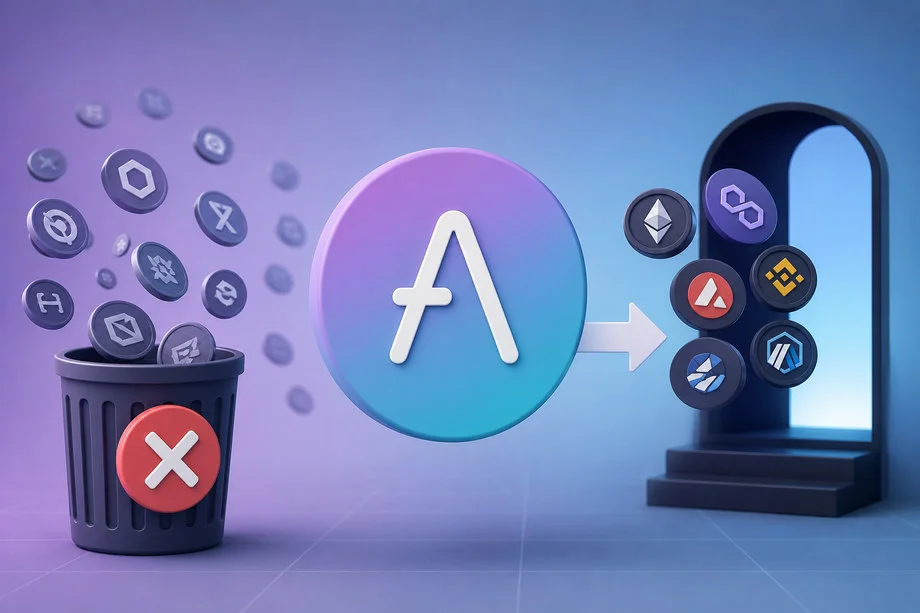
Lending protocol targets underused markets in risk overhaul affecting $98 million in supplied assets as it concentrates on higher-activity networks
Aave, one of the largest decentralized lending protocols, has put forward a governance proposal to phase out 75 low-adoption asset reserves and wind down its deployments on six blockchain networks. The changes form part of a broader risk management effort aimed at cutting operational overhead and focusing resources on markets that generate meaningful activity.
Founder Stani Kulechov announced the plan, stating that a comprehensive review identified reserves whose limited usage no longer justifies the ongoing costs of price feeds, monitoring systems and liquidation infrastructure. The initiative aligns with the protocol’s Risk Framework and Technical Asset Listing Framework.
Scope of the Deprecations
The proposal covers 50 low-adoption reserves across major deployments including Ethereum, Arbitrum, Base, Polygon, Avalanche, Optimism, Gnosis and BSC. Separately, Aave intends to close its markets entirely on Sonic, Scroll, zkSync, Metis, Soneium and Aptos, removing another 25 reserves on those networks.
In total, the measures would affect approximately $98.1 million in supplied assets and $15.6 million in outstanding debt. Of that, the individual reserve removals account for $85.3 million supplied and $11.5 million borrowed, while the six full deployment exits represent $12.8 million supplied and $4.1 million in debt.
Among the assets marked for removal are bridged tokens such as certain USDC variants where native versions already exist, as well as MaticX following the token’s sunsetting. The proposal also retires 21 matured Pendle principal tokens, which will be replaced by newer maturities so that users can continue accessing updated Pendle-based markets.
Gradual Wind-Down Process
Rather than abrupt closures, Aave plans an orderly transition. Affected reserves will first be frozen, blocking new deposits, additional borrowing and the use of the assets as fresh collateral. Supply and borrow caps will be reduced to one unit.
Reserve factors on borrowed assets will be raised, directing a larger share of interest to the protocol treasury and lowering yields for suppliers. For the six full deployments being retired, reserve factors will climb to 99 percent and the base borrowing rate will increase to 5 percent. If positions remain open, further rate adjustments or gradual reductions in liquidation thresholds may follow to encourage repayment and reduce collateral exposure.
Once most positions have unwound, live price feeds on the retiring markets are expected to be replaced with fixed-price oracles before final retirement.
Strategic Context and Protocol Position
The review was prepared by risk service provider LlamaRisk and applies portfolio-wide standards rather than responding to any specific incident. Officials described the step as proactive, noting that low-revenue deployments no longer cover the costs of continued support.
Data on the six networks shows sharp declines in activity over recent months. Sonic holds the largest remaining balances among them at roughly $7.6 million supplied, while others such as Scroll, zkSync, Metis, Soneium and Aptos have seen deposits fall by 74 percent to 94 percent.
Aave continues to operate with approximately $14.3 billion to $14.5 billion in total value locked across 23 chains. At the same time, the protocol has recorded growth on stronger networks, including more than $100 million in deposits on its Monad deployment. Resources are also being directed toward Aave V4 development and institutional market initiatives.
The proposal currently sits at the Aave Request for Comment stage. It will require community feedback, a Snapshot vote and subsequent on-chain approval before implementation can begin. Users holding positions in the affected markets are not required to exit immediately, as the timeline will depend on the governance process and technical preparation.
| Category | Supplied Assets | Outstanding Debt |
|---|---|---|
| Individual reserve removals | $85.3 million | $11.5 million |
| Six deployment exits | $12.8 million | $4.1 million |
| Total | $98.1 million | $15.6 million |
By concentrating activity on higher-liquidity markets, the protocol seeks to lower technical complexity and improve long-term sustainability while maintaining its position as the leading decentralized lending platform.

Disclaimer
This article was generated by AI using information from multiple industry sources. It has not been reviewed or verified by a human editor and may contain inaccuracies, omissions, or misinformation. Readers are encouraged to independently verify any information before making decisions based on its content.Tired of the noise?
Let the bots trade for you.
Trade 24/7, without emotion, with data-driven strategies.
Associated articles
Aave V4 Enables USDC Loans Against Coinbase Tokenized Stocks on Base

Aave V4 Launches on Avalanche to Support Tokenized Asset Lending

Aave Founder Stani Kulechov Denies Kraken Stake Sale at Steep Discount

Ether.fi Expands App With Tokenized Stocks, Portfolio Loans and Broader Fiat Access

More Markets Drained of $9.3 Million in WFLOW on Flow EVM
Latest articles

SpaceX and Tesla Set Up Committees to Explore Merger That Would Combine Holdings of Over 30,000 Bitcoins

UK Banks Face Thousands of Complaints Over Crypto Transfer Restrictions

Ripple Backs SEC Proposed Crypto Asset Rules After $150 Million Legal Battle

Blockchain.com Introduces Options Trading on Seven Major Crypto Assets