Newsroom
Zcash Activates Ironwood Upgrade, Sealing $1.7B Orchard Pool After Vulnerability
28 July, 2026 / News / AI / Tags: orchard, ironwood, zcash, pool, shielded
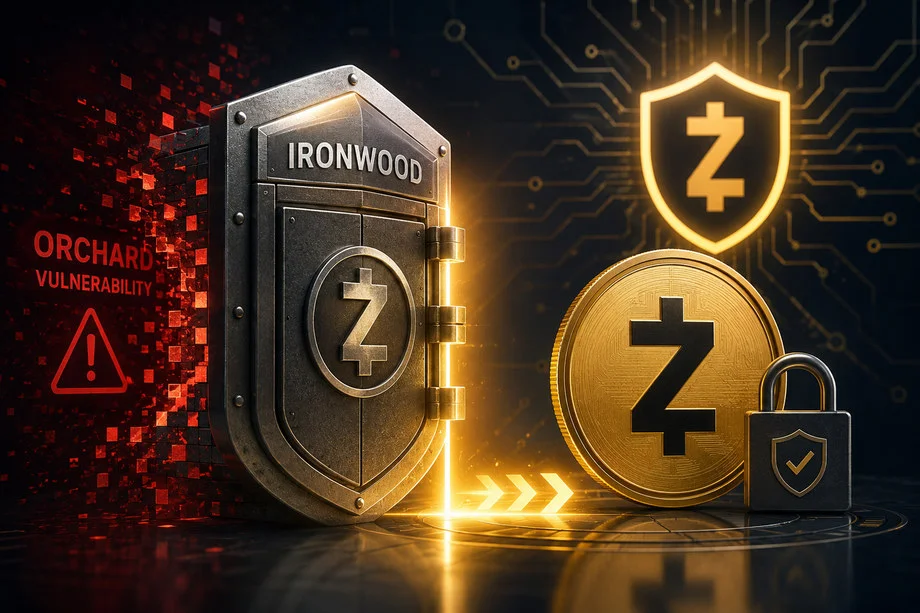
The privacy-focused network retires its main shielded pool following discovery of a long-undetected flaw and opens a new formally verified alternative with stricter controls
Zcash activated its Ironwood network upgrade, formally known as NU6.3, on July 28, 2026, at block height 3,428,143. The change seals the Orchard shielded pool, which held approximately 3.66 million ZEC valued at roughly $1.7 billion, and introduces a new private pool that began with zero coins.
Shielded pools form the private side of the Zcash blockchain, where transaction amounts and participants remain hidden through zero-knowledge proofs. Orchard had served as the primary such pool since its launch in May 2022 and at one point accounted for nearly 88 percent of the network’s shielded token supply.
Discovery of the Vulnerability
The decision to retire Orchard stems from a critical flaw in its proof circuit. Shielded Labs researcher Taylor Hornby identified the issue on May 29. The bug, present since Orchard’s introduction, could have allowed an attacker to create counterfeit ZEC without leaving detectable traces on the blockchain.
Developers applied a patch within days of the finding. An emergency soft fork temporarily restricted Orchard activity in early June, followed by a hard fork that restored corrected functionality. Because the vulnerability existed for four years, however, the privacy features of the pool make it impossible to prove with certainty that no counterfeit coins were ever created.
Available evidence points away from exploitation. Orchard’s balance increased steadily throughout the period the flaw remained open, including during last year’s price rally when any illicit coins would have been most profitable to move and sell.
Turnstile Mechanism and Migration Process
Ironwood installs a turnstile at the boundary of the sealed Orchard pool. This accounting rule ensures that the total amount withdrawn cannot exceed the sum of funds previously recorded as deposited. Any potential counterfeit coins remain trapped inside.
Migration to the new pool is entirely voluntary and user-driven. Early trackers showed between roughly 1,500 and more than 40,000 ZEC already moved into Ironwood shortly after activation. Until holders complete the transfer, the bulk of Zcash’s private supply remains in Orchard, which now supports only withdrawals.
Funds crossing the public boundary between pools remain visible on-chain even while internal activity stays private. This design allows independent verification of the circulating supply across Ironwood, older pools such as Sapling and Sprout, and the remaining audited Orchard balance, helping confirm that the network’s 21 million coin cap has not been breached.
Enhanced Security Features
Ironwood reuses the corrected Orchard circuit and Halo 2 proof system with targeted modifications. The new pool’s proof circuit is undergoing formal verification, a process that produces a mathematical demonstration the software behaves correctly under every possible condition rather than only those tested manually.
The upgrade also incorporates quantum-recoverable notes under ZIP 2005. Each coin transferred into Ironwood leaves a record designed to remain recoverable if future advances in quantum computing compromise the cryptography now protecting the pool.
Development involved coordinated work across Zcash’s ecosystem, including the Zcash Open Development Lab, Project Tachyon, Valar Group, the Zcash Foundation and Shielded Labs. ZODL Executive Director Josh Swihart noted that 14 engineers from the lab contributed the majority of merged changes to the protocol and wallet repositories.
| Feature | Orchard Pool | Ironwood Pool |
|---|---|---|
| Balance at activation | Approximately 3.66 million ZEC | Zero ZEC |
| Status | Sealed; withdrawals only | Active for new private activity |
| Proof circuit | Contained long-undetected vulnerability | Formally verified |
| Additional safeguards | None specific to the flaw | Turnstile and quantum-recoverable notes |
Market Response
ZEC traded near $460 to $475 around the activation. The token registered declines of roughly 8 to 9 percent on the day and about 15 percent over the preceding week, though it remains substantially higher on a year-over-year basis after a strong rally that began in the prior September.
Wallet providers and infrastructure operators are updating software to support the new transaction format and migration tools. Support for the legacy client has ended in favor of the Zebra-based stack. The pace at which the remaining Orchard balances move into Ironwood will determine how quickly the network’s private supply fully transitions to the strengthened system.

Disclaimer
This article was generated by AI using information from multiple industry sources. It has not been reviewed or verified by a human editor and may contain inaccuracies, omissions, or misinformation. Readers are encouraged to independently verify any information before making decisions based on its content.Tired of the noise?
Let the bots trade for you.
Trade 24/7, without emotion, with data-driven strategies.
Associated articles

Zcash Rapidly Fixes Critical Orchard Bug as ZEC Price Surges Over 10%

Zcash Rebounds Strongly After Critical Orchard Bug and Launches Historic Ironwood Upgrade

Zcash Ironwood Hard Fork to Isolate Orchard Pool Vulnerability

Zcash Sets Ironwood Network Upgrade for July 28 Activation

Zcash Rebounds 30% as Developers Defend Supply Integrity After Bug Scare
Latest articles

Lighter Token Climbs More Than 20% on Planned CFTC Filing and Research Note

Samsung and SK Hynix Upgrade China NAND Factories Amid AI Demand and Local Rivalry

China Prosecutors Move to Confiscate $5.1 Billion Bitcoin Haul Seized in UK Fraud Case

Bank of Korea Holds Rate at 3% After Consecutive Hikes, Eyes Data for Next Move