Newsroom
Uniswap Founder Says Tokenization Will Test Automated Market Makers as On-Chain Assets Grow
26 August, 2026 / News / AI / Tags: tokenized, automated, makers, adams, tokenization
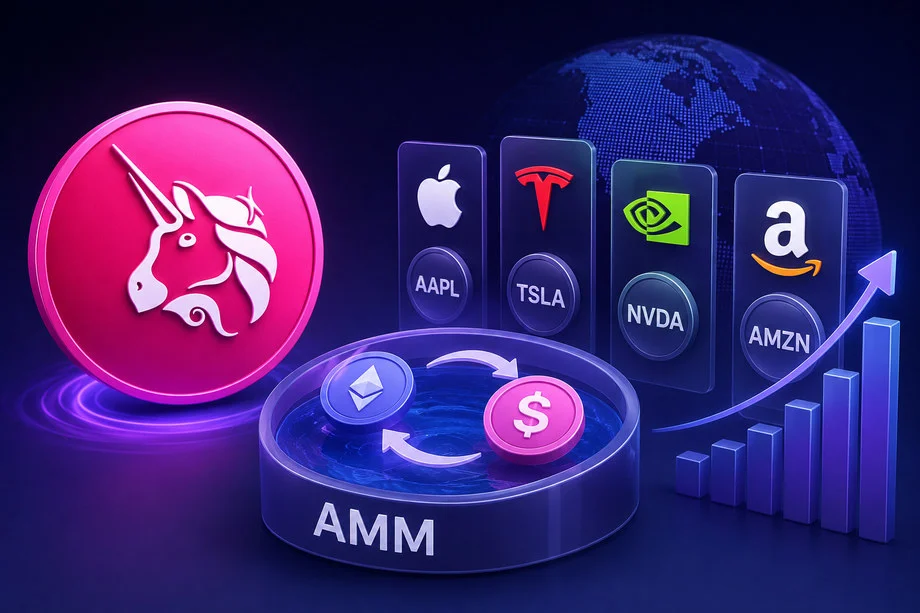
Hayden Adams argues automated market makers remain early-stage tools as tokenized real-world assets reach about $18 billion and early equity pairs show trading activity
Uniswap founder Hayden Adams has stated that the tokenization of real-world assets stands to reshape how liquidity is supplied across both cryptocurrency and traditional markets. In comments posted on August 25, he described automated market makers as still in the early stages of their development despite already handling substantial daily volumes.
Automated market makers enable decentralized exchanges to pool user deposits and determine prices algorithmically without relying on traditional order books. According to a Bank for International Settlements working paper from November 2024, these systems process more than $10 billion in digital asset trades each day. Adams suggested that as more real-world assets move onto public blockchains, such mechanisms could become central to providing scalable liquidity for tokenized instruments.
Growth in Tokenized Real-World Assets
Research shows approximately $18 billion in non-stablecoin real-world assets had been placed on public blockchains by January 2026. That figure represents an 18-fold increase from 2022 levels. The largest share consists of tokenized U.S. Treasuries. BlackRock’s BUIDL fund alone holds more than $2 billion, accounting for nearly a quarter of the tokenized Treasuries total.
Regulatory frameworks are also advancing in several jurisdictions. In the United States, the 2025 GENIUS Act and shifts at the Securities and Exchange Commission under Paul Atkins have contributed to a more defined environment for digital and tokenized assets. Europe’s Markets in Crypto-Assets regulation and distributed ledger technology pilot regime, along with Singapore’s Project Guardian and the UAE’s VARA framework, are supporting regional development of tokenization activity.
Market infrastructure continues to expand. The Depository Trust & Clearing Corporation reported in mid-July that it has converted assets held in its depository into tokenized form for live production trades involving more than 30 conventional and digital market participants. The organization plans to introduce its tokenization service in October 2026.
Early Activity in Tokenized Equity Pools
Early examples of tokenized equities trading through automated market makers have already appeared. Ten tokenized stocks paired against a tokenized version of the SPDR S&P 500 ETF Trust have generated about $33 million in cumulative trading volume across more than 11,000 traders in their first 12 days on the Robinhood Chain. A portion of that activity occurred outside U.S. market hours, and some trades moved directly between equities without intermediate conversion to dollars.
Concentration of Liquidity and Remaining Challenges
Despite the volumes already processed, liquidity provision on major automated market maker platforms remains concentrated. A Bank for International Settlements analysis found that a relatively small group of skilled participants supplied between 65 percent and 85 percent of the liquidity on Uniswap V3. These professional providers often operate in a manner similar to traditional market makers and have generated higher returns than retail liquidity providers.
Tokenization itself does not automatically produce deep secondary markets. Assets become transferable on-chain, yet active two-sided quoting and inventory management by market makers are still required for ready tradability. Many tokenized funds and bonds remain limited to accredited or institutional investors, resulting in relatively thin secondary trading in some cases.
Regulatory Questions for On-Chain Trading
Questions persist about the regulatory treatment of automated market makers when they facilitate trading in tokenized securities. In a March 30, 2026 letter to the Securities and Exchange Commission’s Crypto Task Force, the Securities Industry and Financial Markets Association argued that oversight should focus on the functions performed by a protocol—such as order routing, execution, price discovery, and settlement—rather than on its degree of decentralization. The association also raised issues related to slippage, liquidity provider incentives, pseudonymous trading, and market surveillance capabilities.
How regulators ultimately address these points is expected to influence whether market-making for tokenized assets develops primarily on public blockchains or within more traditional regulated venues. The planned launch of the Depository Trust & Clearing Corporation’s tokenization service later this year adds further weight to the timing of those determinations.
Adams has maintained that automated market makers, while already facilitating billions in daily transfers, still have substantial room for design and ecosystem improvements as tokenized assets continue to expand.

Disclaimer
This article was generated by AI using information from multiple industry sources. It has not been reviewed or verified by a human editor and may contain inaccuracies, omissions, or misinformation. Readers are encouraged to independently verify any information before making decisions based on its content.Tired of the noise?
Let the bots trade for you.
Trade 24/7, without emotion, with data-driven strategies.
Associated articles

Robinhood Chain Tokenized Stocks Surge Fivefold to $70 Million as Trading Volumes Expand
Morgan Stanley Delays Tokenized Stock Trading to First Quarter of 2027

Uniswap Labs Rolls Out Permissioned Pools on v4 for Regulated Asset Trading

Aave V4 Launches on Avalanche to Support Tokenized Asset Lending
DTCC Launches Live Tokenized Trading of Major Stocks and Treasuries
Latest articles

SkyAI Exits Solana Holdings Completely, Launches $201 Million Share Buyback

Strategy Buys 267 Bitcoin and Raises Preferred Share Buyback Cap to $3 Billion

Dormant 2013 Bitcoin Wallets Shift Over $67 Million After More Than a Decade

Binance Rolls Out AI Pro Tool for Chat-Based Automated Trading Strategies