Newsroom
U.S. Treasury Yields Climb to Multi-Decade Highs as Fiscal and Inflation Risks Mount
25 September, 2026 / News / AI / Tags: year, inflation, yield, yields, higher
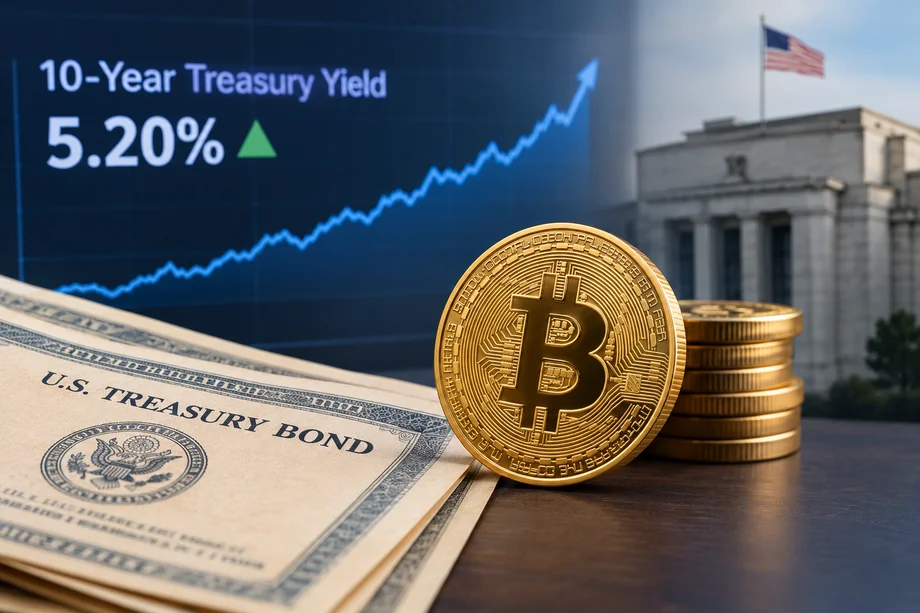
The 10-year yield surpassed 5.20% and the 30-year reached 5.47%, levels not seen in nearly two decades, amid rising oil prices and a more restrictive Federal Reserve stance
U.S. Treasury yields advanced sharply in late September, with the 10-year note and 30-year bond posting their highest levels in many years. Investors demanded higher compensation for mounting fiscal deficits, persistent inflation risks and elevated energy prices, pushing long-term borrowing costs higher and pressuring equity futures and risk assets.
Yields Reach Levels Not Seen Since the Early 2000s
On September 24, the 10-year Treasury yield closed at 5.18%, its highest closing level since July 2007. Intraday readings pushed the yield above 5.20%, marking a 19-year high and a rise of nearly 30 basis points over two sessions. Just days earlier, on September 23, the 10-year had already climbed to 5.14%.
The 30-year Treasury yield closed at 5.47% on September 24, the highest since February 2002. Earlier in the week it approached 5.45% and traded as high as 5.435%, levels last seen in 2004. The rapid move followed a 24-basis-point climb in the 10-year over five sessions after the Federal Reserve raised its policy rate on September 16.
Policy Shift and Economic Data Fuel the Move
The Federal Reserve lifted its target range by a quarter point to 3.75%–4% on September 16, the first increase since July 2023. Six of 18 policymakers signaled at least one additional rise this year. The New York Fed president indicated that another increase before year-end would be reasonable if needed to bring inflation back to target.
September flash purchasing managers’ index data reached a five-year high, adding to signs of economic resilience that supported a more hawkish policy outlook. Markets also absorbed the prospect of continued heavy government borrowing and expanding budget deficits, which increased the risk premium demanded on longer-dated debt.
Oil prices contributed to the pressure. West Texas Intermediate crude rose to about $93.96 a barrel while Brent crude approached $100. A revised outlook lifted the average Brent forecast for the second half of the year to $95 a barrel from $83. Higher energy costs raised the possibility that inflation expectations could firm, keeping monetary policy restrictive for longer.
Year-End Forecasts Adjusted Higher
Analysts raised the year-end projection for the 10-year Treasury yield to 5% from 4.5%. The two-year yield forecast was also lifted to 5%. The revision was presented as recognition that elevated rates may persist rather than a prediction of further sharp gains. Factors cited included Iran-related energy risks, U.S. fiscal pressures, trade tensions, uncertainty surrounding artificial-intelligence investment and a less predictable macroeconomic backdrop.
A sustained 10-year yield near 5% would raise corporate borrowing costs and lower the present value of future cash flows. Growth stocks, AI infrastructure firms and highly valued technology shares were identified as particularly sensitive to such valuation pressure. Higher yields also increase the relative appeal of dollar-denominated fixed-income assets compared with more volatile alternatives.
Market Participants Offer Differing Interpretations
Market commentary diverged on the implications of the yield surge. Gold advocate Peter Schiff argued that current rates remain attractive only temporarily, pointing to soaring government spending, debt, inflation and de-dollarization as forces that will drive yields still higher.
Pershing Square founder Bill Ackman questioned whether the Federal Reserve’s latest increase might prove counterproductive. He suggested that demand for computing power and energy in the pursuit of advanced artificial intelligence may not respond to higher rates, potentially embedding interest costs into the broader economy and stoking rather than cooling inflation.
Coinbase chief executive Brian Armstrong linked higher rates to the risk of larger government deficits and increased money creation. He stated that the priority should be limiting money printing that exceeds economic growth while maximizing growth itself.
Bitmex co-founder Arthur Hayes focused on the MOVE index, a measure of expected Treasury-market volatility. The index rose from 76.2 to 104.6 in one week, its highest reading since late March. Hayes said a move above 130 would signal conditions for some form of policy response that could inject liquidity.
Broader Market Impact
U.S. equity futures declined ahead of the open as yields climbed. Dow futures fell 0.32%, S&P 500 futures dropped 0.59% and Nasdaq 100 futures declined 1.07%. The higher cost of capital added pressure to crypto markets and other risk assets, although bitcoin traded above $84,000 at the time of the latest readings.
Additional developments included the U.S. International Trade Commission opening a Section 337 investigation into dynamic random-access memory devices that named Micron Technology among respondents. Separately, Qualcomm announced renewal of its global patent license agreement with Apple effective April 1, 2027, and Google DeepMind indicated its next major artificial-intelligence model remained in early post-training stages.
Crude oil prices, incoming inflation data, the Federal Reserve’s policy path and the scale of U.S. fiscal financing needs will determine whether yields near 5% prove temporary or establish a new baseline for the remainder of the year.
Disclaimer
This article was generated by AI using information from multiple industry sources. It has not been reviewed or verified by a human editor and may contain inaccuracies, omissions, or misinformation. Readers are encouraged to independently verify any information before making decisions based on its content.Tired of the noise?
Let the bots trade for you.
Trade 24/7, without emotion, with data-driven strategies.
Associated articles

US National Debt Surpasses $40 Trillion, Raising Fiscal and Market Concerns
Goldman Sachs’ Kaplan Backs Fed’s July Rate Hold, Calls for Data-Driven Flexibility Ahead of September

Bitcoin Holds Near $78,000 as U.S.-Iran Escalation Drives Oil Higher
30-Year Treasury Yield Surges Past 5.7% Amid Bond Selloff and $39 Billion Auction

US September CPI Climbs to 3.7% as Core Inflation Exceeds Forecasts
Latest articles

Babylon Labs Advances Proposal for Native Bitcoin Lending on Aave V4

TSMC Posts Record Q3 Profit Surge on AI Chip Demand, Lifts Full-Year Outlook

ASIC Opens Consultation on Capital and Custody Rules for Digital Asset Platforms

GTA 6 Leaker Cyberleek Drops Full Build Plan After Memecoin Collapse, Activates Dead Man’s Switch Threat