Newsroom
Tesla to Wind Down Cybertruck Production in Mid-2027 for Cybercab Expansion
6 November, 2026 / News / AI / Tags: cybertruck, cybercab, tesla, production, musk
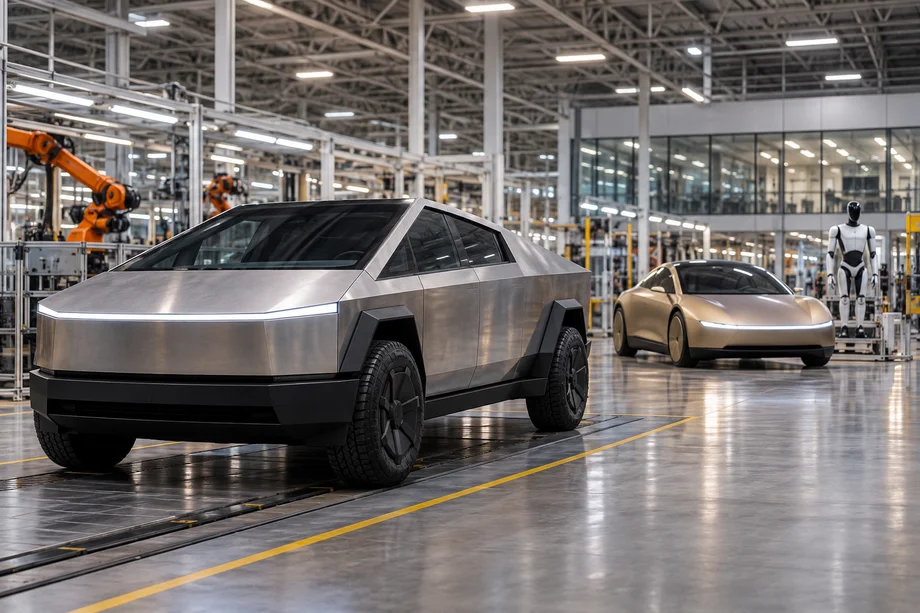
Elon Musk says the Texas Gigafactory will shift capacity from the stainless-steel pickup to the robotaxi as sales lag far behind original targets
Tesla will begin winding down Cybertruck production at its Gigafactory Texas around the middle of 2027, Chief Executive Elon Musk said on Friday. The move is intended to free manufacturing space for higher output of the Cybercab, the company’s purpose-built robotaxi.
Musk made the announcement in a post on X. “Tesla will be winding down production of the Cybertruck at Gigafactory Texas around the middle of next year to make room for increased Cybercab production,” he wrote. The Texas plant is the only Tesla facility currently equipped to produce the specialized components required for the angular stainless-steel pickup.
It remains unclear whether Cybertruck manufacturing will transfer to another site or end altogether. Musk did not provide a final production cutoff date or details on remaining customer orders. In a follow-up reply, he acknowledged the vehicle’s status among some owners while noting its lasting presence. “True, but the Cybertruck fleet will be around for a long time,” he said.
Wes Morrill, the Cybertruck’s lead engineer, described the model as a key technical stepping stone. He called it “an incredible technology development platform” that “lives on through Cybercab” and thanked owners and the teams involved in its creation.
Sales Far Below Ambitious Targets
The Cybertruck, first delivered to customers in late 2023, never approached the volume Musk once projected. At the start of production he forecast annual sales of around 250,000 units. Outside estimates place cumulative deliveries since launch at roughly 70,000 vehicles.
U.S. sales reached 20,237 units in 2025, a 48 percent decline from 38,965 the prior year, according to Kelley Blue Book data. In the third quarter of 2026, Tesla’s “other models” category—which includes the Cybertruck—totaled 8,295 deliveries, down 48 percent from the same period a year earlier. That figure represents only a fraction of the production capacity Tesla installed for the truck.
The model also faced repeated quality issues, multiple recalls shortly after launch, and price adjustments. Its distinctive stainless-steel body complicated regulatory approval in Europe, limiting overseas demand. Tesla has not broken out Cybertruck sales separately in its financial reports, grouping them with other low-volume models.
Shift Toward Robotaxis and Autonomy
The production change aligns with Tesla’s broader pivot toward autonomous vehicles and artificial intelligence. The Cybercab, a two-seat vehicle without steering wheel or pedals, began production at the Texas factory in April. Limited public rides started in parts of Austin on September 3. Federal regulators at the National Highway Traffic Safety Administration said they were evaluating the deployment, noting that U.S. rules generally require human controls.
Musk has positioned the Cybercab as central to Tesla’s future growth, with an expected price near $30,000. The company has also operated robotaxi services using modified Model Y vehicles in several Texas and Florida cities. Earlier this year Tesla ended production of the Model S sedan and Model X SUV at its California plant to free space for Optimus humanoid robots, another priority in the company’s AI and robotics strategy.
Musk has previously indicated plans to expand Cybercab operations beyond Austin, with Dallas named as an early additional market. The capacity freed by the Cybertruck wind-down is expected to support higher Cybercab volumes as the company seeks to scale its autonomous fleet.
The Texas Gigafactory currently assembles both the Cybertruck and Cybercab alongside the Model Y. Reallocating space there is presented as a practical step to accelerate the robotaxi program while the pickup’s sales remain subdued relative to installed capacity.

Disclaimer
This article was generated by AI using information from multiple industry sources. It has not been reviewed or verified by a human editor and may contain inaccuracies, omissions, or misinformation. Readers are encouraged to independently verify any information before making decisions based on its content.Tired of the noise?
Let the bots trade for you.
Trade 24/7, without emotion, with data-driven strategies.
Associated articles
Tesla Q3 Deliveries Reach 486,532 Vehicles, Surpassing Forecasts

SpaceX and Tesla Set Up Committees to Explore Merger That Would Combine Holdings of Over 30,000 Bitcoins

Trump Announces $4.2 Billion Audi Plant in Georgia Ahead of Midterms

SpaceX Shares Climb as 911 Million Unlock Amid Strong Results and Chip Plant Push

ASML Posts Record Q3 Sales of $13.05 Billion as AI Demand Fuels Stronger Outlook
Latest articles

Peter Schiff Mocks Strategy’s Bitcoin Strategy as Holdings Near $75,500 Cost Basis

Microsoft Phases Out Oracle AI Capacity Rental Over Older Nvidia Hardware

Suspicious Bets Precede NYT/Siena Poll Releases on Prediction Markets

Nubank and Mercado Pago Halt Crypto Transfers After Provider Outage