Newsroom
Ten European Banks Launch RL1 Cooperative Blockchain for Tokenized Assets
29 July, 2026 / News / AI / Tags: cooperative, swiat, founding, amro, mutuel
Regulated Layer One begins operations in Luxembourg as a shared permissioned network for digital money, bonds and settlement
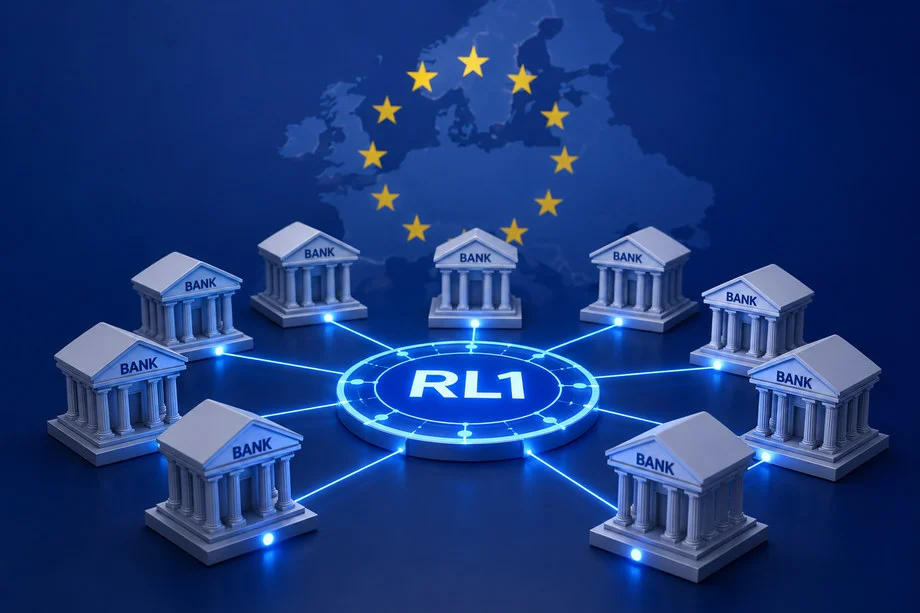
Ten European financial institutions have formally launched Regulated Layer One, or RL1, a jointly owned blockchain cooperative designed for regulated capital markets and tokenized assets. The network was established as a European Cooperative Society in Luxembourg and has begun operations with equal governance rights for each founding member.
Founding Members and Governance Structure
The founding group consists of ABN AMRO, Cecabank, Chartered Investment, Crédit Mutuel Alliance Fédérale, DekaBank, DZ BANK, LBBW, Natixis CIB, SC Ventures and Seturion. Under the cooperative model, each institution holds equal decision-making authority over network governance, technical development and future expansion.
RL1 is structured as a private, permissioned network restricted to approved financial entities. The cooperative includes a general assembly, a supervisory board and an operational management board. Membership remains open to additional regulated market participants.
Technical Foundation from SWIAT
The underlying infrastructure was developed by German fintech Secure Worldwide Interbank Asset Transfer, known as SWIAT. Ownership of the network has been transferred to the new cooperative. SWIAT continues as the software supplier and technical operator.
According to SWIAT, the platform processed more than 50 transactions with a combined value exceeding 700 million euros, equivalent to approximately 808 million dollars, during three years of production use prior to the cooperative launch. Applications such as German electronic securities registry services remain with SWIAT and can migrate to RL1 without software changes.
Henning Vollbehr, previously managing director at SWIAT, leads RL1. KfW and L-Bank will continue supporting the initiative. Discussions are underway with further institutions, including NatWest, which is listed as joining in the coming weeks.
Targeted Use Cases and Market Goals
RL1 is built to support institutional workflows involving digital money, tokenized bonds, collateral management and blockchain-based settlement. Additional proposed applications include funds, real-world assets, repurchase agreements, securities lending, stablecoins and commercial or central-bank money.
The cooperative aims to address fragmentation that arises when financial institutions operate separate distributed ledger systems. A shared network is intended to improve interoperability, collateral mobility and settlement efficiency among regulated participants.
One practical near-term test involves a 100 million euro blockchain bond issued by KfW in June. Plans call for an autumn migration of its registrar and ledger components to infrastructure linked with RL1, with potential later connection to the Eurosystem’s Pontes platform for settlement in central-bank money.
Broader Context for Institutional Tokenization
RL1 positions itself as shared financial market infrastructure rather than a public chain. The cooperative model gives members direct influence over standards, membership criteria and the roadmap for new asset classes. No new token, public investment product or specific regulatory approval for a security was announced at launch.
The initiative arrives as European institutions continue exploring production-grade tokenization rails that meet licensing, audit and risk requirements. Future development will depend on additional memberships, migration of existing applications and sustained transaction activity across the shared network.
Disclaimer
This article was generated by AI using information from multiple industry sources. It has not been reviewed or verified by a human editor and may contain inaccuracies, omissions, or misinformation. Readers are encouraged to independently verify any information before making decisions based on its content.Tired of the noise?
Let the bots trade for you.
Trade 24/7, without emotion, with data-driven strategies.
Associated articles

ECB Official Calls for On-Chain Euro Reserves to Anchor Tokenized Markets

SWIFT Launches Blockchain Ledger for Tokenized Deposit Pilot with 17 Banks

Taurus Connects Tokenization Platforms to Swift Blockchain Ledger for Bank Tokenized Deposits

US State Banking Groups Form BankChain Alliance for 2027 Nationwide Blockchain Network

Lloyds and Visa Settle $750,000 Using USDC in Cross-Border Pilot
Latest articles

SpaceX and Tesla Set Up Committees to Explore Merger That Would Combine Holdings of Over 30,000 Bitcoins

UK Banks Face Thousands of Complaints Over Crypto Transfer Restrictions

Ripple Backs SEC Proposed Crypto Asset Rules After $150 Million Legal Battle

Blockchain.com Introduces Options Trading on Seven Major Crypto Assets