Newsroom
Illinois Agrees to Delay 0.2% Crypto Tax to July 2027 Amid Court Challenges
1 October, 2026 / News / AI / Tags: illinois, tax, court, chamber, digital
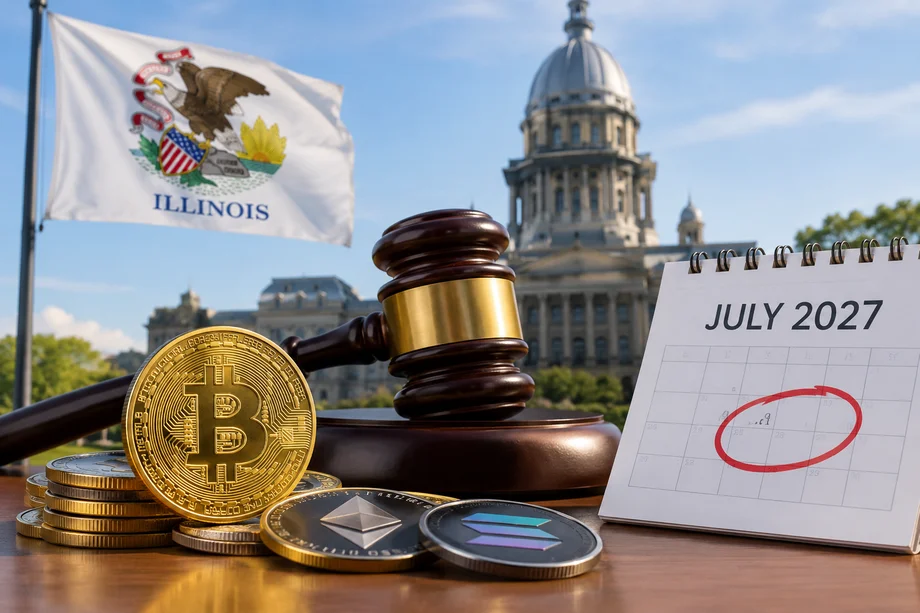
State officials and industry groups jointly seek court approval for a six-month delay of the 0.2% digital asset levy while constitutional disputes proceed
Illinois authorities have agreed with crypto industry organizations to postpone the start of the state's 0.2% Digital Asset Tax from January 1, 2027, to July 1, 2027. The proposal requires approval from a Sangamon County Circuit Court judge before it takes effect.
Joint Court Motion Seeks Temporary Halt
In a filing submitted on October 1, the Chamber of Digital Commerce, known as The Digital Chamber, and the Illinois Blockchain Association joined with Illinois Department of Revenue Director David Harris and Attorney General Kwame Raoul. The parties requested a preliminary injunction that would stay enforcement of the tax for six months.
The stipulated agreement states that extending the effective date will allow orderly briefing and adjudication of the legal questions without harming either side's claims or defenses. The court must still enter the order for the delay to become binding. Illinois officials are scheduled to respond to an amended complaint by November 13.
The Digital Chamber announced the development and credited its legal team at Bellementis PLLC. The agreement does not resolve the broader lawsuit, which continues to seek a ruling that the tax is unconstitutional and unenforceable.
Origins and Scope of the Digital Asset Tax
Governor JB Pritzker signed the Digital Asset Tax Act into law in June as part of the state's fiscal year 2027 budget. The measure imposes a 0.2% levy on certain digital asset activities conducted for Illinois customers, including exchanges, transfers, and storage when facilitated by a qualifying broker and recorded on a blockchain.
Brokers required to collect the tax include centralized exchanges, certain decentralized finance platforms that collect protocol fees, custodians, broker-dealers, and digital payment processors. Peer-to-peer platforms, token issuers, and retailers accepting cryptocurrency as payment are generally excluded from broker status under the law.
State estimates project the tax could generate up to $60 million in revenue for 2027. Industry groups have described it as the most punitive digital asset tax in the United States because it applies regardless of whether a user realizes any gain and covers a wide range of routine transactions.
Industry Challenges and Compliance Concerns
The Digital Chamber filed its lawsuit in July, arguing the tax discriminates against digital assets compared with similar traditional financial activity. Plaintiffs contend the law violates provisions of the Illinois Constitution, the U.S. Commerce Clause, the Fourteenth Amendment Due Process Clause, and the federal Internet Tax Freedom Act. They also assert it could affect transactions involving parties outside Illinois and create risks of multiple taxation on the same activity.
A separate challenge by the Blockchain Association and the Crypto Council for Innovation was filed later. Those groups sought a preliminary injunction in September, citing the need for firms to invest millions of dollars in compliance systems without clear regulatory guidance from the state. They argued that even successful compliance efforts would cause irreparable harm.
Draft rules released by the Illinois Department of Revenue have addressed treatment of stablecoins as covered assets while excluding non-fungible tokens. The department indicated it would accept public comments on the drafts through October 30.
Federal Developments on Crypto Taxation
While the Illinois litigation continues, federal lawmakers have advanced related measures. The U.S. House Ways and Means Committee approved the Digital Asset Tax Certainty Act last month. Among its provisions, the bill would eliminate the need to calculate gains or losses on certain network or transaction fees of $10 or less, beginning in 2028.
The committee vote advanced the legislation for consideration by the full House. Separate market-structure efforts in Congress remain distinct from these tax provisions.
If the Sangamon County court approves the joint motion, crypto users and businesses in Illinois will gain additional time before brokers must begin collecting the 0.2% levy. The underlying constitutional questions remain before the court for resolution.
Disclaimer
This article was generated by AI using information from multiple industry sources. It has not been reviewed or verified by a human editor and may contain inaccuracies, omissions, or misinformation. Readers are encouraged to independently verify any information before making decisions based on its content.Tired of the noise?
Let the bots trade for you.
Trade 24/7, without emotion, with data-driven strategies.
Associated articles

Crypto Groups Seek Court Order to Halt Illinois 0.2% Digital Asset Tax

Crypto Trade Groups Sue Illinois Over 0.2% Digital Asset Tax Set for 2027

Digital Chamber Sues Illinois Over 0.2% Digital Asset Transaction Tax
House Tax Panel Advances First Federal Crypto Tax Framework After Senate Setback

Illinois Issues Draft Rules for 0.2% Digital Asset Tax Covering Stablecoins and Select DeFi Activity
Latest articles
Lighter Token Climbs More Than 20% on Planned CFTC Filing and Research Note

Samsung and SK Hynix Upgrade China NAND Factories Amid AI Demand and Local Rivalry

China Prosecutors Move to Confiscate $5.1 Billion Bitcoin Haul Seized in UK Fraud Case

Bank of Korea Holds Rate at 3% After Consecutive Hikes, Eyes Data for Next Move