Newsroom
South Korea Approves $14 Billion Sovereign Account for AI and Strategic Industries
31 July, 2026 / News / AI / Tags: korea, investment, sovereign, corporation, industries
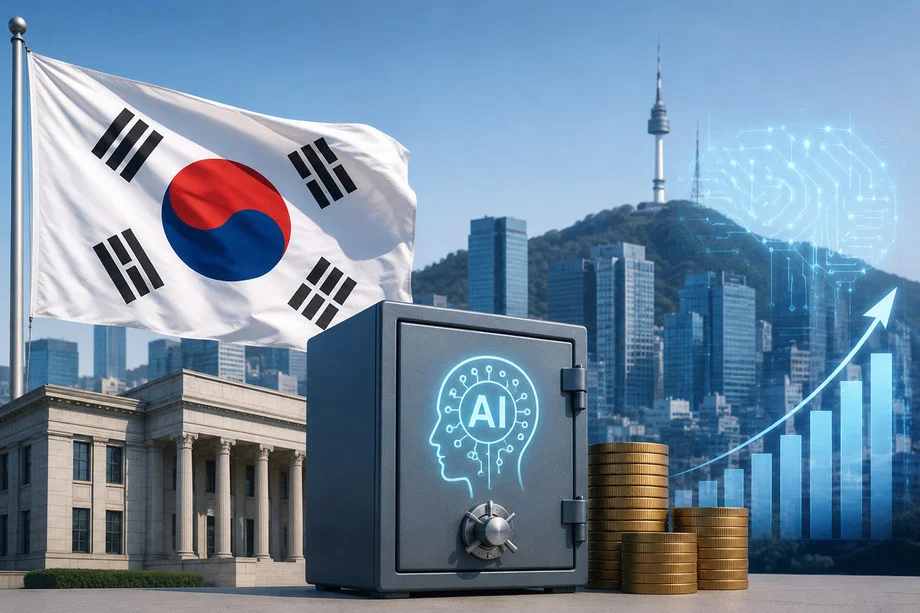
Government authorizes Korea Investment Corporation to invest domestically for the first time, targeting artificial intelligence, data centers and national priorities starting in 2027
South Korea has approved the creation of a new investment account of at least 20 trillion won, equivalent to roughly 14 billion dollars, inside its sovereign wealth fund. The vehicle will channel capital into artificial intelligence, data centers and other strategic industries while marking the first authorization for the Korea Investment Corporation to place funds inside the country.
Until now the Korea Investment Corporation has managed overseas assets exclusively. Its existing portfolio stood at approximately 232 billion dollars at the end of 2025, drawn from government, Bank of Korea and other public institution mandates focused on foreign reserves. The new account will sit apart from that portfolio, with fully independent investment decisions.
Capital Sources and Operating Principles
Public institutions and policy banks will supply the bulk of the capital. Government-backed lenders including the Korea Development Bank, the Export-Import Bank of Korea and the Industrial Bank of Korea are expected to contribute about 16 trillion won. The remaining roughly 4 trillion won will come from equity stakes the government has acquired through inheritance and gift tax settlements.
The account carries no maturity date. Officials stated that it will operate according to three principles: generating returns, maintaining stability and serving public interests. Any profits may be reinvested, distributed as dividends to the government or transferred to the national treasury.
Amendments to the Korea Investment Corporation Act are scheduled for submission to the National Assembly in August. Once approved, the account is expected to begin operations in 2027.
Market Backdrop and Strategic Rationale
The decision arrives amid sharp pressure on domestic equities. The Kospi index fell about 34 percent during July, placing it on course for its weakest monthly performance on record. Investor concern over the scale of artificial intelligence capital expenditure weighed heavily on semiconductor leaders Samsung Electronics and SK Hynix, which supply high-bandwidth memory used in global AI systems.
South Korea dominates production of those memory chips yet maintains limited domestic AI computing capacity. Publicly available operational clusters remain scarce compared with the United States, which hosts the large majority of advanced facilities. The new account is intended to help close that gap while supporting industries viewed as critical to long-term economic security.
Officials described the structure as a means both to back strategic sectors and to deliver returns for future generations. A sizable domestic anchor investor, they argued, could also draw additional capital from foreign sovereign funds and global asset managers seeking exposure to Korean technology at current valuations.
Broader Technology Funding Efforts
The sovereign account forms one element of a wider policy package. President Lee Jae-myung has met representatives from six Silicon Valley venture capital firms—Sequoia Capital, Andreessen Horowitz, Khosla Ventures, Lightspeed Venture Partners, General Catalyst and New Enterprise Associates—to encourage greater investment in Korean startups. The National Pension Service has signed separate memorandums of understanding with the same firms covering investment cooperation and information sharing.
In parallel, authorities are preparing a proposed National Growth Fund of 200 trillion won aimed at artificial intelligence and semiconductor industries. Policymakers anticipate that public money, private capital and overseas funds will combine once the various initiatives advance.
Global spending on AI infrastructure continues to climb, with data-center investment projected to approach 1 trillion dollars and technology companies expected to allocate hundreds of billions of dollars in the near term. South Korea’s finance ministry has framed increased AI adoption as central to a “hyper-innovation economy” and to achieving higher growth targets.
Next Legislative Steps
Passage of the enabling amendments remains the immediate requirement. Lawmakers will determine the precise investment mandate and operational details. Those decisions will shape how much capital flows specifically into AI computing infrastructure and data centers versus other designated strategic sectors.
If the legislative timeline holds, the new account under the Korea Investment Corporation will become operational in 2027, providing a permanent domestic investment channel distinct from the sovereign fund’s traditional foreign-asset role.
Disclaimer
This article was generated by AI using information from multiple industry sources. It has not been reviewed or verified by a human editor and may contain inaccuracies, omissions, or misinformation. Readers are encouraged to independently verify any information before making decisions based on its content.Tired of the noise?
Let the bots trade for you.
Trade 24/7, without emotion, with data-driven strategies.
Associated articles

South Korea Records 18 Months of Stablecoin Outflows as $367 Million Leaves Local Exchanges
South Korea Requires Reporting of Crypto Accounts on Bankrupt Overseas Exchanges
Shinhan Asset Management Partners with Solana for KRW Tokenized Fund Pilot

Bithumb Targets 2028 IPO After Governance Overhaul and Accounting Shift

Hana Bank Bets $670M on Upbit Owner Dunamu as Banks Rush into Crypto
Latest articles

SpaceX and Tesla Set Up Committees to Explore Merger That Would Combine Holdings of Over 30,000 Bitcoins

UK Banks Face Thousands of Complaints Over Crypto Transfer Restrictions
Ripple Backs SEC Proposed Crypto Asset Rules After $150 Million Legal Battle

Blockchain.com Introduces Options Trading on Seven Major Crypto Assets