Newsroom
SEC Charges Four Entities in $15M Crypto and AI Frauds as Scam Networks Expand
30 September, 2026 / News / AI / Tags: myanmar, mule, accounts, fraud, indian
U.S. regulators sued operators of two alleged investment schemes that collected over $15 million using fake AI tools, while Myanmar-based networks continue routing funds from Indian victims through mule accounts and cryptocurrency channels
The U.S. Securities and Exchange Commission filed civil charges on September 29 against four entities accused of running two separate crypto and artificial-intelligence investment schemes that together raised more than $15 million from hundreds of investors. The cases, brought in Manhattan federal court, allege the groups promoted their offerings primarily through WhatsApp and Facebook, falsely claiming SEC oversight and using fabricated documents to appear legitimate.
Details of the Alleged Cryptoaiml Scheme
One defendant group, operating under the name Cryptoaiml, is accused of raising more than $12.5 million from over 300 investors. According to the SEC complaint, the operators promoted AI-generated trading signals via WhatsApp groups and claimed the signals achieved 98 percent accuracy. The agency alleges no actual trading took place and that reported profits were fabricated. Investors later encountered frozen accounts and difficulties withdrawing funds.
TSAI Accused of Selling Nonexistent Trading Bots
A second group, identified as TSAI, allegedly collected at least $2.8 million from 1,715 investors by selling AI trading bots priced from $100 to $500,000. The SEC stated that the bots did not exist. Deposits were allegedly funneled into consolidation wallets. When investors sought to withdraw money, operators demanded additional verification fees or tax payments. The program also included referral incentives that rewarded participants for recruiting new investors.
The Commission is seeking permanent injunctions to stop the alleged schemes, disgorgement of investor funds, and civil monetary penalties. The allegations remain unproven in court.
Myanmar Scam Compounds and Cross-Border Operations
Parallel to these U.S. enforcement actions, organized cybercrime networks based in Myanmar continue to operate large-scale fraud compounds, particularly near border towns such as Myawaddy and Shwe Kokko. These facilities have been linked to investment scams, romance fraud, and cryptocurrency schemes. Many operations begin with deceptive job advertisements for technology, customer service, or digital marketing roles. Recruits are trafficked into the compounds and forced to conduct online fraud against victims worldwide. The United Nations has documented significant human trafficking connected to such Southeast Asian scam operations.
Indian nationals appear on both sides of these networks. Some have fallen victim to the schemes, while others have been recruited through fraudulent employment offers. Investigations continue into connections between trafficking rings in Myanmar and global cyber fraud.
How Funds Move Through Mule Accounts and Crypto
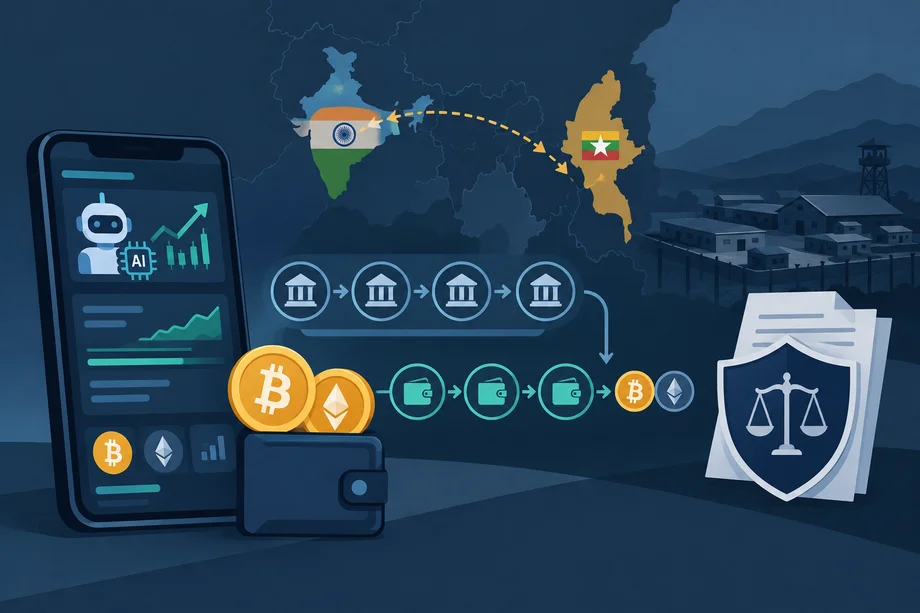
A frequent pattern begins with victims transferring money to bank accounts controlled by the criminal groups. Funds then pass through multiple mule accounts—bank accounts held by individuals who may be willing participants or people deceived into opening accounts under false pretenses—before portions are converted into cryptocurrency. Crypto assets are subsequently moved across wallets and platforms in different jurisdictions, complicating tracing efforts.
In one Bengaluru investigation, police identified more than 500 mule bank accounts tied to an online investment fraud involving approximately $98,000. Investigators followed the money trail to destinations including Kolkata, Hong Kong, and California.
Once funds enter the crypto system, operators can transfer them across blockchains, exchanges, or mixing services, reducing the effectiveness of traditional banking controls.
Indian Authorities’ Tracking Methods
Indian law enforcement agencies combine blockchain analysis with conventional financial records when investigating crypto-related fraud. Examiners review bank transfers, mobile numbers linked to accounts, digital communication logs, wallet activity, and exchange transaction data. The National Cyber Crime Reporting Portal and related agencies have increased focus on digital and cryptocurrency fraud.
Recovery success depends heavily on speed. Assets can be moved across borders quickly, requiring coordination with foreign authorities and private platforms to freeze accounts and wallets. Because scam operations often span multiple countries—victims in India, operators in Myanmar, bank accounts elsewhere, and crypto platforms in still other locations—international cooperation remains essential for identifying networks and recovering assets.
Disclaimer
This article was generated by AI using information from multiple industry sources. It has not been reviewed or verified by a human editor and may contain inaccuracies, omissions, or misinformation. Readers are encouraged to independently verify any information before making decisions based on its content.Tired of the noise?
Let the bots trade for you.
Trade 24/7, without emotion, with data-driven strategies.
Associated articles

Hong Kong Records 25 Crypto Romance Scams With Nearly $9 Million in Losses
US and UK Launch Joint Alliance Against Crypto Scam Centers

Vietnamese National Charged in $16 Million Cryptocurrency Pig Butchering Fraud

U.S. Authorities Seek Forfeiture of $25 Million in Crypto from Romance and Investment Scams

US Authorities Seize Over $25 Million in Crypto From Five Fraud Probes
Latest articles

Blockchain Association Urges Clarity on DeFi and Stablecoin Rules Under GENIUS Act

XRP Launches Official X Account, Jointly Managed by Ripple and XRPL Foundation

ESMA Expands MiCA Register to 375 Providers as BingX, YouHodler and Openbank Join

France Narrowly Approves Crypto-to-Stablecoin Tax from 2027